Developer Audit Log Best Practices: Schema, Correlation, Day 1–90
Christian MontenegroSeptember 13, 202614 min read
Treat audit logs as immutable, centralized, schema-driven evidence, not an afterthought bolted onto your application logging. Capture actor, action, target, timestamp, and a correlation ID on every event, and protect the trail with encryption, RBAC, and tamper detection from day one. Start small if you must, but start with those fields, because retrofitting them into a year of historical data almost never happens.
TL;DR:
- Most teams forget to generate a unique request ID early enough in the process, which hampers effective event correlation during investigations.
- Audit logs must include key fields such as actor ID, action, target, timestamp, outcome, request ID, and source IP, with sensitive data masked or hashed for security.
- Logs should be stored in immutable, encrypted systems with cryptographic chaining and regular validation to prevent tampering and ensure their trustworthiness.
- Access to audit logs must be tightly controlled, with separate roles for ingestion, query, and administration, and thorough auditing of all interactions with the log store.
- Retention policies should be tiered based on event sensitivity, with legal holds and automated lifecycle management, avoiding unnecessary storage costs and data noise.
Table of Contents
- Audit Log Best Practices Start With Knowing What an Audit Log Actually Is
- What Should You Log First? Events and Mandatory Fields
- How Should You Structure Audit Event Schemas?
- How Do You Protect Audit Logs From Tampering?
- Who Should Be Allowed to Access the Audit Trail?
- Retention, Tiering, and Legal Hold Without Breaking the Chain
- What Detection Patterns Actually Scale?
- How Do You Verify Your Audit Logging Actually Works?
- Day-1 and Day-90 Implementation Checklist
- What Engineers Consistently Get Wrong About Audit Logs
- How Bossy Builds Auditability Into Everyday Frontline Work
- Sources
- FAQ
Audit Log Best Practices Start With Knowing What an Audit Log Actually Is
An audit log is a record built to answer one question under pressure: who did what, to what, and when? Security teams use it to detect intrusions. Compliance teams use it to prove controls work. Legal teams use it during litigation holds. That's a different job than debugging a null pointer exception, and it demands a different mindset.
Application logs help you fix bugs. Audit logs help you defend a decision, six months from now, to an auditor who has never seen your codebase. Mixing the two in one stream is one of the most common mistakes teams make. Debug noise buries the events that actually matter, and rotating out "just logs" for storage savings can quietly destroy evidence you were legally required to keep.
Regulatory frameworks shape what "enough" looks like:
- PCI DSS requires logging and retaining access to cardholder data with tamper protection.
- HIPAA requires audit controls over systems containing protected health information.
- SOC 2 and ISO 27001 auditors expect documented, reviewable log management processes as proof controls operate as designed.
What Should You Log First? Events and Mandatory Fields
Not every action deserves a permanent, tamper-evident record. Prioritize event classes where the cost of missing evidence is high:
- Authentication events, both successes and failures, including account lockouts.
- Authorization denials, especially repeated attempts against restricted resources.
- Administrative and configuration changes, including changes to the logging system itself.
- Access to sensitive data such as PII or PHI, including not just writes but sensitive reads.
- Privilege escalations and role assignments.
Every one of those events needs a consistent set of fields regardless of which service emits it: actor ID, action, target, an ISO 8601 timestamp, a request ID, outcome (success or failure), source IP, and the environment (production, staging). The OWASP Logging Cheat Sheet calls out authentication events, admin actions, and configuration changes specifically, and it stresses sanitizing any user-controlled input before it hits the log stream to prevent log injection attacks.
Data minimization matters just as much as completeness. Never write passwords, API tokens, or session cookies into an audit event. When you must reference sensitive data, mask it, hash it, or tokenize it, a pattern the Audit Logging Best Practices guidance treats as non-negotiable.
Pro Tip: Build a small "sensitive field" denylist into your logging library at the schema level, not as a code review checklist item. Developers forget checklists under deadline pressure; a library that strips known field names doesn't.
How Should You Structure Audit Event Schemas?
A structured, versioned schema is what turns a pile of text into something you can actually query during an incident. Model events as JSON, loosely following a CloudEvents style structure, with namespaced event types like auth.login.failed or admin.role.updated instead of free-text descriptions that drift between services.
Enforce the schema at the shipper or logging library level, not through documentation nobody reads. Version the schema explicitly so a v2 field rename doesn't silently break every dashboard and search built against v1.
- Generate a
request_idat the outermost entry point, whether that's an API gateway or the first line of a handler. - Propagate that ID through HTTP headers, into background job payloads, and into database session variables so a slow query at 2 AM can be traced back to the request that triggered it.
- Map fields to the questions an investigator actually asks: who, what, where, when, why, how.
- Where you run a SIEM, plan your field names to translate cleanly into formats like CEF so cross-service correlation doesn't require a translation layer.
This correlation discipline is what separates a searchable audit trail from a folder full of disconnected JSON blobs, a distinction covered well in audit logging architecture guidance built specifically around request ID propagation.
How Do You Protect Audit Logs From Tampering?
Audit logs are only useful if you can trust they haven't been altered, which means treating them under the full CIA triad: confidentiality, integrity, and availability. Encrypt every event in transit with TLS and at rest using your cloud provider's native encryption, and use separate encryption keys per environment so a compromised staging key never touches production evidence.
- Write logs to immutable storage such as S3 Object Lock or Azure immutable blob storage, or a dedicated WORM (write once, read many) system.
- Strip delete privileges from every application service role; nothing that writes logs should also be able to erase them.
- Implement a cryptographic hash chain across sequential events so any deletion or edit breaks the chain and becomes detectable.
- Run periodic validation jobs that walk the chain and alert on sequence gaps or hash mismatches.
Architectural separation reinforces this: aggregate logs into a destination controlled by a different administrative domain than the systems generating them, so a compromised application server can't also erase its own trail, a pattern detailed in CloudCops' audit logging guide. HashiCorp's own Vault audit best practices recommend running multiple audit devices in parallel specifically so one failure doesn't leave you blind.
An estimated majority of breaches involve some form of log tampering or deletion to cover attacker tracks, which is exactly why the CIA-triad protections around audit stores matter more than most teams initially assume.
Who Should Be Allowed to Access the Audit Trail?
Access control on the audit store deserves the same rigor as the events it captures. Ingestion, query, and administrative access should be three distinct roles, not one service account with broad permissions.
- Deny delete and modify privileges to every role except a narrowly scoped, monitored administrative function.
- Log every query and export against the audit store itself, so "who looked at the audit logs" is itself auditable.
- Require an approval step for bulk exports, especially exports destined for external counsel or regulators.
- Run periodic access reviews and rotate credentials and keys on a fixed schedule, not only after an incident.
CIS Control 8 frames this as part of a managed process rather than a one-time setup: establishing the process, centralizing the data, and reviewing access are ongoing safeguards, not launch tasks. Bossy documents its own access model on its security page, which is a reasonable pattern to follow when deciding what to publish about your own controls.
Pro Tip: If your audit store lets any engineer with production database access also query the audit trail directly, you don't have separation of duties, you have a shared password with extra steps.
Retention, Tiering, and Legal Hold Without Breaking the Chain
Retention periods should map to the sensitivity of the event, not a single blanket policy applied to every log line. Authentication events might warrant 90 days of hot storage and a year in cold storage, while administrative changes and access to regulated data often need multi-year retention depending on the framework governing your industry, something regulated compliance guidance on audit trails as recordkeeping evidence covers in detail.
- Move data through hot, warm, and cold tiers automatically as it ages, keeping recent events fast to query and older events cheap to store.
- Build legal hold as an override flag that suspends any automated deletion, regardless of the underlying lifecycle rule.
- Index selectively. Full-text index the fields investigators actually search, and archive the rest in cheaper, less queryable storage.
- Set quotas per service so one noisy microservice doesn't consume the budget meant for higher-value security events.
Cost control and compliance aren't in tension here. The teams that struggle are usually the ones treating every event as equally important, which inflates both storage bills and noise.
What Detection Patterns Actually Scale?
Start with high-confidence rules that almost never produce false positives: privilege escalations, changes to the logging configuration itself, and mass deletions of records. These deserve immediate alerts because a legitimate reason for them is rare and usually well documented in advance.
- Alert immediately on any modification to logging or audit configuration, since that's a common precursor to covering tracks.
- Use correlation searches across services rather than single-event thresholds, since a real attack usually spans more than one system.
- Apply statistical or machine learning models to lower-confidence behavior, like unusual login times or access volume, instead of brittle fixed thresholds that break the moment normal usage shifts.
- Route integrity validation failures and chain-verification alerts to your SOC as P1 incidents, not routine tickets.
Splunk's guidance on audit logging makes the case plainly: rigid thresholds age poorly as systems grow, while statistical models adapt to what normal actually looks like for your environment. The goal is a small number of alerts your team trusts completely, not a dashboard full of noise everyone learns to ignore. For teams building this out for the first time, certificate and monitoring alert patterns from adjacent security monitoring work offer a useful template for keeping alert volume manageable.
How Do You Verify Your Audit Logging Actually Works?
Logging code needs the same scrutiny as any other security-critical path. That means it belongs in code review, in CI test suites, and in your regular security testing cycle, a point the OWASP Logging Cheat Sheet makes explicitly by including logging in verification and testing guidance rather than treating it as a side effect.
- Write tests that confirm sensitive fields never appear in output, using both known values and fuzzed input.
- Test for log injection: feed malicious strings into fields and confirm they're sanitized before storage.
- Simulate pipeline failure and confirm you can detect it, whether through sequence number gaps, cross-system reconciliation, or shipper backpressure alerts.
- Load test the logging path itself. A slow log write can become a bottleneck for the entire request under high traffic.
As volume grows, scale deliberately rather than reactively. Sample lower-value events, retain high-value events in full, choose your index strategy based on what investigators actually search, and buffer writes through a durable shipper so a downstream outage doesn't silently drop events.
Pro Tip: Run a quarterly "delete an event and see who notices" drill against a test environment. If nobody's monitoring catches it, your tamper detection exists on paper only.
Day-1 and Day-90 Implementation Checklist
You don't need every control simultaneously. CIS Control 8's own implementation group structure exists specifically to help teams stage this work by maturity level.
Day 1:
- Instrument authentication, authorization, and admin-change events with the mandatory field set.
- Enforce the event schema in your logging library, not through documentation.
- Ship logs to a centralized, write-restricted destination outside the application's own admin domain.
Day 90:
- Add cryptographic hash chaining with a scheduled validation job.
- Define retention tiers per event category and automate lifecycle transitions.
- Layer in statistical anomaly detection on top of your high-confidence rule set.
Small teams can defer hash chaining and ML detection, but immutable storage and consistent fields aren't optional even at three engineers, since retrofitting historical data almost never happens.
What Engineers Consistently Get Wrong About Audit Logs
The most common mistake isn't a missing control, it's missing correlation. Teams log plenty of events but never generate a request ID early enough to tie a database write back to the API call that caused it, which turns a ten minute investigation into a two day one.

The second mistake is writable local logs. A file on a container's local disk isn't an audit trail, it's a suggestion that disappears the moment the container restarts. And the third, still surprisingly common, is logging secrets directly, tokens and passwords sitting in plaintext in a log line because nobody added a redaction step.
When a team has to ship fast, prioritize in this order: centralization first, immutability second, schema discipline third. Everything else, hash chains, anomaly models, tiered retention, can follow once those three are solid. Review Bossy's security documentation for one example of how these controls look when applied to operational task verification.
— Christian
How Bossy Builds Auditability Into Everyday Frontline Work
Most audit logging advice targets application code, but the same gaps show up on the floor of a restaurant, retail shop, or cleaning crew: a task marked "done" with nothing to back it up. Some platforms close that gap by pairing task assignment with photo proof and a manager approval queue, so completion isn't just claimed, it's verified and timestamped.
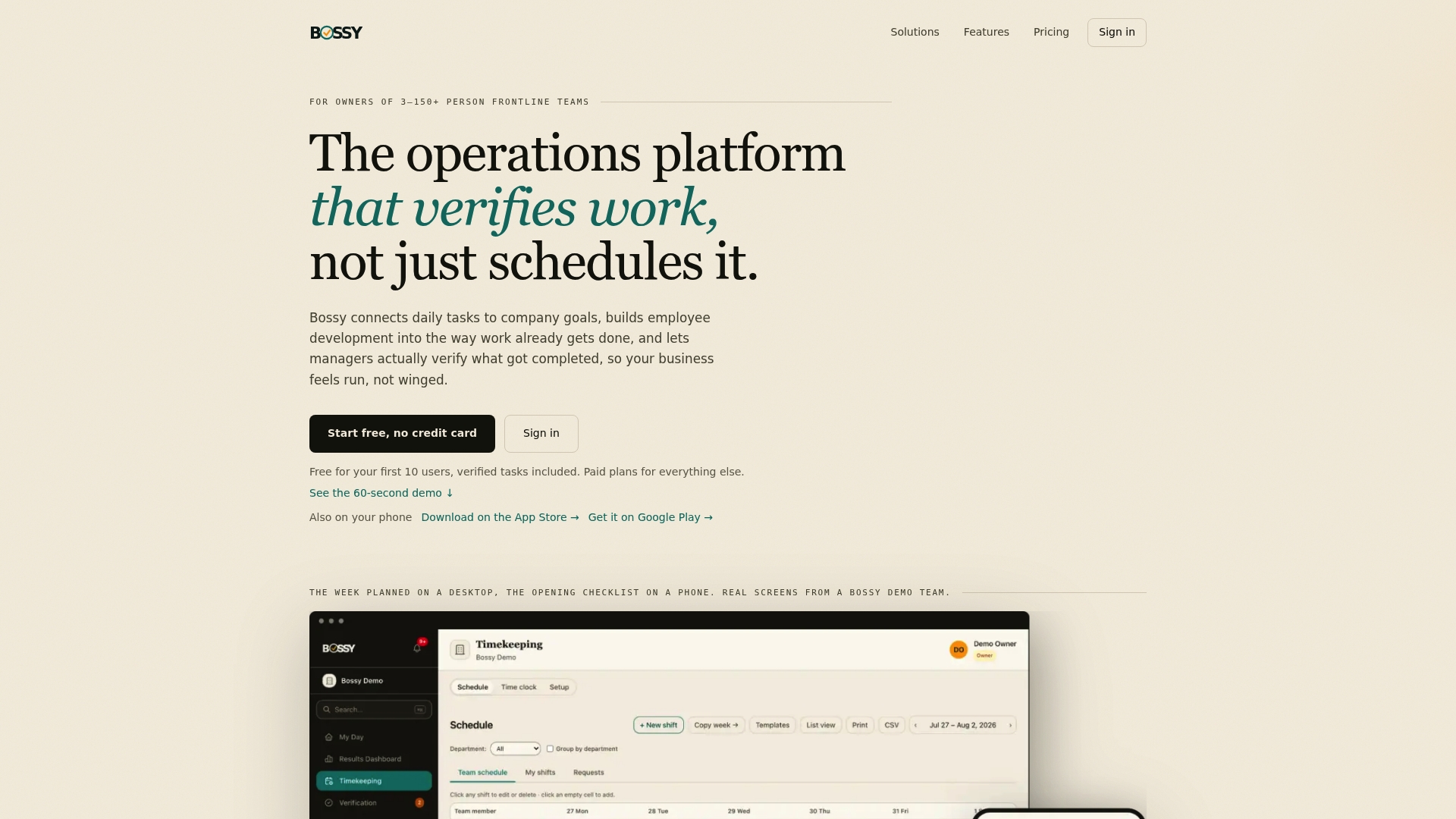
Task verifications, schedule changes, and inventory counts typically generate timestamped records tied to the person who performed them, giving owners actor-action-target-timestamp discipline similar to what's recommended for application audit logs, applied to daily operations instead of database writes. Role-based access typically keeps who-can-see-what tightly scoped, echoing RBAC principles. If you're evaluating how task verification and access control should work together for a growing frontline team, explore Bossy's feature set or start with the main platform overview to see how it fits your operation.
Sources
- OWASP Logging Cheat Sheet
- CIS Critical Security Control 8: Audit Log Management
- Audit Logging Best Practices, Components & Challenges
FAQ
What Should Be Logged in an Audit Log?
At minimum, log authentication events, authorization denials, administrative and configuration changes, and access to sensitive data, each with actor, action, target, timestamp, and request ID fields.
Can You Provide an Example of an Audit Log?
A typical event includes fields like timestamp, actor_id, action, target, outcome, request_id, and source_ip with values illustrating those fields in standard formats.
What Are the 5 C's of Audit Findings?
Definitions vary across audit disciplines, and no single canonical version applies specifically to technical audit logs, so it's worth confirming which framework your compliance team references before citing it.
Should Audit Logs Be Maintained Indefinitely?
No. Retention should match the regulatory and business value of each event category, using tiered storage and automated lifecycle rules, with legal holds overriding deletion only when required.
How Often Should Audit Logs Be Reviewed?
High-confidence security events like privilege changes deserve near-real-time alerting, while broader log reviews for compliance purposes are commonly run weekly or monthly depending on the framework governing your data.