Cascading Goals for Frontline HR: Turn Strategy into Daily Work
Christian MontenegroSeptember 14, 202618 min read
Cascading goals is the practice of breaking company objectives into department, team, and individual targets so every person's daily work traces back to the strategy. The payoff is alignment: fewer duplicated efforts, clearer accountability, and performance reviews that actually connect to something bigger than a task list. The rest of this guide walks through the structure, the benefits, and a step-by-step playbook you can run with your own teams.
TL;DR:
- Limiting each person to three to five goals ensures focused effort and prevents overload, especially as goals cascade from company to individual levels.
- Regular documentation of goal relationships and measures is essential to maintain clarity and traceability across all levels of the cascade.
- Embedding goal check-ins into existing routines, like weekly meetings and one-on-ones, keeps progress transparent and conflicts early visible.
- Leadership must model and consistently reinforce top-level goals and the three to five goal limit to promote genuine adoption and ownership.
- Using task verification and linking daily activities directly to strategic objectives on dashboards helps frontline teams connect tasks to broader company goals.
Table of Contents
- What Is the Cascading Goals Process, Structurally?
- Why Cascading Goals Pay Off for HR and Leadership
- How to Build a Cascade Step by Step
- How Often Should You Review Cascading Goals?
- Where Cascading Goals Usually Break Down
- Running Cascading Goals on the Frontline, Day to Day
- Cascading Goals vs. OKRs and Top-Down Goals
- What Role Does Leadership Actually Play?
- Getting Teams Through the Change
- Does Cascading Goals Actually Improve Motivation?
- Connecting Cascading Goals to Reviews and Feedback
- The One Move HR Leaders Should Make First
- Where Bossy Fits Into Your Cascade
- Sources
- FAQ
What Is the Cascading Goals Process, Structurally?
A cascade works top to bottom, but each level does more than shrink the number. It carries three things forward: the objective, the reasoning behind it, and a way to measure it. Strip out the "why" at any level and you get busywork that technically ties to a goal on paper but means nothing to the person doing it.
Here's how the levels typically break down:
- Company level: A broad strategic goal with a metric attached (grow revenue 15%, cut customer churn by 4 points).
- Department level: A slice of that goal owned by one function (marketing generates 500 qualified leads this quarter to support the revenue target).
- Team level: A concrete deliverable a specific team controls (the field sales team closes 120 of those leads).
- Individual level: A task or behavior one person owns and can act on this week (a rep books 15 discovery calls).
The MIT IS&T explanatory framework describes this as a structured process that preserves context and traceability at every handoff, which is the entire point. Each goal at every level should meet SMART criteria: specific, measurable, achievable, relevant, and time bound. If a manager can't explain in one sentence how an individual's goal supports the company objective above it, the cascade has already broken somewhere in the chain.
Why Cascading Goals Pay Off for HR and Leadership
Alignment sounds abstract until you watch what happens without it. Two departments chase versions of the same outcome using different definitions of success, nobody notices the overlap until budget season, and performance reviews turn into a debate about effort instead of a conversation about results. Cascading goals fix that by forcing every objective through the same chain of logic.
The evidence backs a tighter approach than most companies default to:
- Limiting company-level objectives to 3 to 5 goals keeps focus sharp and prevents the overload that dilutes execution across too many competing priorities.
- Strategic goals that can't be broken into operational tasks a team can actually act on should be reconsidered rather than pursued, according to Harvard Business School's guidance on strategic planning.
- Harvard Business Review's research on strategic goal selection points to a persistent execution gap: organizations set goals that sound right but were never anchored to measurable outcomes, which is exactly what a cascade is supposed to prevent.
Statistic to remember: most practitioner guidance converges on 3 to 5 goals per person during a performance cycle, a range Salary and multiple other sources cite as the sweet spot between focus and coverage.
Engagement climbs when people can point to the line between their work and the company's direction. That's not a soft benefit. It's the difference between a review conversation about "did you hit your number" and one about "how did your number move the business forward."
How to Build a Cascade Step by Step
This is the part most guides skip: the actual sequence. Follow it in order, because each step depends on the one before it.
-
Set 3 to 5 company objectives with metrics attached. Don't write "improve customer experience." Write "reduce average resolution time from 48 hours to 24 hours by Q3." Every objective needs a number and a deadline, or it can't cascade cleanly.
-
Decompose each objective into department and team goals. Ask what each function needs to contribute and why. If a department goal can't be traced back to a company objective in one sentence, cut it or rewrite it. Carry the reasoning down, not just the number.
-
Co-create individual goals with managers, not for them. A goal handed down without input rarely gets ownership. Sit down with each manager, walk through the team goal, and let them propose how their people contribute. This single step determines whether the cascade sticks or gets ignored by month two.
-
Limit goals per person and weight them if needed. Cap individual goals at 3 to 5, matching the same discipline you applied at the company level. If someone owns four goals but one carries most of the business impact, weight it higher so effort follows priority.
-
Document the relationships and the measures. Write down which individual goal supports which team goal, which team goal supports which department goal, and so on. This sounds tedious. It's the single habit that prevents the cascade from turning into four disconnected spreadsheets by the second quarter.
-
Build the cadence into routines you already run. Weekly team meetings get a two-minute goal check-in. One-on-ones include a standing question: "What's blocking your goal this week?" Monthly, leadership reprioritizes based on what's actually moving and what's stalled.
Pro Tip: Don't create a separate "goals meeting." Bolt goal check-ins onto meetings that already exist on the calendar. Practitioners who succeed at this treat weekly staff meetings and one-on-ones as the cadence of accountability instead of adding a new recurring event nobody wants to attend.
The step people skip most often is documentation. It feels like overhead when the cascade is fresh in everyone's mind. Three months later, when a new hire joins or a manager gets promoted, that written trail is the only thing standing between "here's how your work matters" and "just do what your predecessor was doing."
How Often Should You Review Cascading Goals?
Every goal needs a KPI at its own level, and those KPIs should roll up. If the company objective is revenue growth, the department metric might be qualified pipeline, the team metric might be deals closed, and the individual metric might be calls booked. Progress at the bottom should visibly move the number at the top. If it doesn't, the chain was drawn wrong.
Cadence matters as much as structure. A workable rhythm looks like this:
- Weekly: A quick visibility check, either in a team huddle or a shared dashboard, so nobody discovers a stalled goal a month late.
- One-on-ones: A standing goal update baked into regular manager check-ins, not a separate conversation.
- Monthly: A review at the department or leadership level to catch goals that are drifting or conflicting with each other.
- Quarterly: A strategic check to confirm the top-level 3 to 5 objectives still make sense given what's changed in the business.
Conflicts show up fast once visibility is real. Two teams might discover they're both claiming credit for the same customer segment, or a department goal quietly stopped mattering after a strategy shift nobody communicated downward. AIHR's guidance on cascading goals recommends folding progress checks into routines people already attend rather than adding overhead, which is also the fastest way to surface these conflicts before they cost a quarter.
Retiring a goal is not a failure. If a market shifts or a company objective changes, the goals hanging beneath it need to change too. A cascade that never gets pruned turns into a museum of last year's priorities, and employees notice when they're working toward something leadership quietly stopped caring about.
Where Cascading Goals Usually Break Down
Most failures trace back to four repeatable mistakes, and each has a straightforward fix.
- Too many goals. When everyone has eight priorities, nothing is actually a priority. Enforce the 3 to 5 rule at every level, no exceptions for "special" departments.
- The cascade stops before individuals. Department and team goals get set, then leadership assumes people will "figure out" their piece. They won't. Every individual needs an explicit goal tied to the team above them.
- Missing context. A goal handed down as a number with no explanation reads as a mandate, not a mission. Always cascade the reasoning, not just the metric.
- Treating the cascade as static. Goals set in January and never revisited in June are stale by definition. Build in the weekly visibility habit so the cascade adapts when strategy does.
Each of these is fixable without a full restart. Usually it's one habit, added consistently, that repairs the whole chain.
Running Cascading Goals on the Frontline, Day to Day
Strategy documents and quarterly OKRs mean little to a shift lead running a busy Saturday. The fix is attaching individual goals to the actual tasks people complete, not to a separate goal-tracking ritual they have to remember to do.
-
Tie recurring checklists to the individual goal they support, so a daily opening checklist visibly ladders up to a team-level target.
-
Use lightweight task verification, like photo proof or a manager approval step, to keep progress honest instead of self-reported.
-
Run short weekly huddles with a fixed agenda: what moved, what's stuck, what needs a decision.
-
Keep one-on-ones anchored to the individual's goal, not a generic "how's it going" conversation.
The MIT explanatory framework notes that a healthy cascade generates both milestones and the daily actions beneath them, like translating a batch of content by a deadline that then becomes specific assigned tasks for specific people. That's the frontline version of a cascade: the goal on paper and the checklist on the floor are the same thing, just viewed from a different altitude.
Pro Tip: If a frontline employee can't name the one goal their daily checklist supports, the cascade hasn't actually reached them yet, no matter how clean it looks in the strategy deck.
Cascading Goals vs. OKRs and Top-Down Goals
Cascading goals and objectives and key results share a lot of DNA. Both link individual work to strategy. The difference is in the mechanics: OKR cascading typically pairs a qualitative objective with 2 to 4 measurable key results, refreshed on a quarterly rhythm, and often set with more room for teams to propose their own key results against a shared objective. A pure cascading-goals model tends to be more direct: each level inherits a specific target, not just a shared theme.
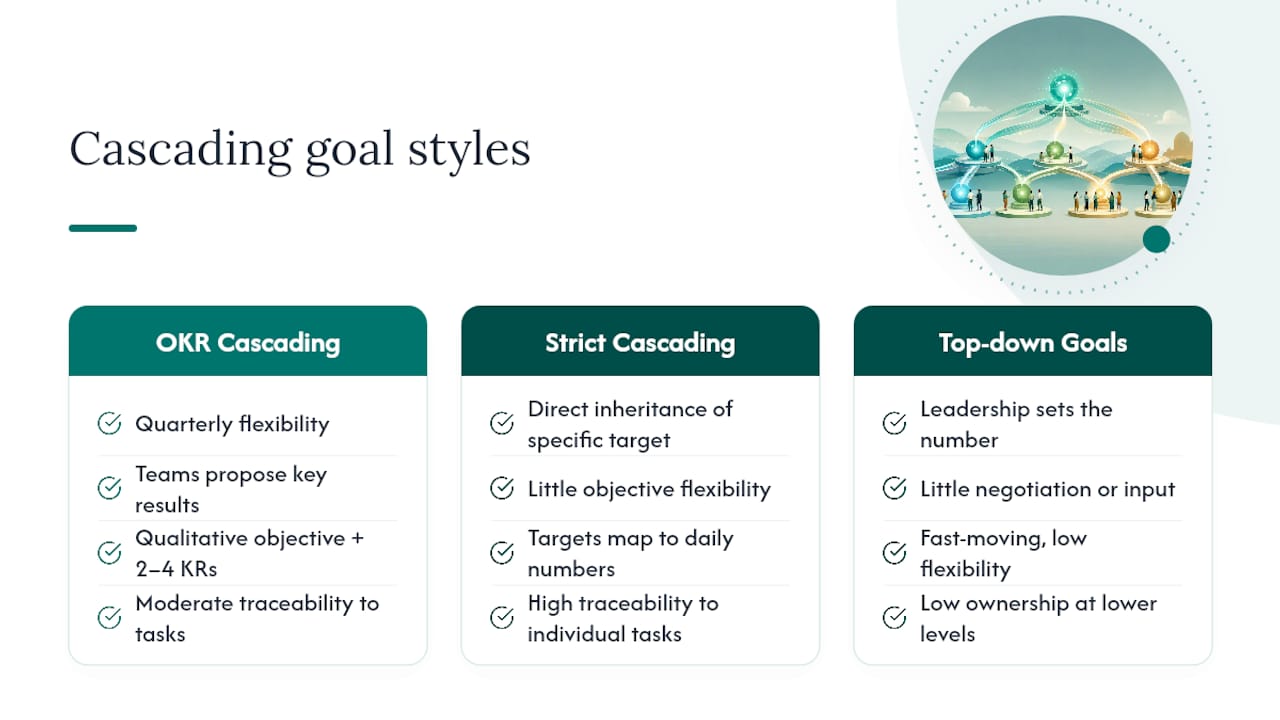
Top-down goal setting is the blunter cousin of both. Leadership decides the number, hands it down, and expects execution with little negotiation at lower levels. It moves fast and works when speed matters more than buy-in, like during a crisis response or a hard compliance deadline. It fails as a long-term operating model because people who never helped shape a goal rarely feel ownership of it.
The practical answer for most HR teams: use OKR cascading when you want quarterly flexibility and cross-team collaboration on how to hit a shared objective. Use a stricter cascading-goals structure when you need tight traceability from company metric to individual task, especially in operational or frontline environments where the "key result" is really just a daily number someone needs to move. Reserve pure top-down goals for genuine emergencies, not as your default management style. Most organizations that succeed long-term end up blending the two: OKR-style flexibility at the department level, tighter cascaded targets once goals reach individual contributors.
What Role Does Leadership Actually Play?
A cascade lives or dies on whether leadership treats it as real or ceremonial. If executives set the top 3 to 5 objectives and then never mention them again until the annual review, managers learn quickly that goals are theater.
Leadership's real job starts with modeling the behavior it wants. If leaders want managers running weekly goal check-ins, leaders need to run their own version at the leadership level first. If leaders want documentation and traceability, leaders need to publish their own top-level goals with the reasoning attached, not just the number.
Adoption spreads through visible repetition, not a memo. When a VP references a cascaded goal in a company all-hands, or a director asks a manager how their team's goal is tracking in a normal conversation rather than a formal review, that signals the cascade matters day to day. Silence from leadership does the opposite: it tells managers the goals were a one-time exercise, safe to file away until someone asks.
The other leadership responsibility is protecting the 3 to 5 rule from itself. Every new priority that shows up mid-quarter tempts leaders to just add a sixth or seventh goal rather than cutting something. Resisting that instinct, and forcing a genuine tradeoff instead of endless addition, is one of the clearest signals that leadership takes the cascade seriously rather than treating it as decoration.
Getting Teams Through the Change
Rolling out cascading goals is a change management project, not a one-time announcement. Most resistance comes from people who've watched goal-setting exercises before and assume this one will also disappear by March.
Start training with managers, not with individual contributors. Managers are the translation layer between a team goal and a person's daily work, so if they can't explain the "why" behind a goal, nobody below them will either. A short working session where managers practice writing their own team goals, with real feedback on whether the goal is measurable and traceable, does more than any slide deck.
Give people language, not just process. Terms like "cascade," "traceability," and "objective versus key result" mean nothing to someone who's never worked in a goal-setting framework before. Translate the concept into something concrete: "here's the one thing leadership is trying to move, here's how your team's number connects to it, here's what that means for your week."
Expect a rough first cycle. Goals will be poorly written, some will get abandoned, and a few managers will quietly revert to their old habits. That's normal for any new operating rhythm. The fix isn't a perfect rollout. It's a second cycle where you fix the goals that clearly didn't work, keep the ones that did, and reinforce the weekly cadence until it stops feeling like an extra task and starts feeling like how the team already works.
Does Cascading Goals Actually Improve Motivation?
People stay engaged with work they can explain, not just work they complete. A cascade gives every employee an answer to "why does this matter," which changes how a task feels even when the task itself doesn't change.
Compare two versions of the same shift. In one, an employee restocks shelves because it's on the checklist. In the other, that same restocking task ties visibly to a team goal around reducing out-of-stock incidents, which ties to a department goal around customer satisfaction scores. Same task, different meaning. The second version gives someone a reason to care about doing it well rather than just doing it.

Performance management benefits the same way. That specificity is what makes a review feel earned rather than arbitrary, on both sides of the table.
The risk runs the other direction too. A cascade that exists on paper but never gets revisited does the opposite of motivating anyone. It signals that the goals were a compliance exercise, and people disengage from compliance exercises fast. The weekly visibility habit isn't just an accountability tool. It's what keeps the motivational value of the cascade alive instead of letting it decay into another ignored spreadsheet.
Connecting Cascading Goals to Reviews and Feedback
Performance reviews built on cascaded goals look fundamentally different from reviews built on a generic job description. Instead of rating someone against broad competencies, a manager can point directly to the individual goals set months earlier and ask a specific question: did this move, and if not, why?
That specificity changes the feedback conversation from evaluative to diagnostic. If a goal stalled, the review becomes a chance to ask whether the goal was unclear, the resourcing was wrong, or the priority shifted mid-cycle without anyone updating the target. That's a far more useful conversation than a vague rating on a five-point scale.
The integration works best when goal check-ins happen continuously rather than only surfacing at review time. If the only time someone hears about their goal is during a formal review, months of drift go unaddressed. Folding goal progress into the same one-on-ones and weekly rituals that support the cascade means the formal review becomes a summary of a conversation that's already been happening, not the first time anyone brought it up.
Documentation matters again here. A written trail of what each goal was, why it existed, and how it evolved gives both the manager and the employee a shared record to review together, rather than relying on memory or a single end-of-quarter snapshot.
The One Move HR Leaders Should Make First
If you take one thing from this: pick your 3 to 5 company objectives this week and put them in front of every manager before you touch any software or template. Traceability and weekly visibility matter more than tooling. Get managers coaching their teams on how individual work connects to those objectives, and the rest of the cascade will follow far more easily than trying to perfect the structure before anyone starts using it.
— Christian
Where Bossy Fits Into Your Cascade
Once your 3 to 5 objectives are set and managers are coaching, the harder problem is keeping the cascade alive week over week without it turning into another spreadsheet nobody opens. Some operations platforms link cascading goals directly to the daily tasks and checklists frontline teams already complete, with photo proof and manager approval built into the workflow, so progress on a goal is verified, not just reported.
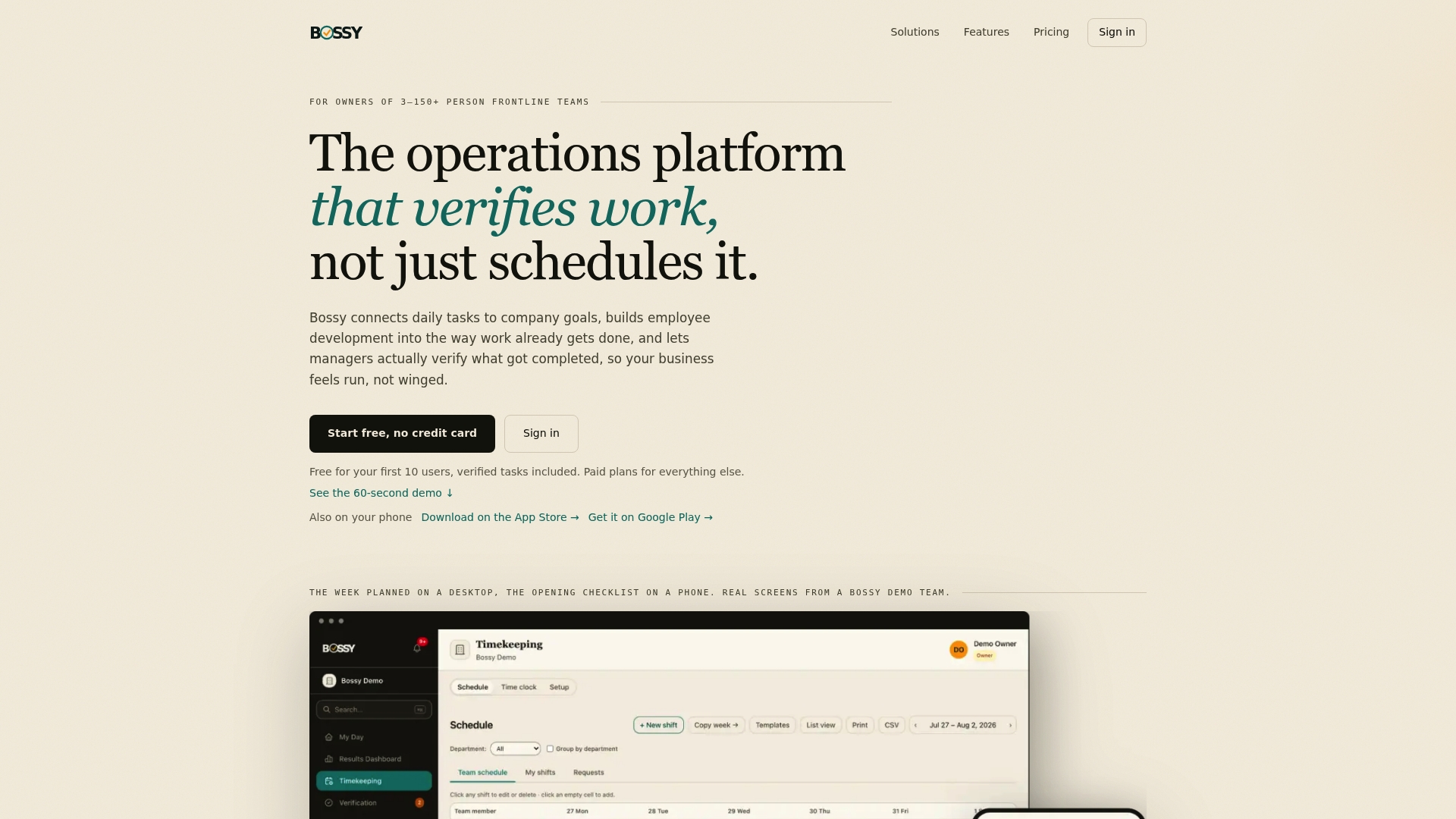
Picture a retail team whose department goal is reducing shrinkage. In Bossy, that goal cascades to a team target on inventory accuracy, which ties to daily stock-count checklists individual employees complete and a manager verifies. Nobody has to guess whether the goal moved. It shows up in the same dashboard where the daily work happens. For frontline teams of various sizes, there's often a gap between the strategy deck and the actual shift that many goal-setting tools do not close. See how it fits your team on the Bossy platform overview and check the features built for task and goal tracking to see what a live cascade looks like in practice.
Sources
- How to Set Strategic Planning Goals | HBS Online
- Cascading goals (MIT IS&T explanatory doc)
- Cascading Goals: 5 Examples + How-To for HR Leaders | AIHR
- Salary
FAQ
What Are Some Good Cascading Goals Examples?
A company goal to grow revenue 15% might cascade to a marketing department goal of 500 qualified leads, a sales team goal of closing 120 of those leads, and an individual goal of booking 15 discovery calls a week, with each level keeping the metric and the reasoning behind it.
What Does Cascading Mean in Business?
In business, cascading means breaking a high-level objective into progressively specific goals at each organizational level, from company to department to team to individual, while preserving the original context and metric so the chain stays traceable.
How Do You Cascade Goals in Workday or Similar HR Systems?
Most HR platforms, including Workday, let you link a parent goal to child goals so progress rolls up automatically. The setup matters less than the discipline behind it: define the top 3 to 5 company goals first, then build department and team goals underneath before assigning individual targets, and document the relationships so the links stay meaningful as priorities shift.
What Are the Five SMART Goal Criteria?
SMART goals are specific, measurable, achievable, relevant, and time bound. Applying these criteria at every level of a cascade, not just at the company level, is what keeps individual goals from turning into vague intentions nobody can actually track.
How Many Goals Should One Person Have at a Time?
Most guidance points to 3 to 5 goals per person during a performance cycle, a range that Salary.com's HR resources and other practitioner sources converge on to keep focus without overloading anyone's plate.