30–60 Minute One Page Development Plans for Frontline Managers
Christian MontenegroSeptember 16, 202617 min read
An employee development plan is a one-page, employee-owned roadmap that links two or three specific goals to concrete actions, measures, and review dates. The fastest way to start one? Schedule a 30 to 60 minute conversation, co-write it live with your employee, and use a simple template. Set short-term goals for the next one to six months and longer targets for the year ahead, leaning on a 70/20/10 mix of experience, exposure, and formal training.
TL;DR:
- Most effective development plans focus on short-term goals of six to twelve months with quarterly reviews and monthly check-ins to maintain relevance.
- They should include specific SMART objectives, clear development areas, and actions distributed across experience, exposure, and formal training, with ownership and deadlines.
- Building in a cadence and tracking progress through tangible evidence like task completion or photo verification helps ensure follow-through.
- Poorly managed plans often become shelfware, so scheduling review dates immediately and embedding follow-ups in calendars is crucial for success.
- The goal isn’t the template but establishing a habit of regular engagement, with emphasis on on-the-job experience and mentoring over reliance on formal courses.
Table of Contents
- Why Employee Development Plans Matter Right Now
- What Goes Into a One-Page Employee Development Plan
- How to Run the Planning Conversation and Finalize the Plan
- Copy-Ready Templates and Three Filled Examples
- Keeping the Plan Alive: Manager Actions and Cadence
- How to Measure Whether Development Plans Are Working
- Common Pitfalls and How to Fix Them
- What Frontline Reality Does to a Development Plan
- What the Research Actually Supports
- Run Development Plans Without the Spreadsheet Chaos
- Templates and Guidance Worth Bookmarking
- Sources
- FAQ
Why Employee Development Plans Matter Right Now
Your best people don't leave over money nearly as often as they leave because they can't see a future where they work. A majority of workers who quit in 2021 pointed to low pay and no path to advancement as their reasons for walking out the door, according to Pew Research Center. That's the retention math in one sentence: if people can't grow with you, they'll grow somewhere else.
A development plan is also cheaper than replacing someone. Promoting from within skips months of recruiting, onboarding, and the productivity dip that comes with a new hire learning your systems from scratch. Every internal promotion is a recruiting cost you didn't pay and a knowledge gap you didn't create.
Here's where a lot of managers get confused. A development plan is not the same tool as a performance improvement plan, and it's not the same as a five-year career map either.
- A performance improvement plan (PIP) is corrective. It exists because performance has dropped below an acceptable line, and it usually carries a deadline tied to continued employment.
- A long-range career plan looks years out. It's aspirational and loosely structured, more of a direction than a workplan.
- An employee development plan sits in the middle. It's proactive, tied to real goals in the next 6 to 12 months, and built for someone who is meeting expectations and wants to grow.
A quick number worth sitting with: most guides recommend a 6 to 12 month planning horizon with quarterly formal reviews and monthly informal check-ins, according to Zendesk's employee development research. That cadence is short enough to stay relevant and long enough to show real progress.
What Goes Into a One-Page Employee Development Plan
You don't need twelve pages of jargon. You need one page that someone will actually open again in three months. The templates used by university HR departments and workplace platforms converge on the same handful of fields, and for good reason: they cover everything a manager needs to track without burying the point.
- Current state. A short note on strengths, gaps, and where the role sits today. This grounds the whole plan in reality instead of wishful thinking.
- Objective. One SMART goal, tied to something the business actually needs. "Get better at communication" isn't a goal. "Lead the weekly team huddle independently by Q3" is.
- Development areas. Sort them into technical, behavioral, or managerial skills so the actions below make sense.
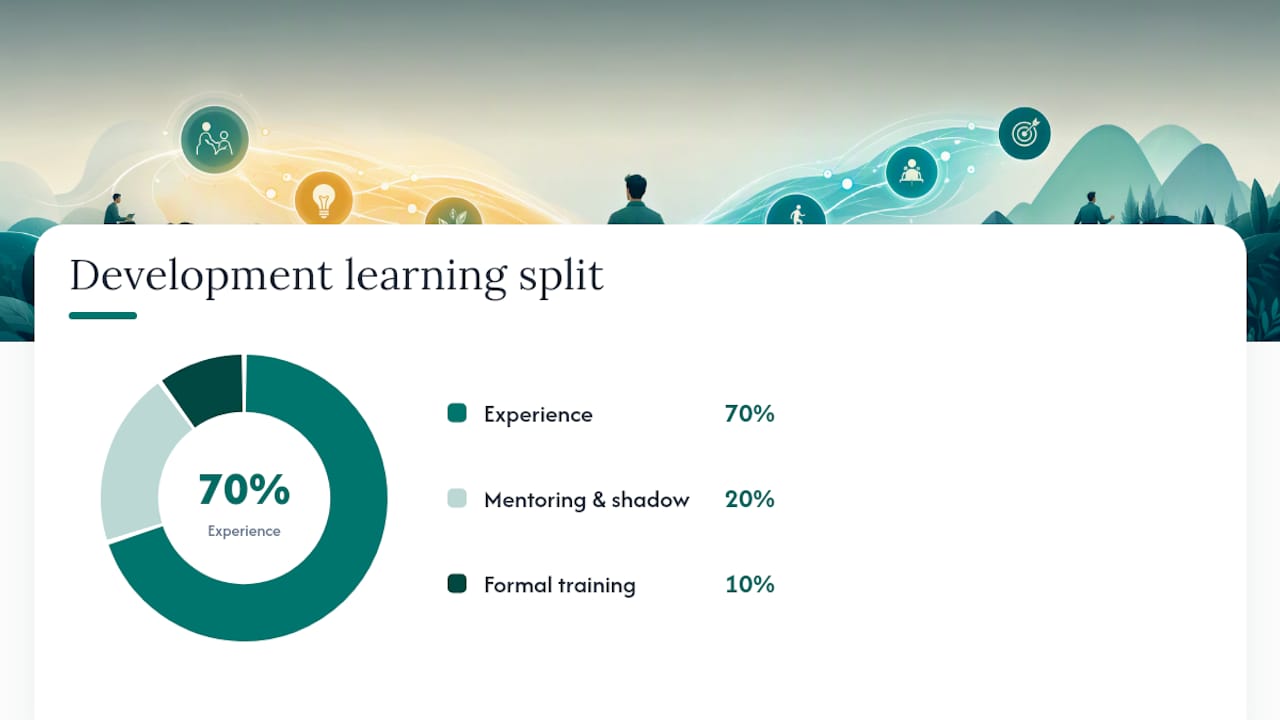
- Actions, mapped to 70/20/10. Most of the growth (70%) should come from real work. Some (20%) comes from exposure like shadowing or mentoring. A small slice (10%) comes from formal training.
- Measures, ownership, and timeline. Who is responsible for each action, what evidence proves it happened, and by when.
Individual development plan templates built by university HR offices structure exactly these fields: strengths, goals, action steps split into short and long term, accountability, target dates, and measures. That structure isn't an accident. It's what keeps a plan usable instead of decorative.
The 70/20/10 split deserves a beat of its own. Practitioner research consistently points to experience-based learning, things like stretch assignments, mentoring, and shadowing, as more effective for building most workplace skills than formal courses alone, according to Culture Amp's development research. Formal training still matters. It just shouldn't carry the whole plan.
Pro Tip: Write the objective as a sentence a stranger could verify. If someone outside your team couldn't tell whether the goal was met by reading it, rewrite it.
How to Run the Planning Conversation and Finalize the Plan
The plan lives or dies in one meeting. Get this conversation right and the document practically writes itself. Get it wrong and you'll end up with a form nobody remembers filling out.
Before the meeting, gather three things:
- Recent feedback from peers, customers, or your own observations
- A clear picture of what the role requires right now versus six months from now
- Examples of the employee's recent work, both wins and gaps
Come in with material, not a blank page. An employee who feels ambushed by vague questions will give you vague answers.
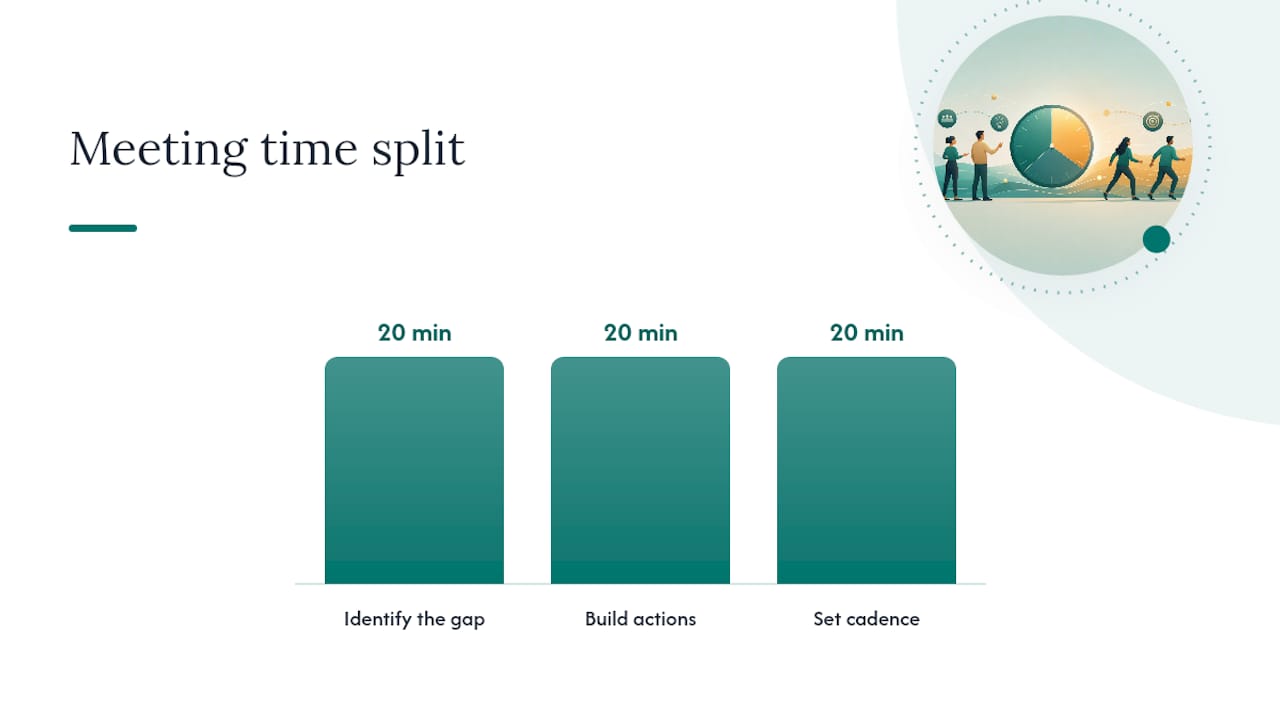
During the meeting, run a simple 20/20/20 structure across your 30 to 60 minutes:
- First 20 minutes: identify the gap. Ask directly what skill or responsibility would make the biggest difference to their role in the next six months. Ask what's getting in the way today.
- Middle 20 minutes: build the actions. For each gap, brainstorm one action from each 70/20/10 category. A stretch project, a mentor or shadowing opportunity, and, if genuinely needed, one course or certification.
- Final 20 minutes: set the cadence. Agree on check-in dates right there in the meeting, not "sometime next month." Put them on both calendars before anyone leaves the room.
Turning the conversation into SMART goals is the part people rush, and it's the part that determines whether the plan survives past week two. If someone says they want to "get better at delegating," push for specifics: what does delegating look like when it's working? Who notices the difference? By when? The goal that comes out the other side should read something like "delegate the weekly inventory count to two team members by the end of next month, with zero missed counts."
One insight worth borrowing from practitioners: make the planning meeting itself the product. Co-write the plan live in a shared document during the conversation rather than promising to "type it up later." A plan drafted in front of the employee, with their language and their priorities, gets treated as theirs. A plan emailed to them after the fact gets treated as homework.
After the meeting, close the loop the same day:
- Assign clear ownership for each action (some belong to the employee, some to you, some to HR)
- Save the document somewhere both people can access without asking
- Put the first check-in on the calendar before you close the laptop
- Note any resources or budget approvals you promised, and follow through within the week
If you manage a team where shifts and staffing shift daily, the fundamentals don't change but the scheduling does. Building this cadence around a schedule that survives call-outs keeps development conversations from getting bumped every time someone calls in sick.
Copy-Ready Templates and Three Filled Examples
A blank template only helps if you can see it filled in. Here's the skeleton, followed by three examples built for different situations.
Blank one-page template fields:
- Employee name, role, and date
- Current state (strengths and gaps)
- Objective (one SMART goal per cycle)
- Development area (technical, behavioral, or managerial)
- Actions (one each from experience, exposure, education)
- Measure of success
- Owner for each action
- Target date and next review date
| Plan Type | Objective Example | Primary 70/20/10 Action | Review Cadence |
|---|---|---|---|
| First 90 days (onboarding) | Run the closing checklist independently by day 60 | Shadow a senior team member for two full closing shifts | Weekly for 4 weeks, then biweekly |
| First-time manager (6 months) | Lead one-on-ones with direct reports without a manager present by month 3 | Co-lead sessions with current manager, then solo with feedback debrief | Monthly formal, biweekly informal |
| Individual contributor, technical skill (6 months) | Build and ship one feature independently by month 4 | Pair-program with a senior engineer on two prior features | Monthly |
Example 1, first 90-day plan: A new hire in a retail role has a goal of running the closing checklist without supervision by day 60. The action mix leans heavily on experience: shadowing during weeks one and two, running the checklist with a supervisor present during weeks three and four, then solo with a manager spot-check. The measure is simple. Zero missed steps on two consecutive unsupervised closes.
Example 2, first-time manager plan: A newly promoted team lead has six months to build comfort running one-on-ones. The plan pairs a mentoring relationship with an experienced manager (exposure) with direct practice leading real conversations (experience), plus a single short course on feedback delivery (education). Success is measured by direct-report survey scores and the manager's own confidence rating at the three-month mark.
Example 3, individual contributor technical plan: A frontline supervisor wants to build inventory forecasting skills over six months. The plan includes hands-on ordering practice under a mentor for two cycles, exposure through sitting in on supplier calls, and one short certification course. Progress gets measured by forecast accuracy against actual usage.
For small frontline teams without a training budget, these examples still work. Swap the formal course for a short video or a fifteen-minute walkthrough from someone who already does the job well. The structure matters more than the polish.
Keeping the Plan Alive: Manager Actions and Cadence
A development plan that sits in a folder is worse than no plan at all, because it creates the appearance of investment without the substance. Keeping it alive is a manager's job, not HR's.
Your responsibilities as the manager:
- Actually create the stretch assignments you promised in the meeting, not just approve them in theory
- Give specific feedback tied to the plan's actions, not generic praise
- Protect the follow-up meetings from getting canceled when the shift gets busy
Cadence matters more than most managers think. Quarterly formal reviews paired with monthly quick check-ins keep plans current and stop them from turning into shelfware, according to FirstHR's guidance on development plans. Put both on the calendar the same week you write the plan, not "whenever things settle down."
Recording evidence doesn't require a fancy system. A photo of completed work, a note from a shadowing session, or a line in your one-on-one notes is enough. What matters is that the evidence exists somewhere both people can find it later.
Pro Tip: If your team runs on shift work, tie each development action to a specific shift or task rather than a vague "this month." "Lead the Thursday closing shift" is trackable. "Get better at closing" isn't.
HR's role here is to own the system: the template, the reminders, the reporting structure. Managers own the conversation. Employees own the goal. All three have to show up, according to Careerminds' research on employee growth plans, or the plan quietly stalls.
How to Measure Whether Development Plans Are Working
Four numbers tell you almost everything you need to know, and none of them require a dashboard you have to build from scratch.
- Goal completion rate. What percentage of development goals set last quarter actually got marked complete?
- Observable skill progression. Can the employee now do something they couldn't do three months ago? This one is qualitative but still trackable through manager notes or 360-degree feedback.
- Internal mobility. How many people moved into new roles or expanded responsibilities after completing a plan?
- Retention differential. Do employees with active development plans stay longer than those without one? This is the number that ties directly back to the retention research from Pew.
Collecting qualitative signals doesn't need to be complicated. A short 360 survey once a quarter, or even a running document of manager observations, gives you texture the completion rate alone can't.
A simple quarterly report to leadership might cover: percentage of goals completed, two or three specific skill wins worth naming, how many people moved into new roles, and any retention gap between people on active plans versus those without one. Keep it to one page. If leadership has to dig for the point, you've lost them before the second slide.
Common Pitfalls and How to Fix Them
Most development plans fail in one of four predictable ways, and each has a fast fix.
- Plans become shelfware. Fix it by putting review dates on the calendar the day you write the plan, not "sometime later."
- Goals stay vague. "Improve communication" fixes into "run the weekly huddle independently by Q3" the moment you ask what success actually looks like.
- Everything routes through formal courses. Prioritize the on-the-job action first. Courses support the plan; they shouldn't be the whole plan.
- The manager who wrote the plan leaves. Build a one-page handover checklist listing the goal, current progress, and next review date so a new manager can pick it up in five minutes, not five weeks.
Each of these is a process gap, not a motivation gap. Fix the process and most plans survive.
What Frontline Reality Does to a Development Plan
A development plan written for an office job doesn't always survive contact with a restaurant floor, a retail shift, or a cleaning crew running on tight schedules. Short shifts, variable staffing, and constant interruptions mean the 20/20/20 meeting structure often has to compress into two ten-minute conversations instead of one long sitting.
That's fine. The structure matters more than the runtime.
- Map development actions to tasks that already exist on the shift, like closing procedures or inventory counts, instead of inventing new projects
- Use photo proof or task verification as your evidence field instead of a written report nobody has time to write
- Let cascading goals connect an individual's development action to a team-level target, so a shift lead's growth goal visibly supports the location's numbers
Operations tooling that logs task completion and photo evidence helps provide a paper trail for a development plan without requiring a separate report from a busy manager. When cascading goals tie daily tasks to bigger targets, a development action can be naturally linked to them.
What the Research Actually Supports
Most advice on this topic treats the template as the hard part. It isn't. The hard part is the habit of showing up to the calendar reminder three months later, and most companies never build that habit because nobody owns the follow-through.
The conventional wisdom oversells formal training and undersells the boring stuff. A mentoring relationship, a stretch assignment, a shadowing shift. These sound less impressive on a slide than "we launched a leadership academy," but they move the needle further per dollar spent, especially for frontline teams that don't have training budgets to begin with.
If you take one thing from this guide, prioritize the calendar over the content. A mediocre goal with a real review date beats a perfect goal that nobody revisits. Write the plan in the meeting, not after it. Put the follow-up on both calendars before anyone stands up. Everything else, the SMART wording, the 70/20/10 split, the fancy template, matters less than whether the plan gets opened again in ninety days.
— Christian
Run Development Plans Without the Spreadsheet Chaos
This platform addresses the issue of development plans that get written but are not followed through. Task verification provides evidence such as photos or completed checklist items rather than vague progress notes. Cascading goals connect individual growth actions to organizational needs, and built-in one-on-ones encourage making monthly check-ins a calendar habit.
Picture a small restaurant running a 90-day onboarding plan for a new shift lead. The manager sets a goal tied to closing procedures, assigns a mentor for the first two weeks, and uses task verification to confirm the checklist gets completed correctly without a supervisor standing over their shoulder. Three check-ins later, the goal either got met or the manager knows exactly where it stalled.
See how the features fit your team on the Bossy features page, check out the restaurant-specific tools if that's your world, or start a trial directly at Bossy to see how cascading goals and task verification work together on your own floor.
Templates and Guidance Worth Bookmarking
Skip building a template from scratch. The UCI Staff Individual Development Plan template and the University of South Carolina IDP sample both offer fillable structures. Adapt the fields to your team instead of copying them word for word. If you're coordinating development across a distributed or multi-country team, Segmento do Trabalho's guide to employer-of-record workflows is worth a look for keeping compliance in step with growth.
Sources
- UCI Staff Individual Development Plan template
- Individual development plan (IDP) sample — University template
- Employee development plans: Templates and examples | Culture Amp
- Pew Research Center: majority of workers who quit in 2021 cite low pay, no opportunities for advancement
FAQ
What Makes a Good Employee Development Plan?
A good plan fits on one page, ties to two or three specific SMART goals, and splits actions across the 70/20/10 mix of experience, exposure, and training. It also names an owner for every action and a real review date, which is what separates a working plan from a form that gets filed and forgotten.
What Is the 70/20/10 Rule for Employee Development?
The 70/20/10 framework suggests 70% of growth comes from real, on-the-job experience, 20% from exposure like mentoring or shadowing, and 10% from formal training or courses. It's a balance, not a strict formula, and it exists to stop plans from leaning too heavily on courses that don't stick.
What Are Some Good Employee Development Goals?
Strong goals are specific and observable: leading a weekly team meeting independently by a set date, reducing order errors to zero over a defined period, or completing a cross-training rotation in a new department. The common thread is a verifiable outcome, not a vague intention like "improve leadership skills."
What Is the 30/60/90 Rule at Work?
The 30/60/90 rule breaks a new employee's first three months into milestones: getting oriented and learning systems in the first 30 days, taking on real tasks with support by day 60, and working with growing independence by day 90. It works well as the structure for a first-90-day development plan, similar to the onboarding example covered earlier in this guide.
How Often Should You Review a Development Plan?
Most guides recommend a quarterly formal review paired with monthly informal check-ins. That cadence keeps the plan current without turning it into another meeting nobody has time for, and it's the single biggest factor in whether a plan survives past its first month.