Five Part One on One Template and Questions for Frontline Managers
Christian MontenegroSeptember 4, 202612 min read
Your best 1-on-1 meeting template has five parts: a quick check-in, wins and progress, priorities for the week ahead, blockers that need support, and action items with one open question for next time. Both people add notes to a shared document before, during, and after the meeting. Whatever gets written down as an action item gets checked at the start of the next 1:1, every time.
TL;DR:
- Weekly check-ins should focus on priorities and blockers, reserving development and feedback discussions for monthly meetings to allow deeper conversations.
- Using a shared, editable document that captures action items with assigned owners and due dates increases follow-through and accountability.
- Action items must specify who is responsible, when they are due, and what completion looks like to ensure tasks are actually completed, not just discussed.
- Meeting cadence should match team stability, with weekly for new or fast-changing roles, biweekly for steady teams, and monthly for autonomous, experienced teams.
- Rotating questions across categories like priorities, blockers, feedback, and development keeps meetings engaging and ensures every area receives proper attention over time.
Table of Contents
- What Goes Into a One-on-One Meeting Template?
- Which Template Should You Use: Weekly, Monthly, or Quarterly?
- What Questions Should You Ask in a 1-on-1?
- How Often Should You Have 1-on-1s, and What's the Right Format?
- How Do You Turn Meeting Notes Into Finished Work?
- How Bossy Helps Managers Keep 1-on-1 Commitments
- Three Tactics I'd Push Every Frontline Manager to Try
- Keep Every 1-on-1 Commitment Visible, Not Just Written Down
- Sources
- FAQ
What Goes Into a One-on-One Meeting Template?
A template only works if it lives somewhere both people can touch it. Confluence's approach to this is worth copying directly: run the 1:1 in a shared document before, during, and after the conversation, so nothing depends on memory. Here's the full copy-paste structure.
Header fields (fill in once, reuse every meeting):
- Employee name and role
- Manager name
- Date and meeting type (weekly check-in, monthly development, quarterly review)
- Cadence (weekly, biweekly, monthly)
Agenda body (fill in before or during the meeting):
- Check-in. One line on how the week is going, energy level, anything personal worth flagging.
- Wins and progress. What moved forward since the last meeting. Specific tasks, not vague feelings.
- Priorities. Top two or three things for the coming week, ranked.
- Blockers and support needed. Anything stuck, and what would unstick it.
- Development or feedback. One item, rotated meeting to meeting so it doesn't get skipped.
- Manager notes. Coaching observations, context the employee should know.
- Action items. Owner, due date, and what "done" looks like for each one.
- One question for next time. A single open thread to pick back up.
Who owns what matters here. The employee should add their agenda items at least 48 hours ahead, since surprise topics rarely get a real answer. The manager reviews before the meeting and adds their own notes section, but shouldn't rewrite the employee's items. Slack's version of this template pushes the same idea further by bundling in OKR and progress fields directly into the shared canvas, so goal tracking and meeting notes live in one place instead of two.
A filled-in row looks like this: "Priorities: Finish new hire onboarding checklist by Thursday. Blockers: Waiting on badge access from IT, need manager to escalate." That second line is the difference between a nice conversation and a completed task, because it names exactly what needs to happen next and who needs to do it.
Which Template Should You Use: Weekly, Monthly, or Quarterly?
Not every 1:1 needs the same depth. Matching the template to the cadence keeps meetings tight instead of bloated.
- Weekly operational check-in (15 to 30 minutes). Stick to check-in, priorities, and blockers only. Skip development and feedback most weeks. This is the version frontline managers use most, since it's built for fast status and unsticking problems, not deep conversation.
- Monthly development meeting (30 to 60 minutes). Add the career and development section plus a two-way feedback exchange. This is where growth conversations actually happen, since a 20-minute weekly slot rarely leaves room for them.
- Quarterly goal review (45 to 60 minutes). Bring in OKRs, a metrics snapshot, and longer-term planning. Miro's template for this kind of session recommends a defined next-steps section recorded directly in the document, so quarterly commitments don't evaporate the moment the meeting ends.
If your team prefers paper, a printable one-page version works fine for the weekly check-in, since there's little to track beyond what's in front of you. Monthly and quarterly templates work better as shared docs or collaborative canvases, because both people need to add to them over time and reference past entries.
What Questions Should You Ask in a 1-on-1?
The template gives you structure. Questions give you substance. Pick three to five per meeting and rotate categories so sessions don't turn stale. Thrivea's research-backed question bank is a strong reference point for this, and Serendly takes it further by mapping each question to a follow-up action, which is the habit worth stealing most.
Check-in and rapport:
- How's your week going so far?
- What's taking up most of your energy right now?
- Anything outside work I should know about?
Priorities and alignment:
- What are your top two priorities this week?
- What would make this week feel like a win?
- Are you clear on how your work connects to team goals?
- What's competing for your attention that shouldn't be?
Blockers and support:
- What's slowing you down right now?
- What do you need from me to move faster?
- Is there a decision you're waiting on?
Every blocker question should end in an assigned action, not just sympathy. If someone names a blocker, write down who owns removing it before the meeting ends.
Feedback, both directions:
- What's one thing I could do differently as your manager?
- Is there feedback you've been holding back?
Career and development:
- What skill do you want to build in the next quarter?
- What part of your role feels most energizing right now?
- Is there a stretch project you'd want to take on?
Pro Tip: Don't ask all five categories every meeting. Pick check-in and priorities every week, then rotate blockers, feedback, and development so each gets real attention instead of a rushed afterthought.
How Often Should You Have 1-on-1s, and What's the Right Format?
Cadence depends on the role and the amount of change happening. New employees or fast-moving teams usually need weekly 1:1s. Stable, experienced team members can often shift to biweekly or monthly without losing much.
- Weekly works best during onboarding, role changes, or high-pressure stretches.
- Biweekly fits most steady-state frontline roles once someone is fully ramped.
- Monthly suits senior or highly autonomous team members who mostly need a development check-in, not operational oversight.
Whatever cadence you pick, be deliberate about it. Research from Harvard Business Review points out that meeting frequency should preserve time for the conversations that actually matter, not just fill calendar slots because that's what everyone else does.
Preparation workflow:
- Employee adds agenda items 48 hours ahead.
- Manager reviews and adds their own notes the day before.
- Both prioritize the top two items if time runs short.
Timing splits:
- 30-minute meeting: 5 minutes check-in, 10 minutes priorities and progress, 10 minutes blockers, 5 minutes wrap and next question.
- 60-minute meeting: add 15 to 20 minutes for development or feedback, and slow down the blockers discussion instead of rushing it.
Remote 1:1s need a few extra habits. Turn cameras on when possible, since tone gets lost fast over audio alone. Use the shared document as an actual on-screen canvas during the call rather than a file someone fills in later, and send a calendar reminder the morning of the meeting so agenda items don't get added at the last minute. If connections drop, default to finishing the action items section by chat rather than losing the whole meeting. For more on making video calls actually productive instead of draining, this guide on video call etiquette covers the small habits that make the biggest difference.
How Do You Turn Meeting Notes Into Finished Work?
An action item without an owner and a date is just a wish. Every item coming out of a 1:1 needs three things: who's doing it, when it's due, and what finished actually looks like. "Follow up on IT ticket" is vague. "Sarah escalates badge access ticket with IT by Wednesday, confirmed by badge working" is a task someone can actually be held to.
Link those action items to whatever your team already tracks, whether that's weekly task lists or quarterly OKRs, so a commitment made in a private conversation shows up somewhere visible. A commitment that only exists in a meeting doc tends to disappear the moment the next fire starts.
Before each next meeting, check:
- Did last meeting's action items get done?
- Did any blocker resurface that was supposedly resolved?
- Is there an unanswered question still sitting from last time?
Slack's guidance leans hard on this point: a dynamic shared canvas that both people can edit between meetings catches more forgotten items than a static document one person updates alone. Whether you're tracking follow-up in a shared doc, a task in your team's tracker, or inside an operations platform that ties tasks to goals automatically, the mechanism matters less than the discipline of actually checking it.
How Bossy Helps Managers Keep 1-on-1 Commitments
Meeting notes are only as good as what happens after the meeting ends. A shared operations platform keeps the full history of past 1:1s in one place and turns action items into daily tasks that get verified, not just promised.
- Cascading goals mean a commitment made in a 1:1 connects visibly to the team's broader targets, not a private note that only two people ever see again.
- Task verification, including photo proof and manager approval, turns "I'll get to it" into something checked off with evidence.
Even without a tool, managers can borrow the pattern: write action items where both people can see them, and revisit them out loud at the start of the next meeting instead of hoping they got done.
Three Tactics I'd Push Every Frontline Manager to Try
Skipping the "how's it going" small talk and opening with priorities cuts meeting length without losing trust, contrary to what most advice suggests. Writing the blocker's fix down, not just the blocker, is the single habit that separates 1:1s that produce results from ones that just feel supportive. Try this next week: pick one rotating question category, write down every action item's owner and date, and check last week's items before adding new ones. For more on building manager habits that stick, see how to develop managers you can actually trust.
— Christian
Keep Every 1-on-1 Commitment Visible, Not Just Written Down
The hardest part of running good 1:1s isn't the conversation. It's remembering what got promised three weeks ago. Bossy keeps every meeting note, action item, and goal in one shared record, so nothing depends on someone's memory of what was said in a hallway or a video call.
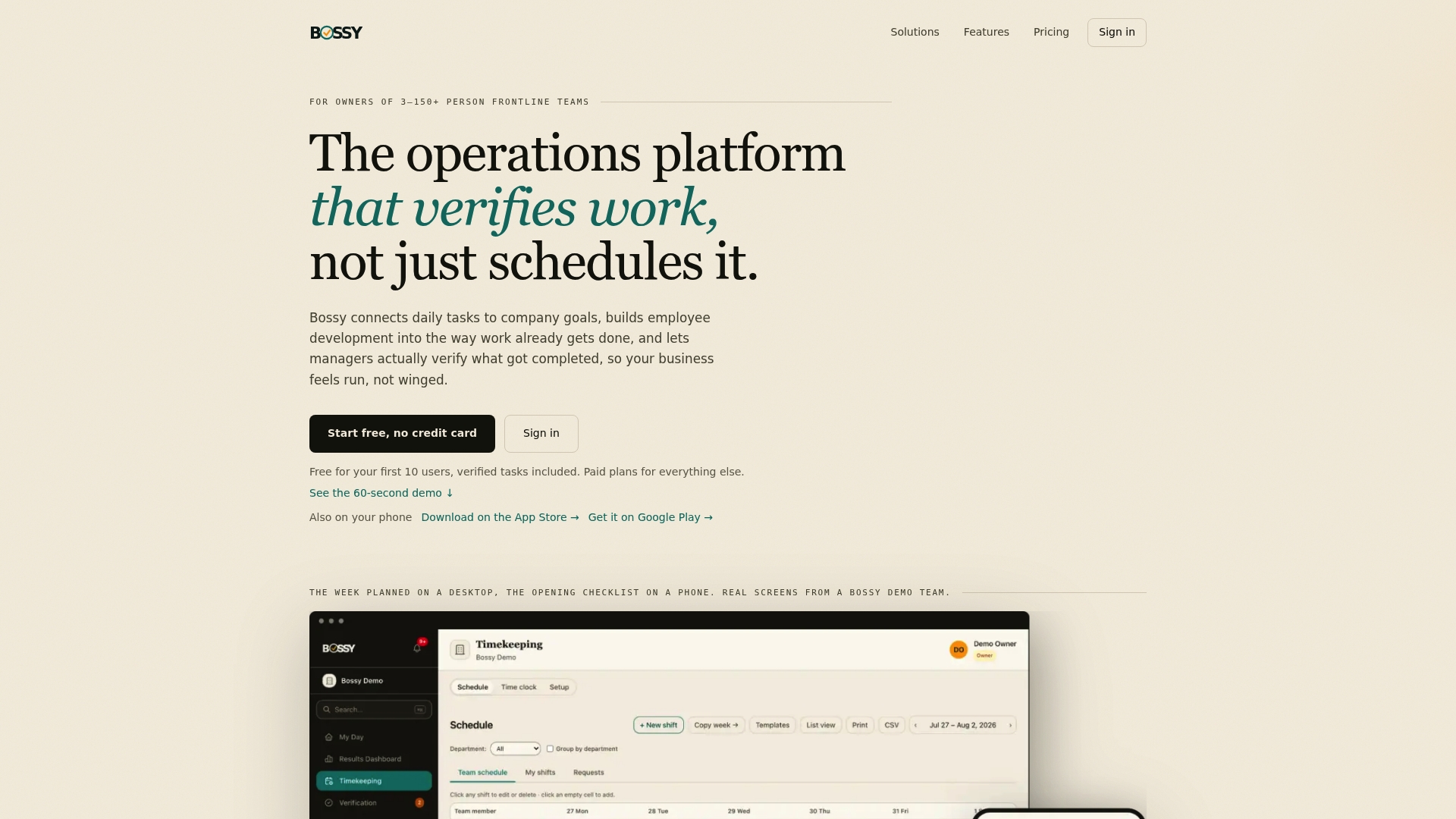
Cascading goals link what you discuss in a 1:1 to the tasks your team completes that same week, and task verification means a commitment gets marked done only when there's actual proof, not just a check mark. If you manage a frontline team of hourly staff, shift workers, or field crews, this closes the gap between what gets talked about and what actually happens on the floor. Explore how tasks and goal tracking work together and see whether it fits how your team already runs its week.
Sources
- 1 on 1 Meeting Template and Agenda | Confluence
- One-on-one Meeting Template | Slack
- 40 One-on-One Meeting Questions That Bring Answers
- FREE One-on-One Meeting Template | Miro
- Dear Manager, You’re Holding Too Many Meetings | HBR
FAQ
How Should You Structure a 1-on-1 Meeting?
Open with a short check-in, cover wins and priorities, spend the most time on blockers and support, and close with clear action items and one open question for next time. Keeping that order prevents the conversation from turning into status reporting only.
What Is the Best Agenda for a One-on-One Meeting?
The strongest agendas combine a shared document both people can edit, a rotating question bank, and a dedicated action-items section reviewed at the start of every meeting. Confluence and Slack both build their templates around this same shared, living document approach.
What Should a Manager 1:1 Template With an Employee Include?
At minimum, include a check-in, current priorities, blockers, one feedback or development prompt, and action items with owners and due dates. Add OKR or goal fields for monthly and quarterly versions.
How Often Should Managers Run 1-on-1s?
Weekly works best for new employees or fast-changing roles, while biweekly or monthly suits steady, experienced team members who need less operational oversight. The right cadence preserves time for meetings that create real value instead of filling a recurring slot out of habit.
What Are Good Questions to Ask in a 1-on-1?
Strong questions cover priorities, blockers, feedback, and development, rotated across meetings so conversations stay fresh. Picking three to five questions per session, rather than working through a long list, keeps the meeting focused and prevents fatigue on either side.