Photo Verified Employee Engagement Software for Frontline Managers
Christian MontenegroOctober 1, 20269 min read

If you run a business with frontline staff, the best employee engagement software isn't a survey tool or a recognition app. It's an operations platform that links daily tasks to company goals and verifies the work actually got done. That combination gives you visibility, accountability, and less manager busywork. Bossy is built around exactly that approach, which makes it our pick for teams like yours.
TL;DR:
- Frontline engagement software should verify task completion with photo proof or approvals to ensure accountability and meaningful progress tracking.
- Stable scheduling features, such as shift swapping and predictable shifts, have been shown to increase sales, morale, and labor productivity in retail and service environments.
- A comprehensive operations platform that integrates scheduling, task verification, communication, and analytics is more effective than multiple separate apps for teams larger than a handful of employees.
- Pilot new features like task verification and cascading goals gradually, focusing on high-impact tasks to build manager confidence and avoid staff micromanagement.
- Check how hours and data get to your payroll, POS, or HR systems before you commit, since manual re-entry adds manager workload.
Table of Contents
- How to choose employee engagement software for frontline teams
- Feature checklist: the capabilities that actually move engagement
- What research says about scheduling, autonomy, and engagement
- Implementation playbook: a 90-day rollout to increase engagement quickly
- Why Bossy is the recommended choice for frontline teams
- Author perspective and proof points
- Sources
- FAQ
How to choose employee engagement software for frontline teams
Here's the thing about engagement on a frontline team: it isn't a feeling you survey for, it's a pattern you can see. When a task is assigned, completed, and checked, people know what matters and managers know who's pulling their weight. That's the whole game.
When you're comparing options, look past the marketing page and check for these:
- Task verification: photo proof or manager approval, not just a checkbox someone can tap without doing the work.
- Cascading goals: a clear line from a daily task to a shift target to a company-level number.
- Scheduling tools: shift swapping, coverage alerts, and support for stable, predictable shifts.
- Time clocks with geofencing: so clock-ins match where people are actually standing.
- Checklists and audit trails: recurring tasks you can look back on, not just a to-do list that disappears.
- Communication features: a place for announcements and quick messages that doesn't require a separate app.
- Analytics dashboards: numbers you can act on, not vanity charts.
- Employee development tools: built-in coaching, feedback, and growth tasks, not an afterthought.
Red flags during a demo: vague answers about how verification actually works, no clear way to see audit history, or scheduling that's really just a shared calendar. Ask vendors directly: "Can I see a completed task with photo proof and the approval trail?" and "How does a daily task connect to a goal I set for the store?"
Pro Tip: Hand a phone to your least tech-savvy employee during the trial and watch them clock in and complete a task. If they struggle, your whole team will.

Feature checklist: the capabilities that actually move engagement
Not every feature on a pricing page matters equally. These are the ones that change behavior on the floor.
- Task verification and approval queues: look for photo proof requirements and a manager queue that flags incomplete work before it's marked done.
- Cascading goals: a sample chain looks like "restock shelf" tied to "shift sales target" tied to "store revenue goal" for the month.
- Scheduling: core scheduling with built-in shift swapping reduces the scramble when someone calls out.
- Time clocks and geofencing: clock-ins tied to location cut down on buddy punching and clean up payroll disputes.
- Recurring checklists and inventory tasks: opening and closing lists, stock counts, and transfers that feed straight into accountability reports.
- Communications: chats, announcements, and quick polls that don't require a separate group text thread.
- Analytics and dashboards: completion rates, late tasks, and goal progress visible at a glance, by person and by shift.
- Mobile usability: a manager workflow that works on a phone in a stockroom, not just at a desk.
During evaluation, ask for a live demo on a phone, not a laptop screen share. If the vendor hesitates, that tells you something about how the product actually performs in the hands of hourly staff.
What research says about scheduling, autonomy, and engagement
Two pieces of research are worth factoring into both your vendor pick and your rollout plan.
A stable-scheduling pilot that combined core scheduling, tech-enabled shift swapping, stable shift structure, part-time guarantees, and targeted staffing increased sales and labor productivity in treatment stores, and separate reporting ties those stable-scheduling practices to improved morale and better demand alignment. The lesson for you: predictable shifts aren't a nice-to-have, they're a lever on performance.
On the task side, a field experiment on task choice enabled by wearables found that letting workers pick their own tasks sped up completion once a task was chosen, but it also shifted response times and could narrow exposure to new skills over time. That's a trade-off, not a reason to avoid choice entirely.
Translate both into evaluation questions: does the platform support core scheduling and swap workflows out of the box? Does it let you build in required development tasks so choice doesn't quietly become avoidance? Pilot these features on one team before rolling them out company-wide, since both studies were run in specific retail and service contexts.

Implementation playbook: a 90-day rollout to increase engagement quickly
Picking the right tool is half the job. Here's how to turn it into results you can point to.
- Set a baseline: pick three KPIs, such as task completion rate, late clock-ins, and goal attainment by store or shift.
- Phase 1 (days 0 to 30): configure scheduling, checklists, and time clocks, then pilot with a single team before going wider.
- Phase 2 (days 31 to 60): turn on verification workflows and manager approval queues, and coach managers to use verified work as a coaching tool, not a gotcha.
- Phase 3 (days 61 to 90): cascade goals from company targets down to daily tasks, enable development tasks, and run structured 30, 60, and 90 day reviews.
- Track weekly, not just monthly: a sudden drop in completion rates usually signals a scheduling conflict or a confusing task, not a motivation problem.
Our scheduling guide and our breakdown of verifying completed work both dig deeper into phases 1 and 2 if you want more detail before you start.
Pro Tip: Start verification on just one or two high-impact tasks, like opening checklists, instead of everything at once. That builds manager confidence and keeps staff from feeling micromanaged.
Why Bossy is the recommended choice for frontline teams
Bossy maps directly to the checklist above. It verifies tasks with photo proof and manager approval queues and builds cascading goals that connect a daily task to a store-level target. The Operations plan adds scheduling, geofenced time clocks, inventory counts, and recurring checklists; the Growth plan adds team messaging and employee development tools including 1-on-1s, feedback, and growth tasks; Scale + combines both in one system. You can see the full breakdown on the features page.
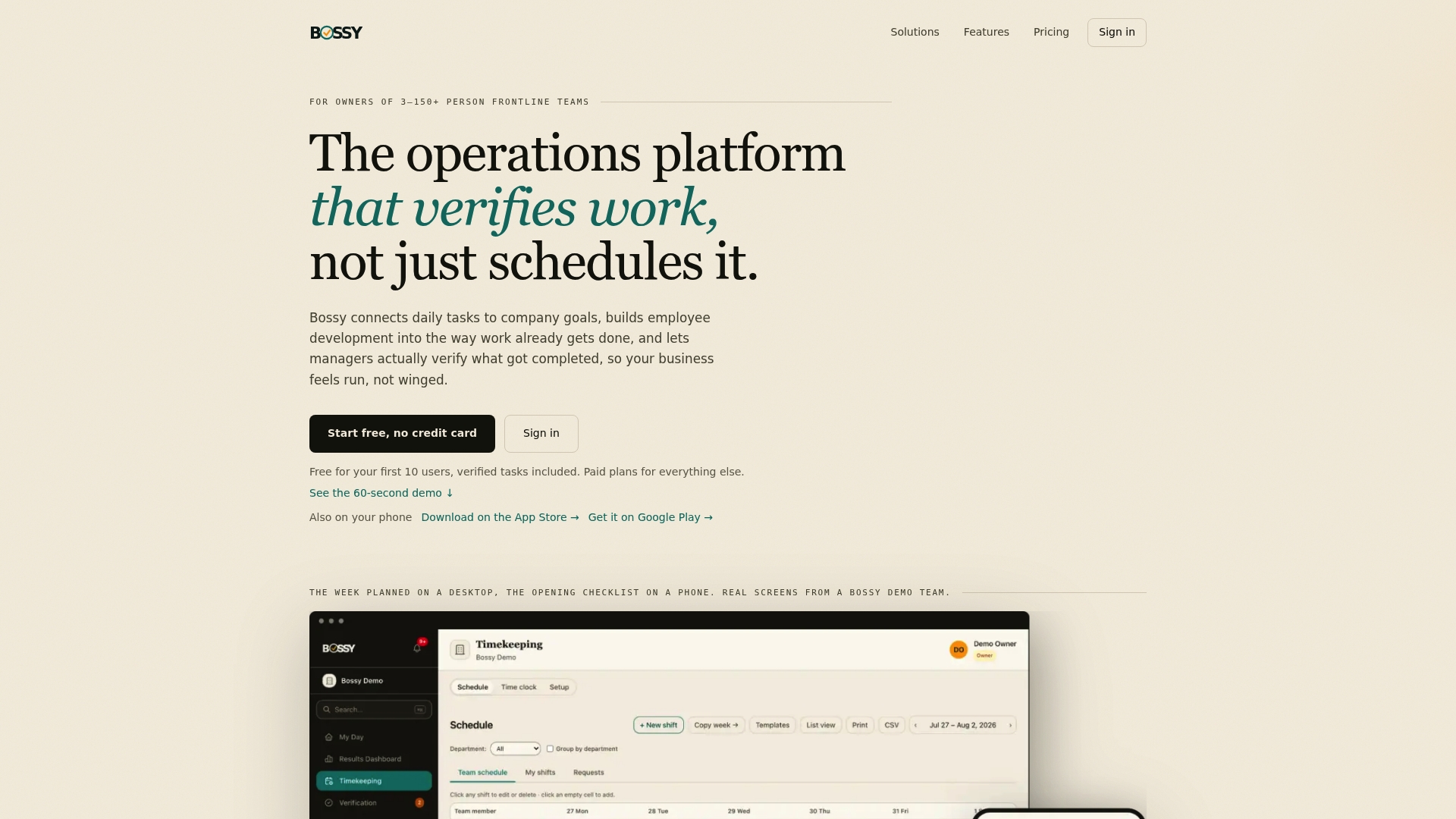
It's built for businesses with 3 to 150 frontline employees, which covers most restaurants, salons, retail chains, and warehouse teams where the owner isn't standing over every shift. Bossy offers a Free plan for task verification, with paid tiers and additional per-seat pricing, all listed on the pricing page. The 90-day playbook above uses scheduling, checklists, and time clocks, so run it on Operations or Scale + with one team and see your completion and goal numbers for yourself.
Author perspective and proof points
An integrated platform beats a stack of point tools the moment you have more than a handful of frontline employees, because reconciling five different apps eats the manager time you were trying to save. The research on stable scheduling and task choice backs up a simple idea: visibility and structure drive engagement more reliably than perks or surveys ever did. A set of standalone apps can still work for a very small team. But once you're coordinating shifts, tasks, and goals across multiple people, the gaps between tools become the problem.
— Christian
Sources
- Stable Scheduling Study report (worklife law)
- Stable scheduling increases sales and employee productivity (University of Chicago news)
- Give Me a Choice! A field experiment on task choice enabled by wearables (peer-reviewed article)
FAQ
What is the best employee engagement software for small businesses?
For frontline teams, the strongest fit is an operations platform that verifies completed tasks and ties them to company goals, rather than a survey or recognition tool. Bossy is built for this, combining task verification with scheduling, time clocks, and analytics on its paid plans, for teams of 3 to 150 employees.
How much does Bossy cost?
Bossy offers a Free plan, with paid tiers at $30 per month for Operations (15 users included), $25 per month for Growth (15 users included), and $50 per month for Scale + (35 users included), plus a $5 per month per seat add-on above included limits, all listed on the pricing page.
Does stable scheduling really improve engagement?
A pilot combining core scheduling, shift swapping, and stable shift structures increased sales and productivity in treatment stores compared to control locations. Predictable schedules give employees a sense of control that shows up in performance, not just satisfaction scores.
Should I let employees choose their own tasks?
Choice can speed up task completion once an employee picks something, but a field experiment found it can also narrow exposure to new skills over time. The practical fix is to mix in required development tasks so choice doesn't turn into avoidance.
What integrations should I look for in engagement software?
Check whether the platform connects to your existing payroll, point-of-sale, or HR systems so you're not duplicating data entry across tools. Ask vendors directly during a demo which systems they currently support and how that integration handles scheduling and time clock data.