Verify Work, Not Just Shifts: Best Restaurant Scheduling Software
Christian MontenegroSeptember 28, 202620 min read

Bossy is our pick for restaurants that need scheduling tied to daily operations, task verification, and time clocks in one place, not just a shift calendar sitting off to the side. It ties schedules to the work that actually needs to happen on each shift, so a manager can see who's on the floor and whether closing checklists got done. Restaurants running a single small location and wanting a free, no-frills calendar might be happier starting with a lighter scheduler instead.
TL;DR:
- Bossy is our pick for restaurants that want to connect scheduling directly with task completion, inventory, and time clocks on one platform.
- It offers a free tier and scalable paid plans, with features like photo proof, approval queues, and cascading goals that link staff work to location targets.
- For multi-location operations, TCP and HotSchedules provide advanced demand forecasting and enterprise-level compliance, but might be overkill for small businesses.
- Smaller restaurants can start with free plans from Homebase, Sling, or Connecteam, which support single locations and basic scheduling needs.
- When evaluating options, restaurants should prioritize features like POS and payroll integrations, scheduling automation, and support quality tailored to their size and operation complexity.
Table of Contents
- Top picks and how they compare at a glance
- How to choose: criteria and exact demo questions to ask
- Mini-reviews: what each scheduler actually does for restaurants
- How we compared these tools
- Pros and cons that matter most per product
- What onboarding actually looks like once you sign up
- What a schedule actually costs once the add-ons show up
- Support quality varies more than most buyers expect
- Security and compliance features worth checking
- What managers actually report once they're using these tools
- Why scheduling and operations belong in the same system
- Where Bossy fits if you're ready to move past a bare scheduler
- FAQ
Top picks and how they compare at a glance
Every restaurant scheduler on the market handles shifts. Few connect those shifts to whether the work behind them actually happened, and that gap is where most of the frustration in this category lies.
Bossy leads this list for restaurants that want scheduling paired with task verification, time clocks, and inventory basics under one login. 7shifts is the strongest choice if your priority is restaurant-specific payroll and tip handling. Homebase fits small, single-location restaurants that want a dependable free tier before spending anything. HotSchedules suits high-turnover, labor-intensive operations and multi-unit chains that need deep forecasting. Deputy is built for restaurants chasing AI-assisted scheduling and tighter labor-cost control. Sling works well for budget-conscious operators who want basic scheduling without a paid plan. TCP targets enterprise and franchise groups that need demand-driven forecasting at scale. When I Work appeals to smaller teams that want a clean, no-frills scheduling app. Connecteam offers a generous free plan for small teams that want scheduling bundled with basic operations tools. Planday suits growing restaurants that lean on visual schedule planning. ZoomShift fits small or seasonal restaurants that need a simple builder without a learning curve. Buddy Punch is the pick for operators who care most about strict time and attendance controls.
- Free tier badge: Homebase, Sling, and Connecteam each publish a usable free plan for small teams.
- Best for multi-location badge: TCP and HotSchedules carry the deepest multi-unit forecasting.
- Best for enterprise badge: TCP, built for franchise-scale compliance and demand forecasting.
- Best budget option badge: Sling, for its free scheduling tier.
| Software | Best for | Pricing shape / free tier | Auto-scheduling / forecasting | Time clock & attendance | Mobile app quality | Integrations (POS, payroll) | Multi-location support | Support / onboarding |
|---|---|---|---|---|---|---|---|---|
| Bossy | Restaurants wanting scheduling tied to task verification and accountability | Paid tiers from $25 per month (scheduling on Operations, $30), per-seat add-ons | Basic scheduling, no AI forecasting engine | Geofenced time clock included | Built for frontline mobile use | No POS or payroll integrations yet | Supports multi-location teams under one account | Onboarding guides and ticket-based support |
| 7shifts | Multi-shift restaurants focused on tip and payroll workflows | Tiered plans, including a limited free option | Shift-level scheduling, tip pooling tools | Time clock included | Strong restaurant-specific mobile app | Restaurant payroll integrations | Supports multiple locations | Dedicated onboarding for restaurant teams |
| Homebase | Small single-location restaurants wanting an affordable starter | Free tier for a single location with an employee cap, paid tiers above it | Basic auto-scheduling on paid tiers | Time clock included | Well-rated mobile app | POS and payroll integrations | Limited on the free tier | Self-serve plus paid support |
| HotSchedules | High-turnover, labor-intense hospitality operations | Paid, enterprise-oriented | Deep forecasting for busy operations | Time clock and attendance | Long-standing hospitality mobile app | Broad hospitality POS/payroll ties | Strong multi-location and chain support | Hospitality-focused onboarding |
| Deputy | Restaurants wanting AI-assisted scheduling and labor-cost control | Paid, per-user pricing | AI-assisted auto-scheduling | Time-tracking included | Solid, widely used mobile app | Broad third-party integrations | Multi-location capable | Standard support tiers |
| Sling | Budget-conscious restaurants needing basic multi-location scheduling | Free tier for basic scheduling | Manual scheduling, limited forecasting | Time clock on paid tiers | Functional mobile app | Limited native integrations | Multi-location support | Community and paid support |
| TCP | Multi-location and franchise operations needing advanced forecasting | Enterprise, quote-based | Demand-driven forecasting engine | Compliance-grade time and attendance | Enterprise mobile app | Deep enterprise payroll integrations | Built for large multi-unit groups | Enterprise onboarding and account management |
| When I Work | Small to medium restaurants wanting simple scheduling | Paid, per-user pricing | Manual scheduling focus | Time clock included | Clean, simple mobile interface | Moderate integration list | Multi-location on higher tiers | Standard support |
| Connecteam | Small teams wanting scheduling bundled with basic ops tools | Free plan for small teams, paid tiers above | Manual scheduling, limited forecasting | Time clock included | Broad feature set on mobile | Moderate integrations | Multi-location on paid tiers | Onboarding resources and support |
| Planday | Growing restaurants needing visual schedule planning | Paid, affordable tiers | Visual scheduling, limited AI forecasting | Time clock included | Visual, easy-to-read mobile app | Moderate POS/payroll ties | Solid multi-location support | Praised after-sales support |
| ZoomShift | Small or seasonal restaurants needing a simple builder | Paid, low-cost tiers | Manual scheduling | Time clock included | Intuitive mobile experience | Limited integrations | Limited multi-location depth | Standard support |
| Buddy Punch | Restaurants needing strict time and attendance controls | Paid, per-user pricing | Manual scheduling, attendance-focused | Strong time-tracking and controls | Functional mobile app | Payroll integrations | Multi-location on higher tiers | Standard support |
This list draws on a 2026 roundup of restaurant scheduling tools that weighed staffing features, ease of use, and pricing across more than ten products.
How to choose: criteria and exact demo questions to ask
Picking a scheduler on brochure features alone is how restaurants end up paying for tools nobody uses. Before you sit through another sales call, know which axes actually matter for your operation.
- Team size and seat pricing. Some tools price per seat, others per location. Know your headcount before you compare quotes.
- Multi-location needs. If you run more than one site, confirm the plan actually supports shared schedules and central reporting, not a separate login per store.
- Payroll and tip integration. Ask whether tips, overtime, and payroll exports flow automatically or need manual reconciliation.
- Forecasting and auto-scheduling. Tools that build schedules from historical sales data can save hours a week, but only if the forecasting engine understands your sales patterns.
- Shift swaps and call-outs. Ask exactly how a swap request routes, who approves it, and what happens if nobody picks up the shift. Bossy's own guide to scheduling that survives a call-out walks through this workflow in more detail.
- POS and payroll integrations. Get the exact list of supported systems in writing, not a vague "we integrate with most platforms."
- Offline mode. Restaurant Wi-Fi drops. Ask what the app does when a manager's phone loses signal mid-shift.
- Security and data export. Confirm you can export your own schedule and staff data if you ever switch tools.
When you get on a demo, ask these directly:
- "What's included at this price, and what triggers an upgrade?"
- "Can I try this with my own staff for two weeks before paying?"
- "What's the full list of POS and payroll systems you integrate with today?"
- "Can I export my schedule and time-clock data in a standard format?"
- "How exactly does auto-scheduling use my past sales data to build a roster?"
- "What's your support response time, and is it different on weekends?"
Watch for contracts that lock you into annual billing with no trial period, vague language around "integration partners" rather than named systems, and fees for data export that only appear after you sign.
Pro Tip: Feed a vendor's auto-scheduler a week of your actual historical sales data during the demo and compare the roster it produces against what you scheduled by hand. The gap tells you more than any feature sheet.
Mini-reviews: what each scheduler actually does for restaurants
Bossy builds scheduling around a simple idea: a shift only matters if the work on it gets done. Managers assign shifts alongside recurring checklists, and staff confirm completion with photo proof that routes to an approval queue. That closes the gap between "someone was scheduled" and "the walk-in got cleaned." Its hospitality-specific page covers how this plays out for restaurant operations, including geofenced time clocks and cascading goals that connect each location's and department's targets to the business's numbers. Scheduling and time clocks come with Operations at $30 per month; Growth at $25 per month focuses on team development, and Scale + at $50 per month includes both, plus a $5 per month per-seat add-on above included limits, all detailed on the pricing page.
- Best for: Restaurants that want scheduling and accountability in the same system rather than two disconnected tools.
- Standout: Task verification and shift-linked checklists alongside the schedule.
- Limitation: Schedules are built by hand or from templates, with no auto-scheduling or AI demand forecasting, so operators who want the software to build the roster should compare that feature elsewhere.
- Verdict: The strongest fit for restaurants where the real problem isn't building the schedule, it's knowing what happened once the doors opened.
7shifts was built specifically for restaurants and it shows in the details: tip pooling, labor-cost tracking against sales, and payroll exports that understand restaurant pay structures. It fits multi-shift operations that live and die by tip compliance and payroll accuracy. The tradeoff is that its operational features center on scheduling, labor, and communication rather than photo-verified task completion or inventory.
Homebase earns its reputation with a genuinely usable free tier for single-location restaurants, covering scheduling, time clocks, and basic team messaging at no cost. It's an easy on-ramp for a small diner or café that isn't ready to pay for software yet. Multi-location support and advanced features sit behind paid tiers, and it doesn't offer the task-verification layer some operations need once they grow past one site.
HotSchedules has been a hospitality staple for years, with scheduling and forecasting depth built for high-turnover, high-volume operations. Chains and busy multi-unit groups get real value from its demand forecasting and long track record in the industry. It's priced and built for scale, which makes it a heavier lift for a small independent restaurant that just needs a clean weekly schedule.
Deputy brings AI-assisted scheduling into the mix, using sales and labor data to suggest rosters and flag overtime risk before it happens. Restaurants focused on tightening labor costs get real utility from this. It's a strong scheduling and time-tracking tool first, with less emphasis on the day-to-day task management that connects a shift to actual completed work.
Sling stands out for one reason: a free scheduling tier that covers the basics, which is rare in this category. Budget-conscious operators running a few small locations can get real scheduling coverage without a subscription. The forecasting and integration depth are lighter than paid competitors, so it fits operations that value cost control over automation.
TCP is built for the enterprise end of the market: franchise groups and multi-location chains that need demand-driven forecasting and compliance safeguards across dozens of sites. Its strength is scale and labor-law compliance handling, but that same depth makes it overkill and often over budget for a single restaurant or small local group.
When I Work keeps things deliberately simple: a clean scheduling calendar, shift swaps, and team messaging without a lot of extra modules. Small to medium restaurants that just want scheduling handled well, without a learning curve, tend to like it. It's not the tool to reach for if you want forecasting, task verification, or inventory built in.
Connecteam offers one of the more generous free plans for small teams, bundling scheduling with basic operations features like checklists and communication. It suits a small restaurant team that wants more than a bare scheduler but isn't ready to pay for a full operations platform. Bossy's own comparison against Connecteam breaks down where the feature sets diverge for growing teams.
Planday leans on a visual, calendar-style interface that makes shift planning easy to read at a glance, and its after-sales support is consistently well regarded. Growing restaurants that want an intuitive planning view without a steep price jump fit well here. Its auto-scheduling and forecasting tools are lighter than category leaders built specifically around demand data.
ZoomShift keeps the build simple: a fast, intuitive schedule builder that suits small or seasonal restaurants without a lot of complexity to manage. It's a good fit for a seasonal spot that staffs up and down through the year. Multi-location depth and integrations are limited compared to larger platforms.
Buddy Punch puts its weight behind time and attendance controls, with strong safeguards against buddy punching and detailed attendance reporting. Restaurants that have struggled with time theft or inconsistent clock-ins get real value here. Scheduling itself is functional rather than a standout, so it fits best as an attendance-first tool.
How we compared these tools
This roundup weighed each tool against the same criteria: staffing and scheduling depth, integration breadth, pricing transparency, ease of use, and support quality, the same framework a 2026 buyer's guide to restaurant scheduling software used when evaluating more than ten tools in this category.
- Staffing features: shift building, swaps, forecasting, and time clocks, weighted heaviest.
- Integrations: POS and payroll connections that reduce manual reconciliation.
- Pricing: whether the free tier or entry plan is usable for a real restaurant, not just a demo.
- Ease of use: how quickly a manager and staff can adopt the tool without extensive training.
- Support: response times and onboarding quality reported by users.
Free or low-cost entry tiers show up across most of this category, and that transparency shapes which tools make a shortlist worth trialing, according to the same 2026 roundup. Findings come from vendor product pages, published pricing, and aggregated user feedback, last checked in September 2026.
Pros and cons that matter most per product
Bossy's advantage is depth: task verification and time clocks alongside scheduling, at the cost of a lighter forecasting engine than dedicated AI schedulers. 7shifts wins on restaurant-specific payroll and tips but stops short of operational task tracking. Homebase's free tier is genuinely useful for one location, but multi-site operators outgrow it fast. HotSchedules and TCP both bring serious forecasting depth, built and priced for chains rather than independents. Deputy's AI scheduling suggestions save time but ask you to trust an algorithm with your labor budget. Sling's free tier is hard to beat on cost, though integrations and forecasting stay basic. When I Work, ZoomShift, and Planday all trade advanced features for simplicity, which is exactly what smaller teams often want. Connecteam and Buddy Punch each specialize, one in bundled small-team operations, the other in attendance accuracy, so the right pick depends on which gap you're actually trying to close.
What onboarding actually looks like once you sign up
Most restaurant schedulers follow a similar rollout: import your team and locations, set pay rates and roles, build your first schedule template, and connect your POS or payroll system. Simpler tools like ZoomShift or When I Work can have a small team scheduling within a day. Platforms with deeper integrations, like TCP or HotSchedules, typically need one to two weeks to fully connect payroll and multi-location reporting. Bossy's onboarding sets up your locations, departments, team, and starter task templates, so managers see task verification working within the same week they start scheduling. Whatever tool you pick, run one full location through a real week before rolling it out chain-wide. That single trial week catches integration gaps and staff confusion before they multiply across every site.

What a schedule actually costs once the add-ons show up
The sticker price rarely tells the whole story. Per-seat add-ons above your included headcount, extra fees for payroll integrations, and higher-tier unlocks for forecasting or multi-location reporting all stack onto the base plan. Bossy's per-seat add-on runs $5 per month per seat above included limits, and additional seats on its free plan cost $10 per month per 10 seats, both listed on its pricing page. Enterprise-oriented tools like TCP typically quote custom pricing that bundles compliance and forecasting features you may not need at a single-location scale. Before signing anything, ask for the total monthly cost at your actual headcount, not the advertised starting price, and confirm which features sit behind a paid upgrade.
Support quality varies more than most buyers expect
A scheduling outage on a Friday night doesn't wait for business hours. HotSchedules and TCP, both built for hospitality at scale, offer dedicated account management suited to chains with complex needs. Planday is consistently noted for responsive after-sales support even on its more affordable tiers. Smaller or newer platforms often lean on self-serve help centers with paid tiers for faster response. Bossy pairs onboarding guides with in-app support tickets. Whichever tool you choose, ask directly what weekend and after-hours support looks like before you need it, not after.
Security and compliance features worth checking
Restaurants handle staff personal data, payroll details, and increasingly, biometric or geofenced time-clock data, all of which raise real compliance questions. Look for role-based access so a shift lead can't see payroll data meant for owners only, audit logs that show who changed a schedule and when, and clear data export options so you're never locked into one vendor. Geofenced time clocks, which Bossy includes, help confirm staff clocked in from the actual location rather than a phone left in a back office. Compliance-grade platforms like TCP build in labor-law safeguards for multi-state or multi-country chains. Whatever you choose, confirm data export and deletion policies in writing before you commit staff records to any system.
What managers actually report once they're using these tools
Across the tools in this category, the recurring theme in manager feedback isn't a missing feature, it's whether the software matches how a real shift actually runs. Bundled tools like Connecteam or Bossy aim to cut dropped tasks by keeping the checklist and the schedule live in the same place instead of two apps a manager has to check separately. Operators on dedicated schedulers like 7shifts or Deputy report smoother payroll cycles and fewer tip-pooling disputes, which tracks with those tools' restaurant-specific payroll depth. Smaller teams on Sling or ZoomShift consistently mention ease of setup as the reason they stuck with the free or low-cost tier rather than upgrading. The pattern across a 2026 roundup evaluating these tools holds: fit for your operation's size and complexity matters more than any single flagship feature.
Why scheduling and operations belong in the same system
The conventional wisdom in this category treats scheduling as a standalone problem: build the roster, fill the gaps, done. That framing misses what actually breaks a restaurant's week. A schedule tells you who's supposed to show up. It says nothing about whether the walk-in cooler got checked or the prep list got finished, and that gap is where most operational failures actually live.

Here's a simple case: a line cook calls out an hour before their shift. A scheduling-only tool flags the open shift and stops there. An operations-linked system shows the manager not just the gap, but which of that cook's assigned prep tasks are now unverified, so the replacement knows exactly what still needs doing instead of guessing. That's the difference between reacting to a call-out and absorbing it without the kitchen falling behind.
Restaurants that connect daily tasks to schedules tend to catch small failures before they become customer complaints. A missed opening checklist becomes visible in minutes, not at the end of a bad shift. That visibility is what actually drives retention and accountability, not the schedule itself.
— Christian
Where Bossy fits if you're ready to move past a bare scheduler
If you've read this far, you already know the tradeoff: a scheduler alone tells you who's supposed to be there, and Bossy tells you what actually got done while they were. That's the gap it's built to close for restaurants, pairing scheduling with task verification, geofenced time clocks, and basic inventory tracking in one system your managers already check every shift.
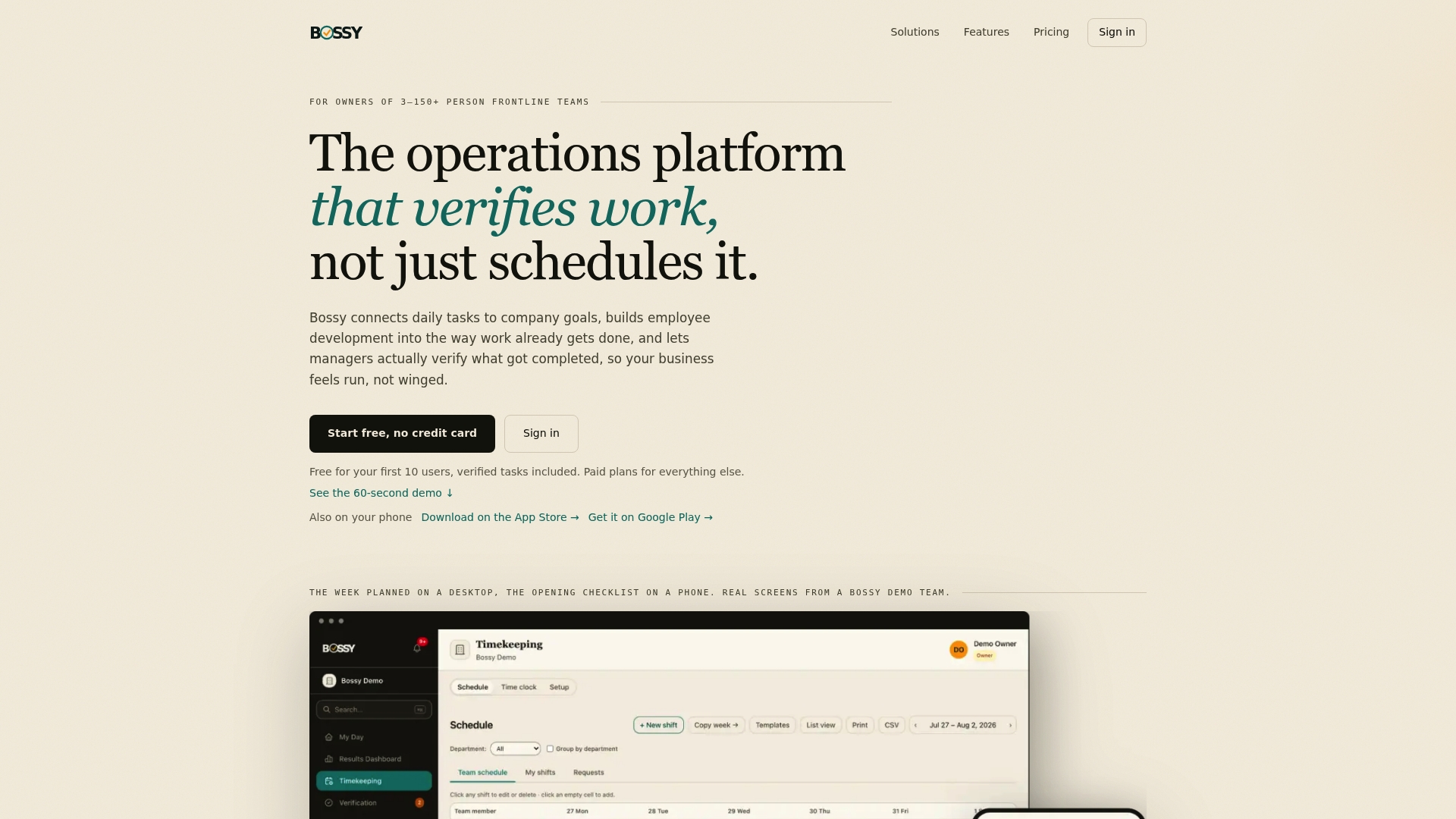
- Schedules connect directly to recurring checklists, so a shift and its actual duties live in one view.
- Photo proof and an approval queue mean a manager can confirm work happened without walking the floor for every item.
- Cascading goals link each location's targets to the schedule, so staff see how their shift connects to the bigger numbers.
Bossy's scheduling, time clock, and checklists start on the Operations plan at $30 per month, with every option detailed on the pricing page. The restaurant landing page walks through how the setup applies to a single kitchen or a small group of locations.
A reasonable first step: run a 30-day pilot on one location before rolling anything out chain-wide. Check the features page for the full scheduling and task-verification breakdown, or head to pricing to pick a plan and get started.
FAQ
What are the top restaurant management software options?
The strongest options for restaurant scheduling and operations include Bossy, 7shifts, Homebase, HotSchedules, Deputy, Sling, TCP, When I Work, Connecteam, Planday, ZoomShift, and Buddy Punch. Each fits a different priority, from Bossy's task verification and scheduling combination to 7shifts' restaurant-specific payroll tools, so the right choice depends on team size and which features matter most.
What app does Chick-fil-A use for scheduling?
This isn't publicly listed in vendor documentation reviewed for this comparison, and restaurant chains often use custom or enterprise-negotiated scheduling systems that aren't publicly disclosed. For most independent restaurants, tools like Bossy, 7shifts, or HotSchedules cover the same core scheduling needs without requiring an enterprise contract.
How much does 7shifts cost per month?
7shifts prices through tiered plans, including a limited free option, rather than a single flat rate, and its exact current pricing is available on its own site rather than in this roundup's sourced data. Restaurants comparing costs should request a current quote directly, since restaurant scheduling pricing shapes change by seat count and feature tier.
What is the most popular scheduling software for restaurants?
Popularity varies by restaurant size and need: HotSchedules and 7shifts have long track records in high-volume hospitality, while Homebase and Sling are widely used by small, single-location restaurants for their free tiers. Bossy is built for restaurants that want scheduling paired with task verification and accountability rather than a standalone calendar.
Do restaurant scheduling tools handle multi-location scheduling?
Several tools, including Bossy, TCP, HotSchedules, and Sling, support multi-location scheduling under one account, though the depth of forecasting and reporting varies by platform. TCP and HotSchedules lean toward enterprise and franchise-scale needs, while Bossy and Sling fit growing multi-site operators that don't yet need enterprise-level forecasting.