For Retail Managers: Retail Scheduling Software That Verifies Work
Christian MontenegroSeptember 30, 202615 min read

Bossy is our pick for retail scheduling software for most small-to-midsize retail managers because it combines centralized multi-site scheduling with task verification and geofenced time clocks. Instead of juggling a scheduling app, a separate time clock, and a group chat for tasks, you get one dashboard that shows who is working, what they finished, and where they clocked in. It fits stores with a handful of locations best, and if you run a single shop with three employees, a simpler tool might do the job just fine.
TL;DR:
- Multi-location support with bulk editing capabilities is crucial for managers overseeing several stores to efficiently update schedules and roles across all sites.
- Demand-based scheduling combined with active manager overrides can reduce labor costs and understaffing incidents by 11.3% and 47% respectively, enhancing store performance.
- Geofenced time clocks provide accurate attendance verification, while task verification with photo proof ensures work completion rather than just logged hours.
- Implementing a phased rollout with pilot testing, staff communication, and KPI tracking helps prevent disruption and measure success during software adoption.
- Pricing typically includes onboarding, hardware, and integrations, with ROI achievable through significant time savings and improved coverage, especially when using templates and forecast adjustments.
Table of Contents
- Why this recommendation: quick summary of Bossy's fit for retail teams
- How to evaluate retail scheduling software
- Feature priorities for retail: what matters most in practice
- How pricing usually works and quick ROI checks for retailers
- Step-by-step rollout checklist for retail managers
- Why trust this recommendation: evidence, research, and publisher proof points
- When to pick a combined ops platform vs. a pure scheduler
- How Bossy helps: a concise product pitch and next steps
- Sources
- FAQ
Why this recommendation: quick summary of Bossy's fit for retail teams
Retail managers do not just need a schedule. You need to know the schedule actually happened the way you planned it, and that the tasks tied to each shift got done. Bossy was built around that gap. It links your staff schedule to daily task lists, so a shift is not just a block of time on a calendar. It is a set of responsibilities you can check off, with photo proof when you need it.
For managers running two, five, or twenty locations, multi-location support is the feature that saves the most time. You manage every store's schedule from one account instead of logging into five separate tools.
Here is what stands out for retail specifically:
- Centralized scheduling across multiple locations, built from templates so you are not rebuilding shifts from scratch every week.
- Geofenced time clocks that confirm employees are actually at the store when they clock in.
- Task verification with photo proof, so a completed shift means completed work, not just logged hours.
- Manager approval queues that flag issues before they become bigger problems.
Bossy also offers a free plan that covers task verification, which gives new managers room to test that workflow; scheduling and geofenced time clocks start on the Operations plan. The Human-Computer Interactions in Demand Forecasting and Labor Scheduling Decisions research backs up why that kind of manager control matters, a point worth coming back to below.
How to evaluate retail scheduling software
Picking scheduling software by feature list alone is how managers end up with a tool that looks great in a demo and falls apart during a Saturday rush. Judge any platform, including Bossy, against these core axes:
- Multi-location support: can one manager view and edit schedules across stores without logging into separate accounts?
- Forecasting: does it suggest staffing levels based on sales history, foot traffic, or seasonality?
- Time and attendance: does it verify location, not just a clock-in tap that anyone could do from home?
- HR and payroll integrations: does it export hours cleanly to your existing payroll system, or does someone retype numbers every week?
- Compliance and audit trail: does it log schedule changes with timestamps and reasons, in case you need records for labor disputes?
Beyond those five, look at the operational layer that turns a schedule into a working store:
- Roles and skills mapping, so shifts get filled by people qualified to run the register, stock shelves, or handle returns.
- Reusable templates, so a typical week takes minutes to build instead of hours.
- Schedule-change history, showing who swapped a shift, who approved it, and when.
- Usability for non-technical staff, since your part-time team will not read a manual before their first shift.
- Support responsiveness, tested by actually messaging support during your trial, not just reading their promised response time.
Before signing anything, run a real demo and ask pointed questions. Bring a real week of your own scheduling headaches into the room instead of letting the vendor walk you through their prepared script.
- Can I bulk-edit shifts across all my locations at once, or do I need to repeat the same change store by store?
- What happens when an employee no-shows: does the system flag the gap and suggest who is available to cover it?
- Can I export a plan-versus-actual report showing scheduled hours against clocked hours?
- Is the time clock geofenced, and can I set the radius per location?
- What does onboarding look like for a team that has never used scheduling software before?
Pro Tip: Ask the vendor to show you their mobile app on a phone that is not their demo phone. Half of your staff will manage their schedule from a personal device with spotty signal in a stockroom.
Microsoft documents this kind of publish, claim, and approve flow as a baseline expectation in its staff scheduling and shift management tools, which is a useful benchmark. If a retail-specific platform cannot match that baseline plus the retail-specific pieces above, keep looking.
Feature priorities for retail: what matters most in practice
Not every feature matters equally once you are running a real store. Here is what to weigh heaviest, and why.
Multi-location scheduling and bulk edits top the list for any manager overseeing more than one site. If your holiday hours change across all stores, you should be able to apply that change once, not location by location. Bulk editing also matters for role-based templates: if every store needs one opener, one closer, and two mid-shift staff, that pattern should copy across locations without rebuilding it each week.
Demand-driven scheduling paired with manager overrides is where the real value shows up, and it is backed by more than intuition. Research from Harvard Business School found that AI-generated schedules align with realized demand only 54.3% of the time on average, and that manager overrides of those forecasts significantly improve store labor productivity: a one standard deviation increase in overrides was tied to a notable increase in labor productivity. That is the opposite of what a lot of managers assume. You are not fighting the algorithm when you override a suggested schedule. You are supplying information the software does not have, like knowing that a regular customer's kid has a birthday party this weekend and the store will be dead.
Separate research applying machine-learning forecasting alongside constrained optimization across a multi-store retail deployment reported an 11.3% reduction in labor costs, a 47% drop in understaffing incidents, and an 8.2% improvement in service levels. The pattern across both studies points the same direction: software forecasts are a strong starting point, not a final answer, and the combination of forecasting plus human judgment beats either one alone.

Time tracking options come with real tradeoffs. A basic geofence confirms an employee's phone is near the store, which is fast to set up and good enough for most retail settings. Identity verification, like requiring a photo at clock-in, adds a layer of certainty but slows down the process and can feel invasive to staff. For most retail teams, geofencing hits the right balance between accuracy and friction.
Shift management features decide how much of your week goes to firefighting versus planning. Look for:
- Open shift posting, where unfilled shifts appear to qualified staff automatically.
- Shift trading with approval, so employees can swap shifts without you playing middleman for every request.
- Role matching, ensuring a swap does not leave a shift covered by someone untrained for that role.
Operational attachments are the piece most scheduling tools skip entirely, and it is the piece Bossy built its whole approach around. A shift is not just "Maria works 9 to 5." It is "Maria works 9 to 5 and needs to complete the morning stock count, restock the front display, and check the walk-in cooler temperature." When tasks are attached to shifts and verified with photo proof, you stop wondering whether the work got done. You know.
How pricing usually works and quick ROI checks for retailers
Retail scheduling software is typically priced one of three ways: per employee per month, per location per month, or in tiers based on feature access, with advanced forecasting and reporting reserved for higher tiers. Some platforms combine two of these, charging a base fee per location plus a smaller per-seat add-on once you cross a set headcount.
Before you commit, budget for costs that do not show up on the pricing page:
- Onboarding time, especially if you are migrating years of employee data and historical schedules from spreadsheets.
- Integration work, if your payroll or point-of-sale system needs a custom connection rather than a built-in one.
- Hardware, if your stores do not already have a tablet or dedicated device for time clock check-ins.
Here is a simple, conservative way to estimate ROI before you buy. Say a manager currently spends 5 hours a week building and adjusting schedules by hand across two stores, at a fully loaded manager wage of $25 an hour. That is $125 a week, or roughly $6,500 a year, just in scheduling time. Cut that time in half with templates and bulk editing, and you have recovered about $3,250 a year, before counting reduced overtime from better coverage planning. The EXA.ai deployment reporting a 47% drop in understaffing suggests the coverage gains alone can be meaningful once forecasting and manager input work together.
When you talk pricing with any vendor, ask directly: does the quote include time clock hardware, is there a setup fee, and what happens to your price if you add a sixth location mid-contract? Some vendors will extend a trial period if you ask, especially if you are evaluating more than one location.

Step-by-step rollout checklist for retail managers
Switching scheduling software mid-season is stressful, but a clean rollout plan makes it manageable.
- Collect your current data first: employee roles, certifications, availability windows, and at least three months of past schedules to build your templates from.
- Pick one store as a pilot before rolling out chainwide. Run it alongside your old system for two weeks so you can compare plan versus actual coverage.
- Train managers before staff. Managers need to understand overrides, approval queues, and reporting before they can explain any of it to the team.
- Communicate the change to employees early, with a short walkthrough of the mobile app and where to find their shifts, swap requests, and clock-in button.
- Set clear rules for manager overrides during the pilot: when a manager overrides a suggested schedule, require a short reason code. This builds a record that helps the forecasting improve and gives you data if a scheduling dispute comes up later.
- Build a plan for call-outs before you need it, including who gets notified first and how open shifts get filled. Bossy's own guidance on handling call-outs covers this in more detail.
Track a small set of KPIs from week one so you know if the switch is working: coverage rate (shifts filled versus shifts needed), overtime hours, schedule stability (how often published schedules change after publishing), and time-to-fill for open shifts. If overtime is not dropping within the first month, your templates probably need adjusting, not the software itself.
Pro Tip: Keep your old scheduling method running in parallel for the first pilot week. If the new system misses something, you catch it before it affects a real paycheck.
Why trust this recommendation: evidence, research, and publisher proof points
The case for keeping managers in control of the schedule, and for verifying the work, is not just a Bossy talking point; it shows up across independent research.
The Harvard Business School paper on demand forecasting and labor scheduling decisions found that managers hold private information forecasting models cannot see, and that giving them override power measurably improves productivity. That is the strongest argument against any tool that tries to fully automate scheduling with no manager input.
AI-generated schedules aligned with realized demand only 54.3% of the time on average, while manager overrides significantly and positively affected store labor productivity.
That finding, paired with the Exa case showing an 11.3% labor cost reduction and 8.2% service-level improvement from combining forecasting with optimization, supports a hybrid model rather than a fully automated one. It is a good reason to favor phased rollouts where managers keep override control for the first few months.
On the product side, Bossy's own approach reflects that same philosophy of pairing structure with human oversight:
- Task verification with photo proof and manager approval queues, described on the features page.
- Cascading goals that connect daily tasks to broader store or company objectives.
When to pick a combined ops platform vs. a pure scheduler
A pure scheduling app will get shifts on a calendar. It will not tell you whether the closing checklist got done, whether the cooler was checked, or whether the new hire actually showed up trained on the register. That gap is where a lot of retail managers get burned. They trust the schedule, then find out three weeks later that "covered" did not mean "handled."
My honest read after digging into this space: integration beats specialization for most small retail operations, not because point solutions are bad, but because the handoffs between separate tools are where things get dropped. A scheduling app that does not talk to your task list means someone has to manually check both, and that someone is usually you, at 9pm, after closing.
Where a pure scheduler still wins is scale and complexity, like a national chain with a dedicated workforce management team and existing payroll infrastructure that already works. For most retail managers running a handful of locations without a whole department behind them, one system that handles scheduling and verification together reduces the number of places something can slip through.
— Christian
How Bossy helps: a concise product pitch and next steps
Everything covered above, multi-location scheduling, geofenced time clocks, task verification, and managers in control of the schedule, is what Bossy was built around for teams that do not have a dedicated workforce management department. You get one system instead of three, which means fewer logins, fewer spreadsheets, and fewer gaps between "the schedule says covered" and "the work actually got done."
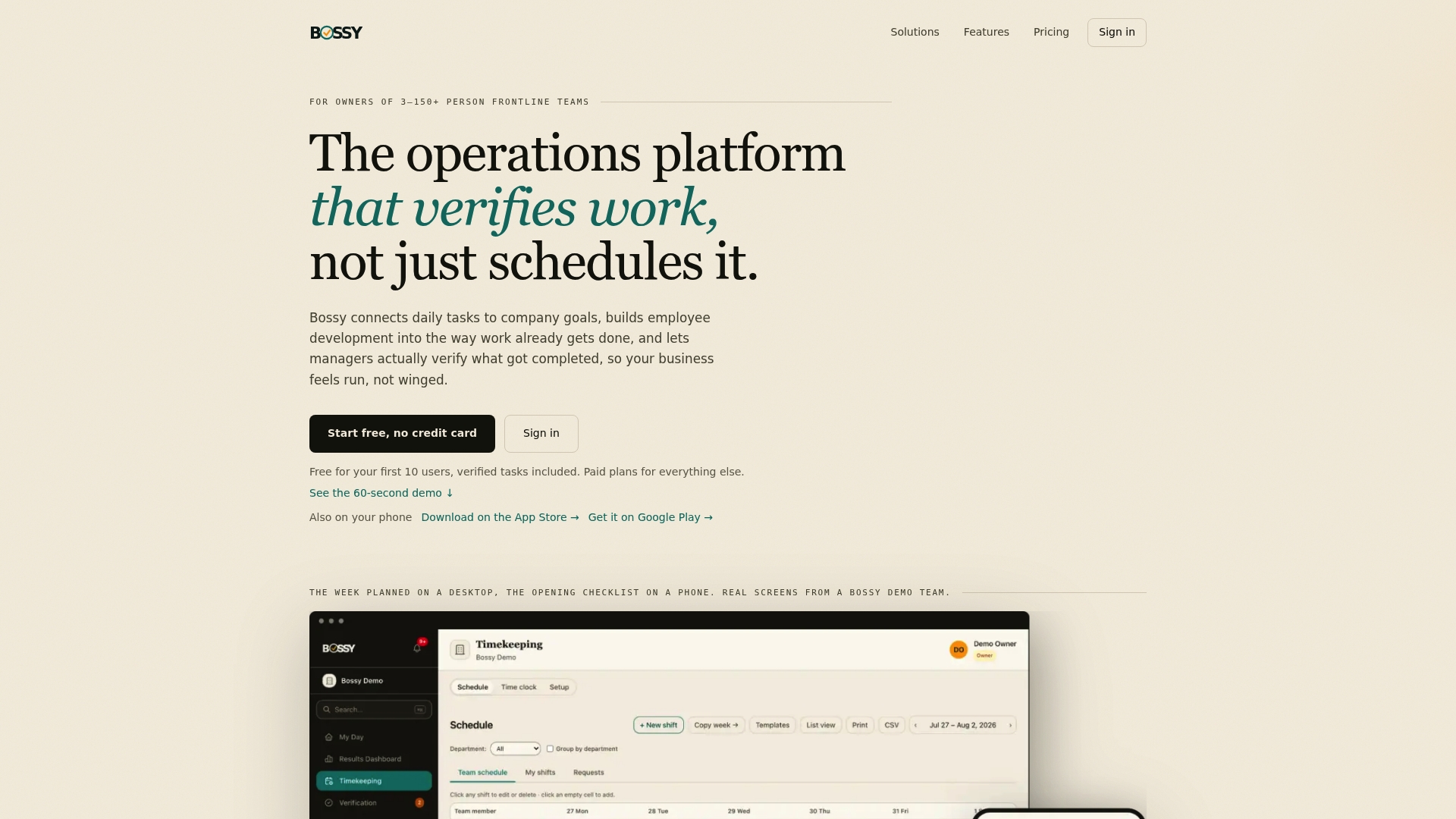
If you are ready to see whether it fits your stores, here are three ways to start:
- Start on the free plan to test task verification with your current team before paying anything.
- Check the pricing page for the Operations or Scale + plans, which include scheduling and geofenced time clocks.
- Visit the retail product page to see how the platform maps to multi-location retail workflows specifically.
Full plan details and current pricing live on the Bossy pricing page.
Sources
- Human-Computer Interactions in Demand Forecasting and Labor Scheduling Decisions (HBS)
- Exa
- Microsoft Teams staff scheduling and shift management
FAQ
What is the best scheduling software for retail?
The right choice depends on how many locations you run and whether you need task verification alongside scheduling. For most small-to-midsize retail teams managing multiple locations, Bossy fits well because it pairs scheduling with geofenced time clocks and task verification in one system.
What is the most popular scheduling software?
Popularity varies widely by industry and region, since restaurants, retail, healthcare, and warehouse operations often gravitate toward different tools built for their specific compliance and staffing needs. Microsoft Teams includes built-in staff scheduling and shift management that many businesses already using Teams adopt as a baseline option.
What software does Walmart use for scheduling?
Large national retailers typically build or license custom, proprietary workforce management systems tailored to their scale, rather than using off-the-shelf software. That kind of system is not publicly listed in detail, and it is generally not a realistic comparison point for small or midsize retail operations choosing between commercial scheduling platforms.
What is the most commonly used scheduling system?
There is no single system used universally across retail. Most retailers choose based on their size and needs, with smaller multi-location operations tending toward integrated platforms that combine scheduling with time tracking and task management, while larger chains often build custom systems or use enterprise workforce management suites.
How much does retail scheduling software typically cost?
Pricing usually falls into per-employee, per-location, or feature-tiered models, and costs can add up with onboarding, integrations, and hardware needs. Bossy, for example, offers a free plan for task verification, and scheduling with geofenced time clocks starts on the Operations plan at $30 per month (15 users included, then $5 per seat), with full details on the pricing page.