Verify Work First: Workforce Analytics Software for 3–150 Frontline Teams
Christian MontenegroOctober 4, 20269 min read

For a business with frontline teams, the best workforce analytics software is one that links task verification, scheduling, inventory, and goal tracking into a single system, which is exactly what we built Bossy to do. The reason this matters more than fancy dashboards is simple: you cannot analyze work that was never confirmed as done. If you want to see how this looks in practice, Bossy's main platform is a good place to start.
TL;DR:
- Proof-of-completion with photo or manager approval is essential, as checkbox data alone cannot verify task execution during audits.
- Implementing geofenced time clocks linked to scheduling helps identify off-site punches and reduce buddy punching, directly impacting labor cost accuracy.
- Inventory workflows must be integrated with analytics dashboards to accurately track counts, transfers, and reordering, preventing data silos.
- A pilot should focus on one or two locations over two to eight weeks, with measurable KPIs such as completion accuracy and late or missed clock-ins.
- Bossy's Free plan covers task verification; scheduling, time clocks, photo proof, and inventory start on Operations at $30 per month (Scale + is $50), with per-seat charges above included users, making quick implementation within weeks realistic for small teams.
Table of Contents
- What Should You Look for in Frontline Workforce Analytics?
- Build a Feature Checklist Before You Demo Anything
- What Rollout and Pricing Usually Look Like
- How Bossy Maps to the Frontline Analytics Checklist
- A 30 to 60-Day Pilot Checklist
- Why Execution Gaps Quietly Cost Small Operators More Than They Realize
- Start a Pilot With Bossy
- FAQ
- Sources
What Should You Look for in Frontline Workforce Analytics?
Most workforce software promises visibility. Fewer of them deliver proof. When you sit through a demo, the question to keep asking is: does this tell me a task was scheduled, or does it tell me a task actually happened?
Here's what we'd put at the top of your checklist:
- Proof-of-completion, not just a checkbox. A task marked "done" with no photo or manager sign-off tells you nothing during an audit.
- Mobile-first design. Hourly workers switch between tasks fast, and software that buries features three menus deep gets ignored.
- Scheduling tied to geofenced time clocks. This is where labor cost and actual execution meet, and it's the detail that catches buddy punching and late opens.
- Inventory workflows that feed the analytics, not a separate spreadsheet. Counts, transfers, and reorder triggers should show up in the same dashboard as your task data.
- Integration readiness with your POS, sensors, or payroll system. Ask vendors directly what breaks during setup, because something usually does.
- Analytics that answer the questions you actually ask, like which locations missed a closing checklist or which employee needs coaching this week.
- A realistic pilot scope and training plan, not a six-month rollout for a 12-person team.
- Clear pricing, including free-tier seat limits and what triggers an upgrade.
Analysts tracking this space point to the same priorities. The Nucleus Research task management value matrix found that buyers are increasingly weighing proof-of-completion, audit workflows, and role-based targeting over basic task lists. That's a shift worth paying attention to before you sign anything.
Pro Tip: Ask every vendor to show you what happens when a task fails an audit. If the answer is "nothing automatic," keep looking.

Build a Feature Checklist Before You Demo Anything
A demo moves fast, and it's easy to walk away impressed by a slick interface without testing the parts that matter six months in. Bring this list with you.
- Photo or video proof-of-completion with a manager approval queue, not a self-reported checkbox.
- Recurring checklists that trigger automatic corrective tasks when something fails an audit.
- Shift schedules with swap mechanics and geofenced clock-ins that flag off-site punches.
- Simple inventory counts with support for stock transfers between locations.
- Task-to-goal linking, so a daily checklist rolls up into a site or regional goal.
- Role-based dashboards that show a site manager one view and a district manager another.
- Built-in communication tools, like announcements, voice notes, or polls, so staff aren't juggling a separate messaging app.
- Exportable data and integration endpoints for your POS, payroll, or BI tool.
Our features page walks through how tasks, scheduling, and inventory connect inside one system, which is worth comparing against whatever else you're testing.
What Rollout and Pricing Usually Look Like
Implementation timelines for a 3 to 150-person frontline team should be measured in weeks, not quarters. A typical rollout looks like scoping a small pilot, defining two or three success metrics, connecting whatever core systems you rely on, training managers directly, then scaling once the pilot proves itself.

Most pilots for teams this size run two to eight weeks. You can shorten that window by starting with a single location or shift instead of your whole operation.
Pricing shapes vary across vendors, so ask specific questions on every sales call:
- What's included in the free tier, and how many seats does it cover?
- Is there a per-user add-on fee once you exceed those seats?
- Which features are gated behind higher-tier plans?
- What does migration and ongoing support actually include?
On the Bossy side, our pricing page lists a Free plan at $0 (task verification, with extra users in blocks of 10 for $10), an Operations plan at $30 per month (where scheduling, time clocks, checklists, and inventory live), a Growth plan at $25 per month, and a Scale + plan at $50 per month, with a per-seat add-on of $5 per month on paid plans beyond included limits. Knowing these numbers before a call keeps the conversation focused on fit instead of guesswork.
How Bossy Maps to the Frontline Analytics Checklist
Most of the checklist above exists in Bossy (POS, payroll, and BI integrations, voice notes, and polls are the exceptions), because we built it around the same gap we kept hearing about from managers: schedules get made, tasks get assigned, and then nobody can say for certain what actually got done.
Here's how the pieces connect:
- Task verification uses a manager approval queue (on every plan, including Free) and photo proof (from Operations), so a completed task means something.
- Scheduling and geofenced time clocks (Operations and Scale +) sit in the same system as task assignments, so labor cost and execution live side by side.
- Inventory counts and transfers (Operations and Scale +) live in the same system your managers already check daily.
- Cascading goals link a single checklist item to a site goal, and a site goal to a company-wide target.
- Built-in development tools (Growth and Scale +), including 1-on-1s and feedback, turn task data into coaching conversations instead of just a compliance log.
Our comparison of Bossy against Asana plus a separate HR tool breaks down why stitching together two or three point solutions tends to create the same visibility gaps a unified system avoids.
The frontline worker technology market is shifting toward platforms that combine these functions, with industry research showing software capturing 78.21% of the market in 2025 as buyers move away from single-purpose tools.
If you run a pilot, track completion accuracy, how much manager follow-up drops, late or missed clock-ins, and inventory variance. Those four numbers tell you more about fit than any feature list.
A 30 to 60-Day Pilot Checklist
Running a short, focused pilot beats a slow, company-wide rollout every time. Here's a sequence that works for most teams our size:
- Define pilot scope by picking one or two locations and two to three measurable KPIs.
- Invite a small cross-section of managers into a time-boxed trial, ideally two to four weeks.
- Require proof-of-completion for your most critical tasks and set a daily manager review habit.
- Measure results against your KPIs and adjust workflows or integrations based on what you see.
- Plan training for a wider rollout and set review checkpoints at 30, 60, and 90 days.
Pro Tip: Pick your most chaotic location for the pilot, not your best one. If the system holds up there, it'll hold up everywhere.
Why Execution Gaps Quietly Cost Small Operators More Than They Realize
Most small frontline businesses don't have a visibility problem. They have a verification problem: tasks get assigned constantly, but almost nothing confirms whether they happened as intended. We think that gap, not a lack of dashboards, is what quietly drains margin in a 10-location retail chain or a busy restaurant group.
— Christian
Start a Pilot With Bossy
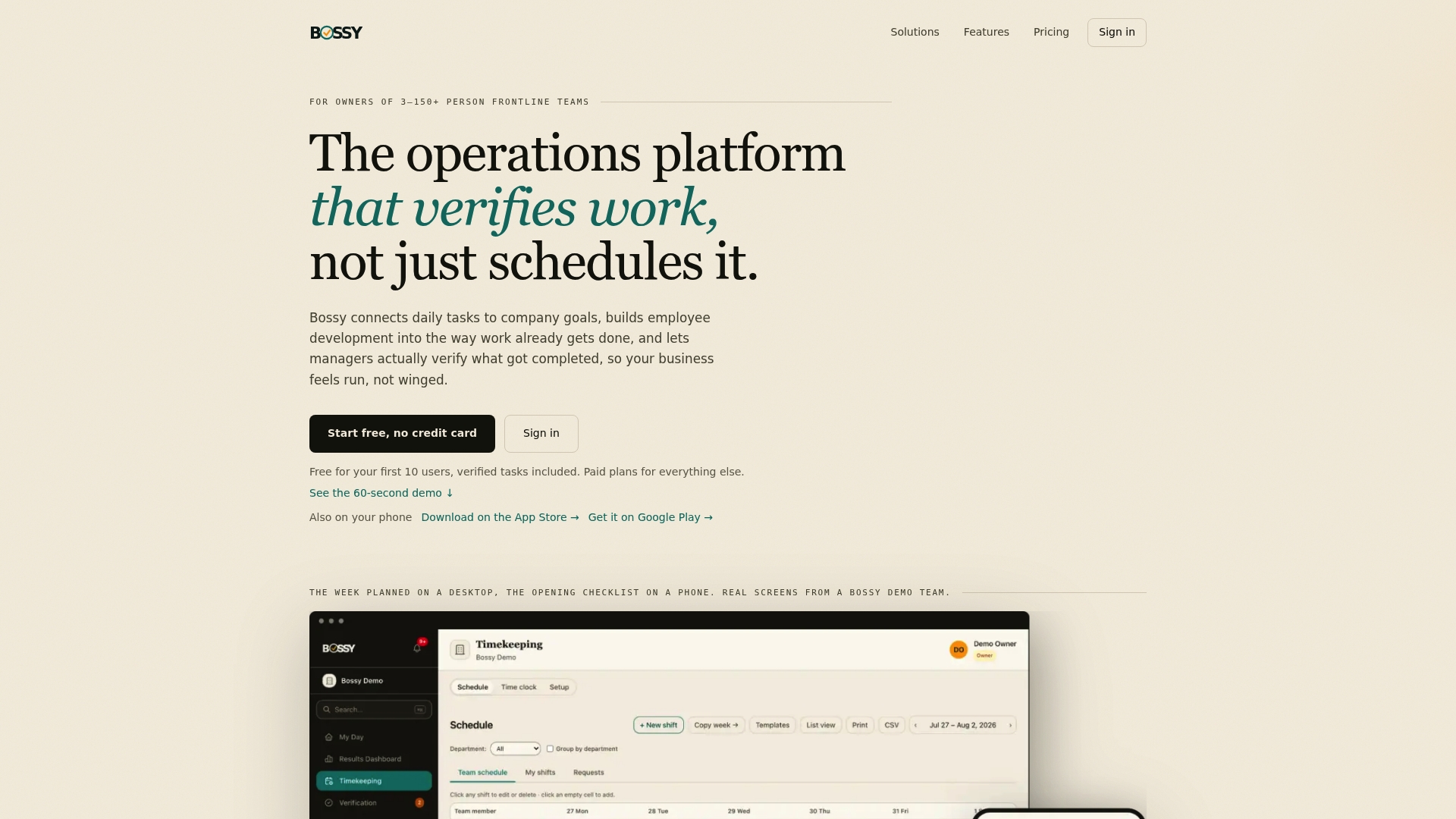
If you want to see whether integrated task verification, scheduling, and inventory analytics actually fit your team, our Free plan is the lowest-friction way to test task verification without committing to anything; scheduling, time clocks, and inventory are on the Operations plan. You can explore the specifics on our pricing page or walk through the capabilities on our features page before talking to anyone on our team.
- Start free with task verification, then move to Operations when your pilot needs scheduling and inventory.
- Review plan details and per-seat pricing before you commit.
- Check our restaurant-specific workflows if your team fits that mold.
Ready to see it on your own schedule? Get started with Bossy today.
FAQ
What makes workforce analytics software different from basic scheduling apps?
Scheduling apps tell you who's supposed to be working. Frontline workforce analytics software like Bossy also verifies what they actually completed, using photo proof, approval queues, and reports instead of just a shift calendar.
How long does it take to implement a frontline analytics platform?
Most small to midsize teams run a focused pilot in two to eight weeks before deciding to scale. Starting with one location and a short training session for managers keeps that timeline realistic.
Does Bossy integrate with POS systems or payroll tools?
Not today. Bossy has no POS or payroll integrations; it keeps scheduling, geofenced time clocks, timesheet approval, and inventory in one system instead, and our features page lists what's included. If a direct POS or payroll connection is a must-have, factor that in before committing to a plan.
How much does Bossy cost for a small team?
Bossy offers a Free plan for task verification (10 users included, then $10 per block of 10), an Operations plan at $30 per month with scheduling and inventory, a Growth plan at $25 per month for 1-on-1s and feedback, and a Scale + plan at $50 per month with both, with a $5 per month per-seat add-on above included users on paid plans, all listed on our pricing page.
What should I measure during a workforce analytics pilot?
Track completion accuracy, how often managers need to follow up manually, late or missed clock-ins, and inventory variance. These four metrics reveal whether the software is actually changing day-to-day execution rather than just adding another dashboard to check.
Sources
- Frontline Worker Technology Market Size, Share & 2031 Growth Trends Report
- Nucleus Research task management value matrix (Zebra profile) - 2026
- Nucleus Research - Task Management Technology Value Matrix 2026