Frontline Teams: 11 Clockify Alternatives That Verify Work
Christian MontenegroOctober 6, 202615 min read

If you're hunting for a Clockify replacement, the shortlist breaks into four camps: all-around trackers like Toggl Track, invoicing-first tools like Harvest, generous free options like TimeCamp and Jibble, and operations platforms like Bossy for frontline teams that need more than a timer. We recommend Bossy for managers who need verified task completion, scheduling, and geofenced clock-ins in one place, especially after Clockify's 2026 free-plan changes pushed many teams to start looking elsewhere.
TL;DR:
- Clockify's 2026 free-plan changes, per its community forum announcement, cap free workspaces at five active users and restrict some reporting and API access (check its pricing page for current terms).
- Bossy offers task verification through photo proof and geofenced clock-ins, making it ideal for frontline operations rather than simple time tracking.
- Tools like TimeCamp and Jibble advertise more generous free tiers for larger teams but raise privacy concerns with automatic tracking features.
- Frontline teams should prioritize verification and scheduling tools over basic timers, especially when task completion proof is critical for accurate billing or operations.
- Migrating from Clockify requires exporting historical data, testing new features over 7 to 14 days, and confirming integration functionality before full switch-over.
Table of Contents
- The best Clockify alternatives, ranked by fit
- How do you weigh these options against each other?
- How do you test a Clockify alternative before committing?
- How we compiled and checked this list
- Why Bossy approaches time tracking differently
- How do you migrate from Clockify to an alternative?
- What should you know about data security in these tools?
- What are the real trade-offs against Clockify?
- What do users actually say about these tools?
- Our take: stop shopping for a timer, start shopping for proof
- Try Bossy free before you commit to anything
- FAQ
- Sources
The best Clockify alternatives, ranked by fit
Before you compare features line by line, it helps to see where each tool actually lands. The table below sorts the top eleven contenders by their primary strength, not by price alone, because the cheapest tool is rarely the right one if it can't do the one thing your team needs.
A few of these deserve more context than a single row can give.
Bossy fits owners and managers running frontline operations, restaurants, retail shops, cleaning crews, and similar teams where the owner can't watch every shift in person. Instead of just logging hours, it verifies that tasks actually got done through photo proof and a manager approval queue, then ties that work back to scheduling and inventory. If your real problem is "did the closing checklist get done," not just "how many hours did Maria work," this is the category you want.
Toggl Track remains the easiest tool to hand a new hire with zero training. Zapier's 2026 testing named it the best free general-purpose time tracker, largely because its timer and reports stay out of your way.
Harvest earns its spot for agencies and consultants who need time entries to turn into invoices without a second tool. My Hours leans into compliance, useful if you need timesheets that survive a client audit. TimeCamp and Jibble both court budget-conscious teams with free tiers that, per their pricing pages, allow more users than Clockify's current cap. Hubstaff adds GPS tracking for field crews, while Everhour and ClickUp suit teams who already live inside a project management tool and want tracking layered on top rather than bolted beside it. TMetric and Timely round out the list for small teams and multitaskers, respectively.

How do you weigh these options against each other?
Five dimensions decide most of these decisions: who the tool is built for, how the pricing or free-plan limits actually work, what single feature sets it apart, which platforms it runs on, and what it connects to. Weigh them in that order, because a tool that's "best for" the wrong audience rarely redeems itself with integrations.
- Best for tells you the intended user, freelancer, agency, field crew, or frontline operation, and mismatches here cause most abandoned trials.
- Pricing shape and free-plan limits matter more in 2026 than before, since Clockify's own forum announcement confirmed its free plan now caps active users at five and restricts some reporting and API access.
- Standout feature is the one thing you'd miss most if you switched back, automatic capture, invoicing, or verified task completion.
- Platforms decide whether your team can actually use the tool on a shop floor or only at a desk.
- Integrations determine whether time data flows into payroll, invoicing, or project tools without manual exports.
Picture three different buyers. A small consultancy of three people mostly cares about invoicing integrations and clean reports, so Harvest or Toggl Track wins on dimension three alone. A frontline retail business with hourly staff across two locations cares most about platforms (does it work on staff phones out on the floor?) and standout feature (can it verify a task got done, not just that a timer ran?), which points toward Bossy or Hubstaff. A distributed agency juggling five client project boards should prioritize integrations above all else, making Everhour or ClickUp the natural fit.
Whatever you shortlist, test the trade-off between automatic capture and privacy. Automatic trackers like Timely and TimeCamp reduce manual entry but raise questions among staff about what's being recorded in the background. Test reporting depth against ease of use too: a tool with richer reports often asks more of the person filling in the timesheet.
Pro Tip: Run your trial with the one employee most likely to resist the switch, not your most tech-savvy staffer. If it works for them, it works for everyone.
How do you test a Clockify alternative before committing?
Give yourself 7 to 14 days and a short list of test cases rather than a gut-feel trial. Here's a sequence that catches most surprises before you pay for a year upfront.
- Days 1 to 2: Start and stop timers on mobile and desktop, then confirm the entries match across devices.
- Days 3 to 4: Run a project report and check whether it breaks down by client, task, or team member the way your current reports do.
- Days 5 to 6: Export historical data and confirm it imports cleanly, since some tools restrict export formats on free tiers.
- Days 7 to 8: Test any API connection you rely on, including rate limits that only show up under real use.
- Days 9 to 10: If you have field staff, test the mobile geofenced clock-in from an actual job site, not your office Wi-Fi.
- Days 11 to 14: Run a payroll export and have whoever handles payroll confirm the format actually works with your system.
While you're testing, ask the vendor directly about free plan caps (how many active users, really), API rate limits, how far back historical exports go, how billing prorates if you add seats mid-cycle, and how granular user roles and permissions get. Vendors answer these questions very differently, and the answers rarely show up on the pricing page.
Watch for a few red flags: a free plan that caps reports at 30 days of history, an API that's only available on the top paid tier, or a mobile app with noticeably worse reviews than the desktop version. Build a simple decision rubric before you start: list your must-haves (say, geofenced clock-ins and photo verification) separately from your nice-to-haves (say, dark mode or Slack integration), and don't let a nice-to-have win the decision.
Pro Tip: Keep your old Clockify data exported and stored before your trial ends. Migrating later is far easier with a clean backup in hand.
For frontline teams specifically, read up on stopping time clock fraud without micromanaging before you pick a tool, since verification features vary enormously between trackers.
How we compiled and checked this list
We built this roundup from Zapier's 2026 time-tracking testing, G2's comparison pages for Clockify against its most common alternatives, vendor documentation for pricing and feature claims, and the Clockify community forum thread confirming the 2026 free-plan changes. We last reviewed this list in 2026.
We rated tools across five categories: audience fit, pricing transparency, standout feature strength, platform coverage, and integration depth.
- We excluded tools with no public pricing information or no evidence of active maintenance.
- We weighted G2 and Capterra review themes around reporting and mobile experience as supporting evidence, not the primary ranking factor.
- We flagged self-hosted tools (Kimai, eHour, Redmine, and similar) separately, since they trade convenience for control.
No roundup replaces a hands-on trial. Treat this as a shortlist, then test the top two or three against your own workflow before you commit.
Why Bossy approaches time tracking differently
Most of the tools above answer "how many hours did someone work." Bossy answers a different question: "did the work actually get done." We built task verification with photo proof and a manager approval queue, geofenced time clocks, employee scheduling, inventory tracking, and analytics dashboards into a single system, because for frontline teams, hours logged and work completed are not the same thing.
Our ideal customer runs a restaurant, a retail shop, a cleaning company, or another business with 3 to 150 frontline employees, where the owner can't be on-site for every shift. The outcomes we aim for are concrete: verified task completion instead of guesswork, clear staffing visibility, and better retention through built-in employee development tools like 1-on-1s and growth tasks (on our Growth and Scale + plans).
How do you migrate from Clockify to an alternative?
Start by exporting your historical time data from Clockify while your account is still active, most tools support CSV export, and confirm the file includes project names, user names, and timestamps before you delete anything. Map your existing projects and clients to the new tool's structure first, since category mismatches cause the most confusing data gaps after a switch.
Run both systems in parallel for one full pay period if you can. This catches discrepancies in rounding, overtime calculation, or reporting before payroll depends entirely on the new tool. Notify your team with a specific date, not a vague "we're switching soon," and give frontline staff a short walkthrough on whatever device they'll actually use, phone, tablet, or kiosk.

Finally, check that any integrations you depend on, payroll software, invoicing tools, or project management platforms, are reconnected and tested before you cancel your old subscription. A lapsed integration is the most common post-migration complaint, and it's entirely avoidable with a short checklist.
What should you know about data security in these tools?
Time tracking data includes location history, work patterns, and sometimes photo verification, so it's worth asking each vendor directly how data is encrypted, where it's stored, and who can access it internally. Self-hosted options like Kimai, eHour, and Redmine give you the most control since the data never leaves your own servers, but that control comes with the responsibility of maintaining security patches yourself.
Cloud-based tools vary in their privacy posture. Ask specifically about geofencing and GPS data retention if you're considering GPS field tracking like Hubstaff's or geofenced clock-ins like Bossy's, since location data carries different expectations than a simple timer entry. Also ask who within your organization can see raw location or photo data versus aggregated reports, since over-broad access is a common complaint buried in review threads.
If you handle client-sensitive project data, confirm whether the vendor carries any relevant compliance certifications and whether data is encrypted both in transit and at rest. A vendor that can't answer clearly in writing is a red flag worth taking seriously before you commit a year of billing.
What are the real trade-offs against Clockify?
Every alternative on this list solves something Clockify's 2026 changes made harder, but each comes with its own give and take. Toggl Track keeps things simple but doesn't verify that work got done, only that a timer ran. Harvest bakes in invoicing but isn't built for shift-based frontline teams. My Hours strengthens compliance but adds more manual approval steps than some teams want.
TimeCamp and Jibble both advertise more generous free user counts than Clockify's new five-user cap (check their pricing pages), but automatic capture (TimeCamp) raises the privacy questions covered above, and Jibble leans attendance-first rather than project-first. Hubstaff's GPS tracking suits field teams but can feel like overkill for a desk-based team. Everhour and ClickUp integrate deeply with project tools but add complexity if your team doesn't already use those platforms.
Bossy's trade-off runs the other direction: we're not a lightweight timer replacement. If all you need is a stopwatch and a report, we're more tool than you need. But if your actual problem is verifying that closing checklists, stock counts, or client tasks got done, not just logged, that's where we're built to help.
What do users actually say about these tools?
Review themes across G2's Toggl Track comparison and similar comparison pages point to a consistent pattern: lightweight trackers get praised for simplicity and speed of setup, while workforce and project suites get praised for depth but criticized when onboarding takes too long. Mobile app quality comes up repeatedly as a differentiator, some tools clearly prioritize desktop first and it shows in the mobile experience.
Integration quality is another recurring theme. Users of tools like Everhour and ClickUp tend to mention how well time tracking fits into their existing project workflow, while users of simpler trackers like Toggl Track mention they chose the tool specifically because they didn't want added complexity. Reporting depth draws mixed reactions, more detail helps finance teams but can overwhelm managers who just want a quick daily view.
Rather than chasing a single aggregate score, read a handful of recent reviews for your shortlisted tools and look for mentions of your specific use case, invoicing, GPS tracking, or task verification. That tells you more than a star rating ever will.
Our take: stop shopping for a timer, start shopping for proof
Most "Clockify alternatives" roundups treat this as a timer-replacement decision: which app has the cleanest interface, the cheapest plan, the most generous free tier. That framing made sense when Clockify's free plan was generous. Now that it caps free workspaces at five active users, per the official forum announcement, the real question worth asking is different: what do you actually need this data to prove?
If you run a desk-based team billing clients by the hour, a simple timer with good invoicing still solves your problem, but field teams may need GPS punch clock solutions like GPS-verified clock-ins for accurate attendance tracking. But if you manage people who aren't sitting at a desk, servers, cleaners, retail staff, the conventional advice to just find "a cheaper Clockify" undersells what you need. Hours logged tell you nothing about whether the prep list got done or the stockroom got counted. Prioritize verification and scheduling fit before you prioritize price.
— Christian
Try Bossy free before you commit to anything
We built Bossy for exactly the gap this article keeps circling back to: tools that track hours but can't confirm the work behind them. Our free plan lets you test task verification and the manager approval queue with your actual team before you pay anything. Scheduling, photo proof, and geofenced clock-ins are on Operations at $30 per month and Scale + at $50 per month (Growth, at $25 per month, covers 1-on-1s and feedback), plus a per-seat add-on at $5 per month per seat if you grow past your included users.
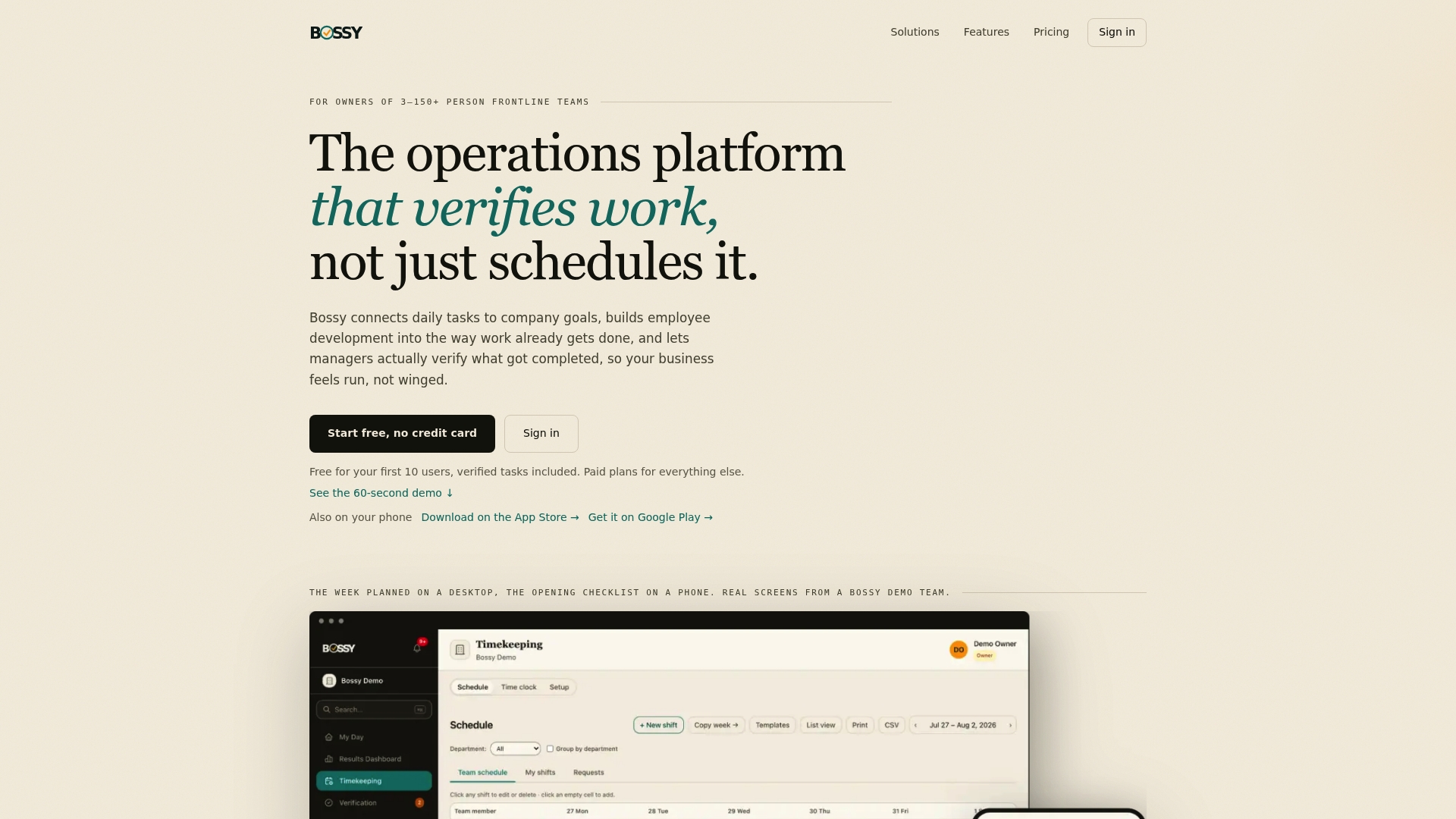
Take a look at our full feature set for tasks, scheduling, and inventory, and see how the pieces fit together for a frontline team like yours. If you run a restaurant, check out what we've built specifically for restaurant operations. Ready to see it on your own schedule? Check our pricing and start with the free plan today.
FAQ
Is Toggl Track or Clockify better?
Neither is universally better. Toggl Track tends to win on simplicity and reporting polish, while Clockify historically won on free-plan generosity, though 2026 changes capped Clockify's free workspaces at five active users, narrowing that gap.
What are the disadvantages of Clockify?
The main disadvantage reported in 2026 is the free plan's new cap of five active users along with restrictions on some reporting ranges and API access, according to Clockify's own community forum announcement. Beyond that, Clockify remains a general-purpose timer rather than a tool built for verifying frontline task completion.
What is the best free timesheet app?
There's no single "best" free timesheet app, since the right choice depends on team size and whether you need automatic capture, attendance tracking, or project-linked timesheets. TimeCamp and Jibble are commonly cited for generous free user counts, while Bossy offers a free plan built around verified task completion rather than timesheets alone.
Is there a free version of Clockify?
Yes, Clockify still offers a free plan, but as of 2026 it's limited to workspaces with up to five active users, with some features like certain webhooks, API access, and report ranges moved to paid tiers, according to Clockify's forum post on the change.
How do I choose between a simple time tracker and an operations platform like Bossy?
Choose a simple tracker if your only need is logging hours for invoicing or payroll. Choose an operations platform like Bossy if you need to verify that scheduled tasks, shift checklists, or stock counts actually got done, not just that someone clocked in.