15 Minute Weekly Employee Feedback Examples for Frontline Managers
Christian MontenegroSeptember 25, 202617 min read

For praise, name the specific behavior and its impact, right in the moment: "You caught that pricing error before it hit the invoice, that saved us a refund." For anything corrective, use Situation, Behavior, Impact, then add one concrete next step. This article gives you copy-ready phrases for both, organized by situation, so you're never stuck for words in a check-in.
TL;DR:
- Regular, focused weekly check-ins with specific praise improve engagement more than annual reviews, especially when recognition connects to actual behaviors.
- Using the SBI framework for corrective feedback ensures clarity, avoids character judgments, and includes a concrete next step to support behavior change.
- Asking employees for advice instead of feedback yields more actionable input, while praise should be detailed and tied to actual impacts.
- In fast-paced frontline environments, brief, intentional conversations are more effective than relying on scheduled formal reviews or lengthy feedback sessions.
- Consistent follow-up on previous feedback and a structured rhythm of communication are crucial for meaningful behavior change and sustained team improvement.
Table of Contents
- Why Frequent, Meaningful Feedback Actually Moves the Needle
- Positive Feedback Examples by Situation
- Constructive Feedback Examples Using the SBI Framework
- Scripts for the Situations Managers Actually Face
- Frameworks That Make Feedback Stick
- Common Feedback Mistakes and How to Recover
- What Frontline Managers Get Wrong About Feedback
- Why Most Feedback Advice Skips the Hard Part
- Make Weekly Check-Ins Something You Actually Keep Doing
- Sources
- FAQ
Why Frequent, Meaningful Feedback Actually Moves the Needle
You already know feedback matters. What most managers get wrong is thinking it needs to be a formal, scheduled event to count.
Gallup's research on manager habits found that employees who get meaningful feedback weekly are several times more likely to be engaged than those who don't. The catch: only a minority of employees say their last conversation with their manager was actually meaningful. That gap between "we talked" and "that mattered" is where most feedback efforts quietly fail.
Weekly feedback, not annual reviews, drives engagement. Gallup reports that 80% of employees who received meaningful feedback in the past week are fully engaged, a number that annual review cycles simply can't touch.
What makes a conversation "meaningful" isn't length. It's focus. Gallup's data points to three ingredients: recognition tied to something specific, clarity on current goals, and attention to individual strengths rather than a generic template applied to everyone. A manager who spends 15 minutes talking about what someone did well this week, where their top priority stands, and what's slowing them down beats an hour-long annual review that nobody remembers by Friday.
You don't need to overhaul your calendar to get this right. A 15 to 30 minute weekly check-in, focused and specific, does more for engagement than a once-a-year sit-down ever will. If you manage a frontline team where shifts overlap and time is tight, shorter focused moments during shift changes, where you name one thing someone did well and one thing to watch, can be more effective than rescheduled meetings that never happen.
The mistake to avoid: treating feedback as a review of the past instead of a tool for what's next. Harvard Business Review's analysis of feedback programs makes the point clearly: employees stop trusting feedback systems when the input they give (or receive) never turns into visible change. Say something, then follow up on it. That's what makes people believe you mean it.

Positive Feedback Examples by Situation
Generic praise ("great job today") feels nice for about four seconds and then evaporates. The employee has no idea what to repeat. Specific praise, tied to a behavior and its effect, actually shapes what happens next time.
Here's the difference in practice, organized by the moments you'll actually use them.
Recognition for a specific accomplishment
- "You hit your upsell target three weeks running. That consistency is exactly why we trust you with new hires on the floor."
- "The way you handled that refund request kept the customer calm and saved us a bad review. That's the kind of judgment call I want more of."
- "Your shift report yesterday flagged the inventory discrepancy before it became a problem. That's the level of attention that saves us money."
Effort and initiative
- "You didn't have to reorganize the stockroom, but you saw it was slowing down the morning rush and fixed it. That's initiative I want to recognize."
- "I noticed you stayed fifteen minutes to walk the new hire through closing procedures. That's the kind of mentoring that helps new hires learn."
Teamwork
- "When Marcus fell behind on prep, you jumped in without being asked. That's the team-first mindset that keeps service moving during a rush."
- "You gave Priya credit for the idea in front of the group instead of taking it yourself. That builds trust across the whole team."
Customer service moments
- "That customer specifically asked for you by name today. Whatever you did, it worked, and it's the reason we get repeat business."
- "You turned a complaint into a five-star review. Walk me through what you said, because I want the rest of the team doing that."
Growth and development
- "Three months ago you needed help closing the register. Today you trained someone else on it. That's real progress."
- "You asked for feedback on your last presentation and it showed. This one was noticeably tighter."
Timing changes the format. A quick chat message or a thirty-second callout during a shift works for the small, immediate wins: "Nice catch on that order mix-up." Save the longer, more detailed version for your one-on-ones, where you have time to connect the behavior to a bigger pattern: "This is the third time this month you've caught an error before it reached the customer. That's becoming a real strength."
Pro Tip: Ask each person how they like to be recognized. Some employees want public praise in a team channel; others find it uncomfortable and would rather hear it privately. Gallup's research notes that very few employees are ever asked this question directly, and personalizing recognition makes it land harder.
Public recognition works well for wins that model behavior you want the whole team to see, like the customer service save or the teamwork example above. Private, one-on-one recognition works better for personal growth moments, since it lets you go deeper on the "why" without putting someone on the spot in front of peers.
Constructive Feedback Examples Using the SBI Framework
Corrective feedback fails for one of two reasons: it's vague ("you need to communicate better") or it's an ambush that feels personal rather than behavioral. The fix for both is the same framework.
The Situation, Behavior, Impact model breaks feedback into three parts: name the specific situation, describe the observable behavior (not a character judgment), and state the actual impact it had. Add a fourth piece the framework doesn't include by default but should always come with it: a next step. Without one, you've just described a problem and left the employee to guess what you want instead.
Here's how that plays out across four situations every manager runs into.
-
Missed deadline. Situation: "The inventory count was due Friday morning." Behavior: "It came in Monday, after I'd already reported numbers to the owner." Impact: "I gave inaccurate figures upstream, which makes me look like I don't have a handle on the stockroom." Next step: "Let's figure out what got in the way this week, and set a check-in Wednesday so I know where things stand before the deadline hits."
-
Communication gap. Situation: "During yesterday's rush, the kitchen ran out of a special without a heads-up to the front." Behavior: "Nobody flagged it until a customer had already ordered it." Impact: "That's an awkward moment for whoever's at the register, and it makes us look disorganized." Next step: "Can we agree that anytime something's down to the last few portions, someone calls it out in the group chat right away?"
-
Quality issue. Situation: "I reviewed the last three closing checklists." Behavior: "The walk-in temperature log was skipped on two of them." Impact: "That's a compliance risk if we ever get audited, and it's the kind of thing that can shut us down for a day." Next step: "I want you to walk me through the closing list tonight so we can spot where it's getting rushed."
-
Time management. Situation: "You clocked in twelve minutes late three times this week." Behavior: "That's pushed the opening checklist behind schedule each time." Impact: "It means whoever opens with you is scrambling to catch up before doors open." Next step: "What's making mornings tight right now? Let's problem-solve it together instead of just flagging it again next week."
Notice what's missing from all four: no "you always," no "you never," no character assessment. Just what happened, what it did, and what happens next. That's the difference between feedback that lands as coaching and feedback that lands as an attack.
For a quick, in-the-moment correction, you can compress this. "Hey, that order went out without the allergy flag. Customer with a nut allergy almost got the wrong dish. Can you double-check that field before you send next time?" That's SBI in three sentences, delivered in under thirty seconds, which is exactly what a busy shift requires.
Save the longer version, with the full next-step conversation, for your one-on-one. That's where you have room to ask what got in the way and actually listen to the answer instead of just issuing a correction and moving on.
Pro Tip: Cap it at one issue per conversation whenever you can. Research on narrative feedback found that piling multiple weaknesses into a single conversation tends to produce scattered, unsystematic attempts to fix everything at once, rather than real improvement on any one thing.
Scripts for the Situations Managers Actually Face
Most feedback advice assumes you have a quiet office and an open calendar. Frontline managers rarely get either. Here are short scripts built for the moments you actually have.
- Chat message shout-out: "Saw the review that customer left about you by name. Nice work, that's exactly the kind of service that keeps people coming back."
- Public team callout: "Before we start today, I want to call out that Jamie caught a scheduling conflict before it became a problem for two of you. That's the kind of thing that keeps this place running."
- Written recognition (remote or async teams): "Wanted to put this in writing so it's not lost in the shuffle: the report you sent Tuesday was the clearest one I've gotten all quarter. Whatever you did differently, keep doing it."
- Promotion-readiness conversation: "I've noticed you've started training new hires without being asked. That's a lead-role skill. What would it take for you to feel ready to take that on officially?"
- Redirecting someone off track: "I want to be direct with you: the last two weeks haven't matched what I know you're capable of. What's going on, and what do you need from me to get back on track?"
- Peer conflict follow-up: "I heard there was some tension with Alex yesterday. I'm not looking to assign blame, I want to understand what happened from your side so we can fix it going forward."
- Remote development check-in: "Since we don't see each other in person, I want to make sure I'm still giving you real feedback. What's one thing you'd want my honest take on right now?"
Each of these takes under a minute to say or type, and none of them require a calendar invite. That's the point: feedback that only happens in scheduled meetings is feedback that mostly doesn't happen at all.
Frameworks That Make Feedback Stick
SBI gives you the structure. Two other findings change how you use it.
The first: how you ask for input changes what you get back. A working paper from Harvard Business School, based on a field experiment involving over 27,000 comments plus multiple lab studies, found that asking someone for "advice" rather than "feedback" produced more concrete, actionable, and future-focused responses, without making the responses any longer. If you want a genuinely useful answer when you ask an employee how a project went, try "What's your advice for next time?" instead of "Any feedback?" The word swap costs nothing and consistently gets a more useful answer.
The second finding governs how specific to be, and it depends on direction. When you're praising a strength, go as specific as you can, since detail helps people recognize and repeat what worked. When you're addressing a weakness, research on narrative feedback suggests dialing back the specificity and instead explaining the cause behind the problem, then picking one target to work on. Naming five things wrong with someone's performance rarely produces five fixes. It produces paralysis.
Put it together into a repeatable rhythm:
- Fifteen minutes, once a week, per employee, no more required.
- Ask three prompts: what's your top priority right now, what's blocking you, and what's one thing worth recognizing this week.
- Frame requests for input as "What's your advice on this?" rather than "Any feedback?"
- Go specific on strengths, selective and causal on weaknesses.
None of this needs a formal review cycle. It needs a standing fifteen minutes and three questions you actually ask every time.
Common Feedback Mistakes and How to Recover
Even good managers slip into bad habits under pressure. Here's what to watch for and how to fix it fast.
- Vague praise that names no behavior. "Great job today" tells someone nothing. Fix it in the moment: "Wait, let me be specific, the way you handled that return was great."
- Correcting someone in front of the team. Public correction damages trust fast. If it happens, repair it directly: "I shouldn't have brought that up in front of everyone, let's talk about it one-on-one."
- Stacking too many negatives in one sitting. Pick the single issue with the biggest impact and table the rest for later.
- Collecting feedback and never acting on it. If you ask an employee for input and nothing changes, they stop giving it honestly. HBR's research is blunt about this: silence after listening is worse than not asking at all.
If a pattern of performance issues continues after two or three documented conversations, that's the point to loop in HR and put the discussion in writing. A verbal check-in is right for a first slip. Repeated misses need a paper trail.
What Frontline Managers Get Wrong About Feedback
Most feedback advice assumes a manager who sees every employee every day in a calm setting. Frontline operations rarely work that way. Shifts overlap, priorities shift by the hour, and the manager on the floor is usually also running the floor.
That's exactly why the weekly 15-minute check-in matters more here, not less. When you can't rely on constant informal contact to convey what's working and what isn't, you need a standing, protected slot where recognition and correction both happen on purpose. Pair that with task verification, so praise and correction are grounded in what actually got done rather than what someone remembers from a rushed handoff, and feedback stops depending on your memory or theirs.
Try this next week: pick one employee, run a fifteen-minute check-in with the three prompts above, and write down one specific piece of praise using Resyme before the conversation starts. Small, deliberate, repeatable. That's the whole system.
Why Most Feedback Advice Skips the Hard Part
Most feedback guides love to talk about tone and empathy. Fewer talk about the actual failure point: managers give feedback once, feel good about it, and never follow up. That's not a communication problem, it's a systems problem.
The conventional advice, "be specific, be kind, be timely," is correct but incomplete. It doesn't answer what happens the week after the conversation. If you praise someone for catching an error and never mention it again, the praise fades into background noise. If you flag a missed deadline and don't check in on the agreed next step, you've just taught the employee that consequences are optional.
What I'd prioritize first isn't a better script. It's a better rhythm. A manager with mediocre phrasing who checks in every week will outperform a manager with perfect SBI language who only talks to their team twice a year. Say the right words, but say them on a schedule you actually keep, and follow up on what you said last time. That consistency is what separates feedback that changes behavior from feedback that just makes everyone feel briefly heard.
— Christian
Make Weekly Check-Ins Something You Actually Keep Doing
Scripts solve what to say. They don't solve the harder problem: remembering to say it, to the right person, on a schedule you'll actually stick to when the shift gets busy. That's where a tool like Bossy fits in, as an optional layer on top of everything in this article, not a replacement for it.
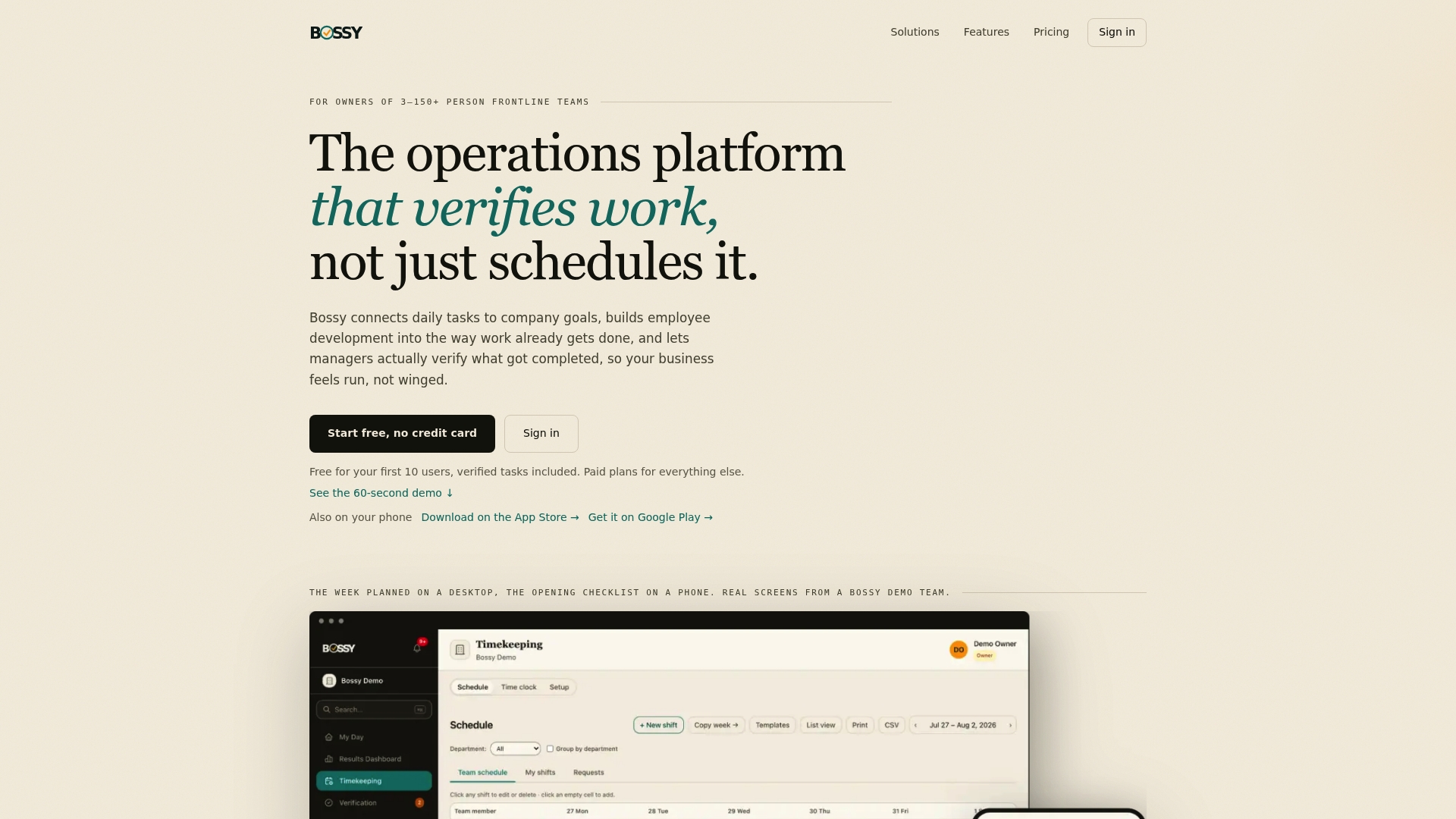
Bossy links daily tasks to your team's goals and gives you a system to verify work actually got done, through a manager approval queue, instead of hoping the checklist was followed. Built-in development tools let you log 1:1 notes, peer and manager feedback, and growth tasks right alongside the operational work, so the weekly check-in doesn't depend on you remembering what happened three shifts ago. Cascading goals keep individual feedback tied to what the business is actually trying to achieve, not just this week's task list.
If you're running a frontline team of 3 to 150 people and want feedback to be something your system supports rather than something you have to remember on your own, the Growth plan, which includes 1:1s, feedback, and growth tasks, runs $25 per month. Check the pricing page to see which plan fits your team size.
Sources
- A great manager's most important habit (Gallup)
- Closing the gap between intent vs impact: SBI (CCL)
- Eliciting advice rather than feedback yields more developmental, critical, and actionable input (HBS working paper)
- From words to actions: Specificity and causality in narrative feedback (Contemporary Accounting Research)
- Turn employee feedback into action (Harvard Business Review)
FAQ
What Are Some Examples of Positive Feedback for an Employee?
The strongest examples name a specific behavior and its impact, such as "You caught that pricing error before it hit the invoice, that saved us a refund." Vague praise like "good job" rarely changes future behavior because the employee doesn't know what to repeat.
What Are Some Examples of Positive Employee Performance Feedback?
Performance-focused praise ties a result to a pattern: "You hit your upsell target three weeks running, that consistency is exactly why I trust you with new hires." Framing it around a trend, not just a single event, shows the employee their effort is being tracked over time.
What Are the Five R's of Feedback?
There's no single, widely agreed-upon "five R's" framework for feedback. If you've seen the term used, it likely varies by source, so it's more reliable to build your feedback around the SBI model of Situation, Behavior, and Impact, plus a clear next step.
What Is a Good Example of Positive Feedback?
A good example names what happened, what effect it had, and often includes a small forward-looking note: "The way you handled that customer complaint turned a bad review into a five-star one. Walk me through what you said, I want the team doing that." That structure works whether you're delivering it in a chat message or a one-on-one.
How Often Should Managers Give Feedback?
Weekly beats annual by a wide margin. Gallup's research shows employees who get meaningful feedback weekly are far more likely to be engaged, and a 15 to 30 minute focused check-in accomplishes more than a once-a-year formal review.