Cut Scheduling Chaos in 20 Minutes: Employee Scheduling for Managers
Christian MontenegroSeptember 24, 202617 min read

Good employee scheduling comes down to three habits: build the schedule from recent demand, publish it 7 to 14 days ahead, and collect availability as a standing default instead of a weekly ask. Do those three things consistently and you'll see fewer callouts, a fairer rotation, and a lot less emergency overtime. Everything else in scheduling is refinement.
TL;DR:
- Scheduling should be based on forecasted demand data from the past two to six weeks to ensure accurate coverage needs.
- Publishing schedules at least 7 to 14 days in advance reduces last-minute edits and improves employee planning and satisfaction.
- Incorporating staffing buffers and layered coverage models helps prevent overtime and handle unexpected callouts effectively.
- Using a repeatable template and sequence for weekly scheduling streamlines the process and minimizes repetitive manual work.
- Clear communication, transparency, and fair shift rotation are essential for building trust and reducing resentment among staff.
Table of Contents
- Employee Scheduling Best Practices: The Foundation
- A Weekly Workflow Checklist For Building The Next Schedule
- Which Scheduling KPIs Actually Tell You Something
- Legal Basics And Fairness Every Manager Should Know
- When To Bring In Scheduling Software
- What A One-Week Experiment Can Prove To You
- Connecting Scheduling To Payroll And Time Tracking
- Communicating Schedule Changes Without Causing Chaos
- Matching Shifts To Skills And Preferences
- Building A Real Contingency Plan For Absences And Spikes
- The Real Gap In Most Scheduling Advice
- Where Bossy Fits If You Want Scheduling And Operations In One Place
- Sources
- FAQ
Employee Scheduling Best Practices: The Foundation
Good scheduling isn't a talent; it's a process supported by practical guidance like the FAQs | REBUILDING THE TRADES resource for trades managers and service industries. It's a process, and most managers never got to build one because they were too busy putting out that week's fires. Here are the practices, in priority order, that turn scheduling from a Sunday-night scramble into a 20-minute task.
1. Collect recurring availability, not weekly one-offs. Ask each employee to set a default availability pattern once. Then only ask for updates when something actually changes. Chasing availability texts every single week is where most of a manager's scheduling time disappears, and it's unnecessary. A recurring default cuts that administrative load dramatically and tends to be more accurate too, since people forget to reply to weekly check-ins but rarely forget to flag a real change to their standing hours.
2. Forecast demand before you fill a single shift. Pull sales data, appointment bookings, foot traffic, or call volume from the last two to six weeks and map your coverage needs against it. Scheduling by gut feeling or "what we did last week" ignores the fact that Tuesdays are never the same as Fridays.
3. Use templates and copy-forward patterns. Build one validated weekly template that matches your typical demand curve, then copy it forward and apply exceptions only where the week actually differs. Treat scheduling as assembly work, not a fresh creative project every time. Managers who rebuild from a blank grid every week are solving the same problem over and over for no reason.
4. Publish 7 to 14 days in advance. This is the single highest leverage change most managers can make. Advance notice in that range is repeatedly recommended across Department of Labor guidance and fatigue-management research as a practical balance between operational flexibility and giving employees enough time to plan their lives. When Los Angeles enacted its Fair Workweek law, shift-level advance notice increased notably, and the share of shifts scheduled with less than two weeks' notice decreased significantly. Keep the published schedule in one single source of truth. Group texts and paper printouts guarantee someone works off an outdated version.
5. Leave a staffing buffer. Scheduling to exactly 100% of forecasted demand looks efficient on paper and falls apart the moment someone calls in sick. Build in a small cushion, whether that's an on-call shift, an extra part-timer, or slightly overlapping shift changes.
6. Sequence your coverage: required roles first, then peaks, then gaps. Lock in certified or legally required positions (a manager on duty, a certified bartender, a licensed technician) before anything else. Then layer in your peak-hour coverage. Fill remaining gaps last, with cross-trained staff who can flex.
7. Build an easy but manager-approved swap process. Employees will always need to trade shifts. The goal is removing friction without losing oversight. A swap request that routes to you for a one-tap approval keeps accountability intact while sparing you from being the sole broker of every trade.
8. Set explicit time-off and swap rules. Ambiguity breeds resentment. Publish a clear policy: how far ahead time-off requests must come in, how many people can be off at once, what qualifies as an emergency swap. Clarity here prevents the same arguments from resurfacing every month.
9. Bring in software once complexity outpaces spreadsheets. If you're juggling more than a handful of availability constraints, editing the schedule multiple times a week, or routinely blowing past overtime thresholds by accident, a spreadsheet is costing you more time than it saves.
10. Adopt a core-plus-flex staffing model and cross-train. A core group covers baseline hours; a flex pool of cross-trained employees absorbs peaks and fills gaps. This is what makes a schedule resilient instead of brittle, because you're not relying on any single person to be available.
11. Rotate premium and undesirable shifts, and track fairness over time. Whoever always gets Friday nights off, and whoever always gets stuck with the Sunday closing shift, will notice. Keep a simple log of who worked which shift types over the past quarter and rotate deliberately. Transparency about how shifts get assigned matters as much as the assignment itself, since research on procedural justice in scheduling finds workers trust systems more when the process is visible and negotiable, not a black box.
12. Write a callout troubleshooting playbook before you need it. Decide in advance: who gets called first for an emergency shift, whether there's a small incentive for last-minute coverage, and at what point you accept being short-staffed rather than forcing an exhausted employee into a double.
Pro Tip: Keep a running "shift bank" spreadsheet of employees who've said yes to picking up extra hours in the past. When you're short, you're calling a pre-qualified list instead of guessing who might answer.

A Weekly Workflow Checklist For Building The Next Schedule
Turn the practices above into a repeatable weekly sequence:
- Monday: Review the last two to six weeks of sales, bookings, or traffic data to map required coverage for the upcoming period.
- Wednesday, 5 PM (example deadline): Close the window for availability updates and time-off requests. Pick a fixed day and time and hold to it.
- Thursday: Copy your template forward, slot in required and certified roles first, fill peak coverage, then check for conflicts and overtime risk.
- Thursday evening: Publish the finished schedule in one system and push a notification to every employee.
- Ongoing through the week: Monitor swap requests and open shifts, approve them quickly, and close any remaining gaps before they become no-shows.
A few habits make this stick:
- Never publish a schedule you haven't checked for overtime overlap.
- Never let two different documents claim to be "the current schedule."
- Never skip the deadline for availability, even once. It trains everyone that the deadline is optional.
If your team survives regular callouts without collapsing into overtime, that workflow is doing its job. For more detail on building resilience into the process itself, this breakdown of scheduling around call-outs walks through the mechanics.
Which Scheduling KPIs Actually Tell You Something
Five numbers separate a schedule that's working from one that's quietly failing: schedule adherence, change frequency after publication, time-to-fill for open shifts, labor cost percentage, and overtime hours.
Targets worth aiming for:
- Schedule adherence above 95%
- Fewer than five post-publication edits per week (this varies by business size and volatility)
- Open shifts filled within 24 hours
- Overtime under 5% of total scheduled hours, though this threshold shifts by industry
Treating the schedule as a management tool rather than a static document is what separates operations that catch problems early from ones that discover them in the payroll report, a distinction echoed in scheduling risk guidance from the GAO.
Run a 10-minute review every week: pull last week's numbers, flag whichever metric moved the wrong direction, and assign one concrete fix before you build the next schedule. If change frequency spikes, your forecast was off. If time-to-fill drags, your swap process has a bottleneck.
Legal Basics And Fairness Every Manager Should Know
The Fair Labor Standards Act requires overtime pay at 1.5 times the regular rate after 40 hours in a workweek for non-exempt employees. It does not mandate advance scheduling notice or guaranteed breaks at the federal level. That's left to state and local law, and a growing number of cities and states have passed predictive or fair-workweek ordinances. Check your local rules before you formalize an advance-notice policy, since requirements on notice periods and predictability pay vary widely by jurisdiction.
Balanced working-time arrangements, meaning shorter shift cycles, capped consecutive workdays, and real choice among available shifts, consistently improve retention and well-being more than rigid, manager-dictated rotas.
That framing comes from the ILO's guidance on balanced working time, which recommends:
- Capping shift length, including overtime, around 12 hours
- Limiting consecutive workdays to six or fewer
- Avoiding "clopening" (closing one night, opening the next morning)
- Being transparent about how premium shifts get assigned, while keeping personal reasons for schedule requests private
When To Bring In Scheduling Software
Spreadsheets work fine until they don't. The tipping point usually shows up as one of three signals: you're managing more availability constraints than you can hold in your head, you're editing the published schedule multiple times a week, or you keep discovering overtime risk after the fact instead of before.
At that point, look for a tool that covers:
- Built-in availability collection, so you're not chasing texts
- A mobile app employees actually check
- Conflict and overtime alerts before you publish, not after
- An open-shift marketplace for swaps
- Integration with your point-of-sale or forecasting data
- A payroll export that doesn't require manual re-entry
Pro Tip: Let automation surface conflicts and suggest fills, but keep the final call on swap approvals and shift assignments human. Workers trust a system more when a person is still making the judgment calls, not just an algorithm.
What A One-Week Experiment Can Prove To You
Skeptical this actually moves the needle? Try it for one cycle. Publish two weeks ahead instead of your usual lead time, and switch availability collection to a standing default instead of a weekly ask. Track two numbers only: how many times you edit the schedule after publishing, and how many callouts you get. Most managers who make this switch see both drop within the first cycle. Platforms in the operations and workforce-management category, including Bossy, are built to make that shift measurable without extra spreadsheets.
Connecting Scheduling To Payroll And Time Tracking
A schedule that lives in one system and payroll that lives in another is where hours quietly go missing. Every time a shift gets swapped, extended, or cut short and that change doesn't flow into your time-tracking system, you're either overpaying, underpaying, or spending an hour every pay period reconciling the two by hand.
The fix is structural, not procedural: use a system where scheduled hours, actual clocked hours, and payroll export sit in the same pipeline. Geofenced time clocks that tie directly to the published schedule catch discrepancies in real time, whether that's an employee clocking in from the wrong location or working outside their scheduled shift without approval. When overtime alerts are based on scheduled hours but your payroll calculates from clocked hours, you'll get numbers that never quite match, and that gap is exactly where compliance risk and payroll disputes come from.
For businesses running lean, this integration also closes the loop on labor cost percentage. You can't manage that KPI in real time if your labor cost number is a week old by the time payroll processes it. A connected system gives you same-day visibility instead of a monthly surprise.

Communicating Schedule Changes Without Causing Chaos
Every schedule changes after it's published. The difference between a team that rolls with it and one that starts texting angry group chats comes down to how the change gets communicated, not whether it happens.
Send changes through the same single source of truth you used to publish the original schedule. A change buried in a text thread, separate from the app or system everyone already checks, guarantees somebody misses it. Push notifications work better than passive updates, since a schedule change nobody sees until they show up for the wrong shift defeats the purpose of advance notice altogether.
Explain the "why" briefly when a change isn't employee-initiated. "We're short-staffed Thursday because of the inventory count" takes five seconds to type and prevents the assumption that changes are arbitrary or personal. Give as much notice as the situation allows, even if it's just a few hours more than the bare minimum. And confirm receipt when the change matters, a shift added, a start time moved, rather than assuming a notification was read.
Matching Shifts To Skills And Preferences
The best schedule on paper still fails if it puts the wrong person in the wrong slot. Optimizing for skills and preferences at the same time, rather than treating scheduling as a pure coverage math problem, is what keeps a good schedule from becoming a resented one.
Start by mapping actual skills, not job titles. A "server" who's also trained on the espresso machine is more valuable in a morning slot than one who isn't, and your template should reflect that layer of detail. Preferences matter almost as much: an employee who's told you they prefer closing shifts over openings will burn out faster if you ignore that repeatedly, even if every individual schedule looks "fair" on paper.
Build a simple preference log alongside your skills map, updated quarterly. When you're filling gaps or assigning premium shifts, check both before defaulting to whoever's available. This is also where a fairness tracker earns its keep. Someone might have the right skill for every closing shift, but if they're also the person who never gets a Saturday off, skill matching without preference balancing just creates a different kind of resentment.
Building A Real Contingency Plan For Absences And Spikes
Every schedule needs a plan B before it needs it, not after. Two categories deserve separate playbooks: sudden absences and unexpected demand spikes, because they call for different fixes.
For absences, your shift bank of pre-qualified employees willing to pick up extra hours is your first call, ahead of the general group chat. Keep a short priority list of two or three people per role who've already said yes to last-minute coverage, and know in advance what, if anything, you're offering for emergency pickups.
For demand spikes, whether that's a surprise rush, a viral social post, or a seasonal jump, cross-trained flex staff matter more than raw headcount. A core-plus-flex staffing model, discussed earlier, is what makes spikes survivable without scrambling to hire overnight. Keep a short list of former employees or trained part-timers open to on-call shifts during known high-volatility periods.
The common thread: contingency planning is a document you write on a calm Tuesday, not a decision you make in a panic on a Saturday night.
The Real Gap In Most Scheduling Advice
Most scheduling advice treats the schedule as a math problem: match supply to demand, minimize labor cost, done. That's incomplete. The evidence on advance notice, fatigue, and procedural fairness all points to the same conclusion: how a schedule gets built matters as much as what it says. A perfectly optimized schedule that nobody trusts still generates callouts, swap requests, and turnover.
Where conventional advice falls short is treating software as the fix. Software helps you execute a good process faster. It doesn't replace collecting availability honestly, publishing early enough to matter, or being transparent about who gets the good shifts. The Los Angeles Fair Workweek data provides a useful reality check: mandated advance notice moved the needle on predictability, but it didn't automatically fix shift-start stability. Rules change behavior at the margins. Culture and process change it at the core.
If you take one thing from this article, prioritize the publish-early habit over any tool purchase. Everything else compounds from there.
— Christian
Where Bossy Fits If You Want Scheduling And Operations In One Place
Bossy links your schedule to the rest of daily operations, task verification with photo proof, geofenced time clocks, and analytics dashboards, so a shift isn't just a name on a grid but a set of accountable work that actually gets checked.
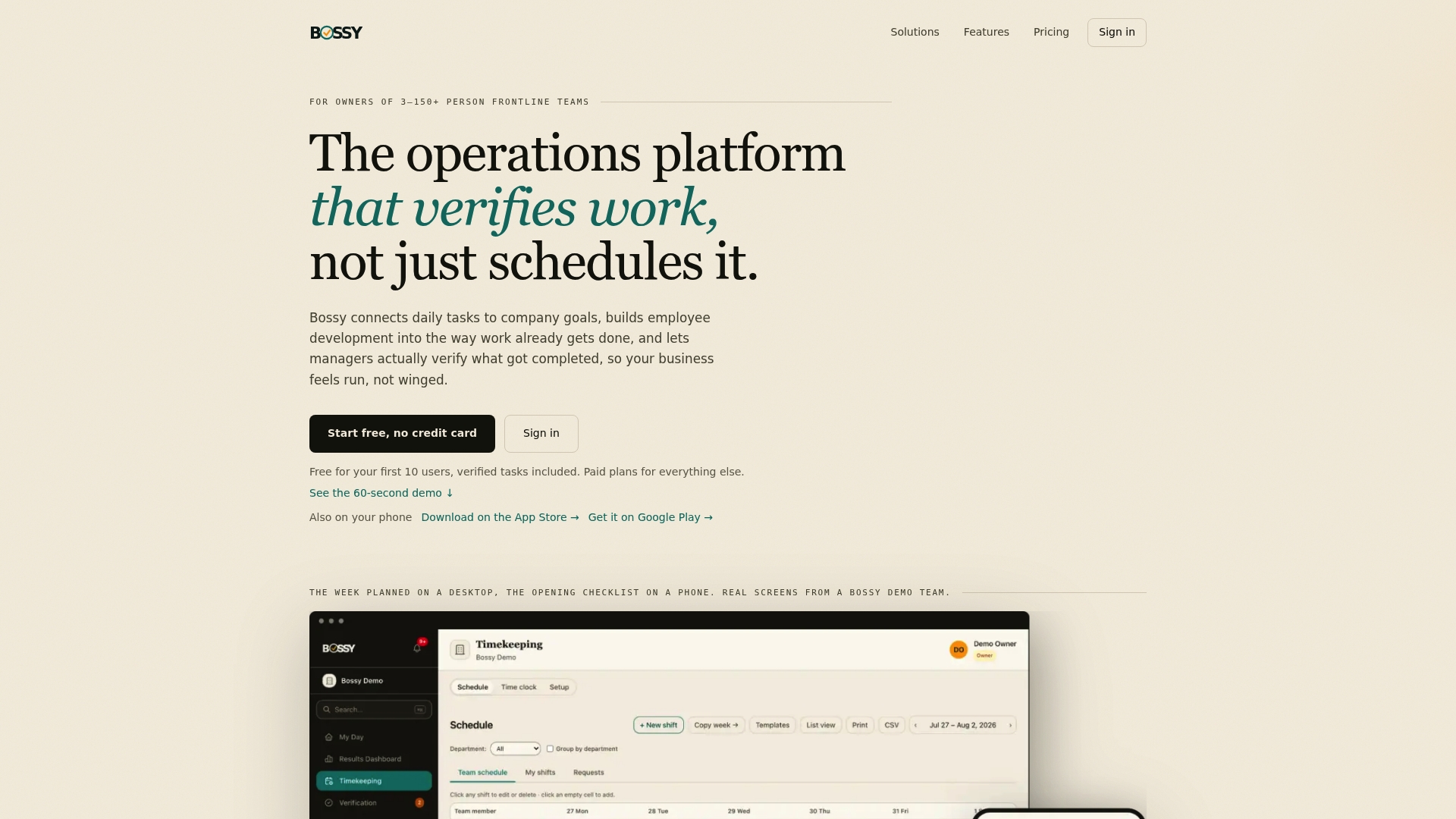
If you're managing a frontline team and tired of a schedule that lives in one app while task tracking lives in your head, that gap is exactly what Bossy was built to close. Scheduling, photo proof, and geofenced time clocks all come with the Operations plan, which runs $30 per month. Restaurant and retail teams in particular tend to feel the coverage-plus-accountability gap hardest; you can see how the platform maps to those environments on the features page. If you're ready to see whether Bossy fits your team size and structure, check current plans and start with whichever tier matches where you are today.
Sources
- The Real Effects of Fair Workweek Laws on Work Schedules: Evidence from Los Angeles
- U.S. Department of Labor: FLSA guidance and FAQs
- Guide to developing balanced working time arrangements (ILO)
- Fairness and procedural justice in shift scheduling (ACM study)
FAQ
What Is A 5 2 2 5 Work Schedule?
A 5 2 2 5 schedule rotates employees through five days on, two days off, two days on, five days off, spreading coverage across a team while giving everyone recurring blocks of rest. It works best for operations that run seven days a week and need consistent overlap between rotating groups, like manufacturing or 24 hour facilities.
What Is A 4 3 3 4 Work Schedule?
A 4 3 3 4 schedule has employees work four days, then three, then three, then four, cycling through a set number of weeks so every worker eventually rotates through weekends and weekdays evenly. It's designed to distribute both workload and less desirable shifts fairly across a team over time.
What Are Common Staff Scheduling Mistakes?
The most frequent mistakes are scheduling to 100% capacity with no buffer, publishing schedules too close to the shift date, and rebuilding the schedule from scratch every week instead of using a template. Ignoring overtime thresholds until after the schedule is live and failing to rotate undesirable shifts fairly round out the list.
What Is The Most Effective Scheduling Method?
The most effective method combines demand forecasting, a reusable template, recurring availability collection, and publishing at least 7 to 14 days in advance, an approach backed by both Department of Labor guidance and empirical Fair Workweek research. Software like Bossy can support this method by centralizing availability, alerts, and approvals, but the underlying process matters more than any single tool.
How Far In Advance Should Schedules Be Published?
Publish schedules 7 to 14 days ahead whenever your operation allows it, since that range balances flexibility with giving employees enough time to plan. Check local predictive-scheduling laws first, since some jurisdictions set specific minimum notice requirements beyond federal rules.