Managers: Task Aligned Frontline Development That Delivers in a Quarter
Christian MontenegroSeptember 18, 202621 min read
Prioritize task focused, continuous development that managers can coach on shift and employees can pull up on their phones. That single shift, away from annual training modules and toward daily coaching, is what actually moves the numbers. Do it well and you'll see faster onboarding, stronger retention, and a better customer experience within a quarter, not a year.
TL;DR:
- Frontline employee development focused on daily coaching improves retention, onboarding, and customer experience faster than annual training modules.
- Effective programs require clear, task-specific objectives, blended on-shift delivery methods, and visible recognition to promote ongoing skill growth.
- Managers must prioritize daily coaching routines, use observation checklists, and leverage mobile tools to keep development integrated into shift workflows.
- Customer feedback should directly inform coaching topics and reinforce positive behaviors, closing the loop between service quality and employee growth.
- Technology that links task verification, goal setting, and coaching in the flow of work enhances engagement and makes consistent development feasible for frontline teams.
Table of Contents
- Why Frontline Employee Development Matters Right Now
- Key Elements of Effective Frontline Development Programs
- Delivery Methods That Actually Work for Deskless Teams
- How to Build Employee Development Plans and Map Career Pathways
- Equipping Managers: Coaching Routines, Accountability, and Trainer Enablement
- Technology and In-the-Flow Tools: Making Development Accessible
- Measuring Impact: Top KPIs and a Short Measurement Cadence
- Compliance and Regulatory Training Considerations for Frontline Roles
- Adapting Frontline Development Programs Across Industries and Cultures
- Integrating Customer Feedback Into Development Programs
- Beyond Mobile: VR, AR, and Simulation Training on the Frontline
- Employee Engagement Techniques That Keep Learning Going
- Onboarding, Ongoing Development, and Career Pathways
- Manager Checklist: What to Prioritize This Quarter
- How Bossy Puts This Playbook Into Practice
- Sources
- FAQ
Why Frontline Employee Development Matters Right Now
Your frontline staff is your customer experience. Whether someone comes back to your restaurant, salon, or store depends almost entirely on the person who greeted them, not the strategy memo sitting in your inbox. That makes frontline employee development an operations problem as much as an HR one.
Here's what most managers get wrong: they assume frontline workers just want a paycheck and a schedule. They don't. More than 70% of surveyed frontline employees have applied to internal advancement opportunities, but most say they lack the resources or visibility to actually get there. That gap between ambition and access is quietly driving your turnover.
Skip development and you pay for it in ways that don't show up on a single line item:
- Higher recruiting and onboarding costs every time someone quits
- More errors, redo work, and safety incidents from undertrained staff
- Slower service and inconsistent quality that customers notice immediately
- Burned out managers who end up training the same tasks over and over
Frontline employee development isn't a nice-to-have benefit. It's how you keep the people who already know your business from walking out the door.
Key Elements of Effective Frontline Development Programs
Good programs share a structure, even across wildly different industries. Strip away the branding and you'll find the same four building blocks every time.
- Task-aligned objectives. Skip vague competencies like "communication skills" and define what a competent shift actually looks like: closes the register correctly, handles a complaint without escalation, restocks to par. Task-centered training beats abstract skill-building for frontline roles almost every time.
- Blended delivery. Pair short hands-on practice with bite-sized microlearning and real coaching during the actual shift, not after it.
- Feedback and recognition loops. People repeat behavior that gets acknowledged. Build small, frequent check-ins rather than a single annual review.
- Visible peer mentors and career pathways. Formalize your informal trainers and make the next role, and the skills it requires, obvious to everyone on the team.
Pro Tip: Write your first competency list on the back of a napkin during a shift, not in a conference room. If you can't picture the exact moment an employee demonstrates the skill, the objective is too vague to coach.
The order matters. Objectives come first because everything else, your microlearning content, your coaching checklist, your recognition triggers, gets built around what "good" actually looks like in that specific role. Programs that start with content instead of objectives end up teaching things nobody needed to know.
Delivery Methods That Actually Work for Deskless Teams
There's no single best delivery method. The right one depends on what you're teaching and who's on shift that day.
Structured on-the-job training works best for procedural tasks with a clear right and wrong way, closing a register, cleaning a piece of equipment, running a point-of-sale system. Role-play and simulation earn their place for situations with judgment calls, like de-escalating an angry customer or handling a return without a receipt.
For everything else, especially refreshers and compliance updates, microlearning wins. Short, mobile-accessible modules fit into the five minutes between a lull and a rush, and training content that lives on employees' own schedules gets completed at far higher rates than anything requiring a dedicated classroom block.
A few practical guardrails:
- Keep any single microlearning module under five minutes; longer than that, and shift workers won't finish it between tasks.
- Build seasonal or high-turnover roles around a repeatable 3 day ramp, not a 3 week orientation nobody has time for.
- Give every new hire a trainee-facing checklist that mirrors the trainer's own checklist, so both sides know what "done" looks like.
- Reserve simulation and role-play for the highest-stakes interactions, not routine tasks that don't need the extra time investment.
How to Build Employee Development Plans and Map Career Pathways
A development plan only works if it's specific enough to act on this week, not just aspirational enough to sound good in a review. SHRM's development planning template breaks a solid plan into five parts: objectives, capability areas, concrete actions, support and resources, and a timeline with checkpoints.
Start with a readiness assessment, not a wish list. Ask what this employee can already do reliably, what they're close on, and where the real gap sits. That assessment becomes the raw material for the plan itself.
| Plan section | What it captures | Review cadence |
|---|---|---|
| Objective | The specific skill or role target | Set once, revisited quarterly |
| Capability areas | Current strengths and gaps | Reassessed every 90 days |
| Actions | Training, shadowing, or projects assigned | Checked weekly during 1-on-1s |
| Support and resources | Mentor, manager time, materials needed | Confirmed at plan creation |
| Progress and readiness | Signals that someone is ready to advance | Reviewed monthly |
Signals of readiness for advancement usually show up before the formal review does: fewer corrections needed on tasks, other employees asking them for help, and consistent performance across different shifts or managers. When you see two or three of those at once, that's your cue to act, not wait for the next scheduled check-in.
- Tie every action item to a specific task or scenario, never a generic skill.
- Review plans in the same 1-on-1 where you review performance, not a separate meeting nobody attends.
- Let employees see their own plan and update progress themselves; ownership sticks better than a manager-only document.
Equipping Managers: Coaching Routines, Accountability, and Trainer Enablement
Programs live or die on manager behavior, not on the content library. If your managers aren't coaching daily, no curriculum fixes that.
- Run a two-minute pre-shift brief. Call out one thing to watch for and one skill to reinforce before the shift starts.
- Use an observation checklist. Watch one task per shift and note it, rather than trying to evaluate everything at once.
- Hold brief, weekly one-on-ones. Five to ten minutes is enough if it's focused on one specific task or behavior, not a general check-in.
- Identify your informal trainers. Every team has someone new hires already gravitate toward for help. Give that person a title, a checklist, and a little recognition; it costs nothing and reduces variance in how new hires get trained. A pairing between a manager checklist and a trainee checklist creates mutual accountability instead of relying on memory.
Pro Tip: Track coaching frequency, not just training completion. A manager who does five two-minute observations a week is doing more for development than one who assigns an hour of e-learning nobody watches.
Metrics managers can realistically own week to week: number of coaching touches logged, competency observations completed, and how many trainee checklist items got signed off. If you want more on building managers who follow through on this consistently, this guide on developing managers you can trust digs into the habits that hold up over time.
Technology and In-the-Flow Tools: Making Development Accessible
The best development content in the world doesn't matter if nobody opens it during a shift. That's the real argument for mobile, task-linked tools over standalone learning platforms.
Frontline workers are far more likely to finish training that's mobile-accessible and available on their own schedule than content that requires logging into a desktop portal after clocking out. That single design choice, mobile versus desktop, tends to be the biggest lever on completion rates.
Marriott's Elevate program saw participants become 2.5 times more likely to be retained and 5.5 times more likely to be promoted compared with employees who didn't take part, an early result that shows what happens when development gets tied directly to visible advancement.
Operations platforms that link daily task verification, scheduling, and cascading goals in one place give managers a natural home for coaching notes and growth tasks, since they're already in that system checking off the day's work. That's the practical logic behind building development into the same tool you use for shift management, rather than a separate app nobody opens twice.
A few rollout pitfalls worth avoiding:
- Don't launch a new platform and a new curriculum in the same week; stagger the change.
- Assign one "champion" per location to answer questions in the first month.
- Start with one team or shift, not the whole organization, so kinks get worked out on a small group.
Measuring Impact: Top KPIs and a Short Measurement Cadence
You don't need a dashboard with forty metrics. You need a handful that tell you whether development is actually working.
Leading indicators, the ones that move first, include time-to-competency for new hires, task pass rates on your observation checklist, and coaching touches logged per manager per week. These give you an early read before the bigger numbers shift.
Lagging indicators confirm whether it's paying off: retention at 90 days, internal promotion rate, and customer satisfaction scores tied to specific locations or shifts.
- Review leading indicators weekly during manager check-ins.
- Review lagging indicators monthly or quarterly, since they move slower and need more data to be meaningful.
- Run any new program as a 30-day pilot with one location before rolling it out everywhere.
- Compare pilot locations against a similar control location, not against your best performing site.
Compliance and Regulatory Training Considerations for Frontline Roles
Compliance training sits in a different category from skill development, and treating it the same way is a common mistake. Skill-building can be flexible and self-paced. Compliance training, food safety, workplace safety, harassment prevention, wage and hour rules, usually has a legal deadline, a required format, and a documentation trail you'll need if anything ever gets challenged.
Start by separating "must complete by law" from "should know for the job." Food handler certifications, OSHA-required safety training, and state-specific harassment prevention courses fall into the first bucket, and they typically carry specific completion windows and record-keeping requirements that vary by jurisdiction and industry. Check your local and state or provincial requirements directly, since they shift often and penalties for missing them can be steep.
Where compliance training differs most from skill development is in how you deliver it. It needs to be trackable, timestamped, and stored somewhere you can produce it on request. Bundling a five-minute microlearning module with a digital sign-off, rather than a paper form in a binder, makes audits far less painful.
A few practical habits:
- Assign compliance modules with a hard deadline, not "whenever you get to it."
- Keep a digital record of completion dates and quiz results for every employee.
- Refresh high-risk compliance content, harassment prevention, safety procedures, more often than general skill training.
- Never let compliance training substitute for skill coaching, or vice versa; they solve different problems and both need attention.
Adapting Frontline Development Programs Across Industries and Cultures
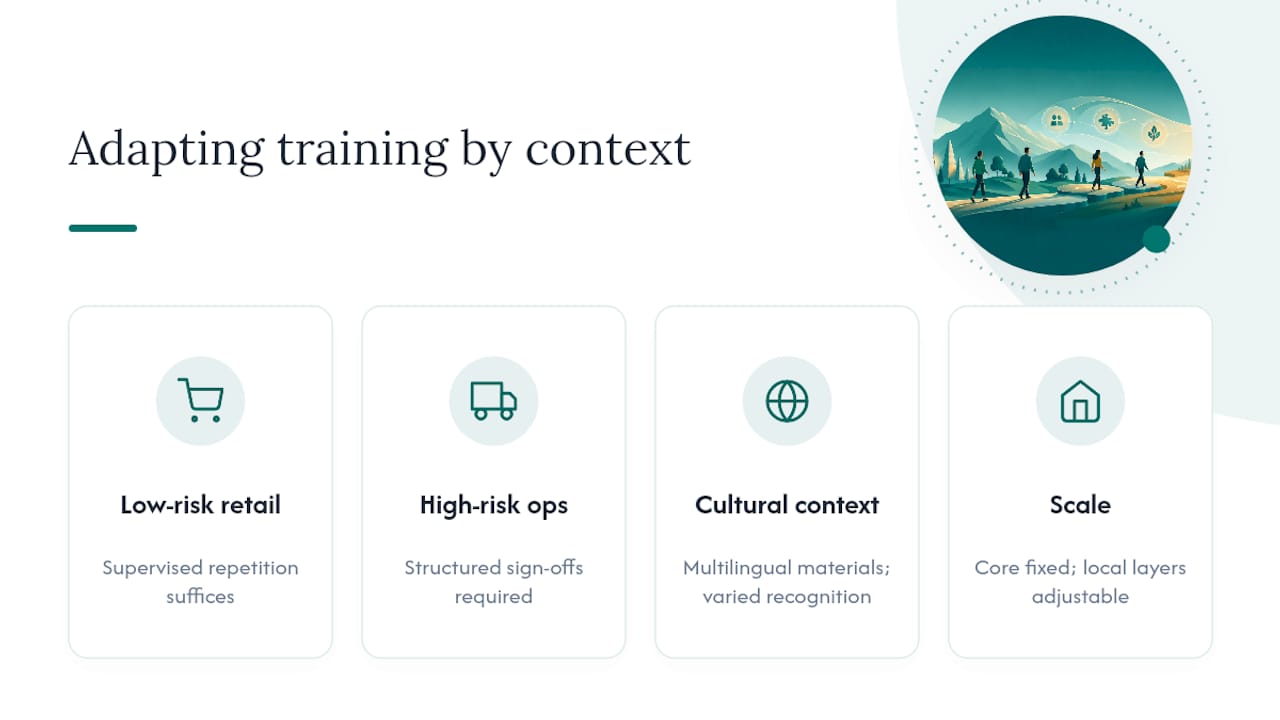
A restaurant's onboarding checklist and a warehouse's safety orientation share almost nothing in the details, but they share the same skeleton: clear objectives, hands-on practice, and a manager who checks the work.
The differences show up in pacing and risk tolerance. A retail associate can learn most tasks through supervised repetition with low stakes if something goes wrong. A warehouse forklift operator or a cleaning crew handling chemicals needs a much more structured, sign-off heavy approach before they're working unsupervised, because the cost of a mistake is physical, not just a dissatisfied customer.
Cultural context matters just as much as industry. A multilingual frontline team needs training materials and coaching conversations available in more than one language, not just translated compliance documents. Recognition also varies by culture. Public praise motivates some employees and embarrasses others, so managers coaching diverse teams need more than one recognition tool in the kit, not a single one-size-fits-all approach.
Franchise and multi-location businesses face a different adaptation challenge: consistency versus local flexibility. A national retail chain benefits from a standard training core so every location trains the same base skills, but individual store managers still need room to adjust for their specific customer base, local competition, and staff makeup. The businesses that get this right treat the core curriculum as non-negotiable and everything layered on top as adjustable.
Small, owner-operated shops face the opposite problem: not enough structure at all. A single coaching checklist and a two-week onboarding rhythm, even a simple one, beats no structure every time, because most turnover in small operations traces back to inconsistent expectations rather than bad training content.
Integrating Customer Feedback Into Development Programs
Customer feedback is one of the most underused inputs in frontline training design, mostly because it lives in a different system than the training program does.
If your reviews consistently mention slow service at a specific location, that's not a general "improve customer service" training need. That's a specific, task-level gap: maybe it's register speed, maybe it's kitchen ticket times, maybe it's a manager not stepping in during rushes. Pull the actual language customers use in reviews and complaints, and you'll usually find the real skill gap hiding in plain sight.
Build a simple feedback loop: route recurring complaint themes to the manager responsible for that location's coaching, and have them turn the top one or two themes into that month's coaching focus. This closes the loop between what customers actually experience and what gets practiced on shift, rather than training staying generic while complaints keep repeating.
Positive feedback deserves the same attention. When a customer specifically praises an employee by name, that's a coaching moment too, a chance to reinforce exactly what that person did well and make it repeatable across the team. Too many managers only use feedback to catch problems and never to identify what's already working.
A few ways to operationalize this:
- Review customer feedback themes monthly alongside your coaching metrics, not as a separate exercise.
- Translate the top recurring complaint into a specific task objective for the next coaching cycle.
- Share positive, specific customer feedback with the employee and the team, not just the manager.
- Track whether complaint themes decrease after a targeted coaching push, which tells you if the fix actually worked.
Beyond Mobile: VR, AR, and Simulation Training on the Frontline
Mobile-first tools solve access. Simulation technology solves something different: giving employees a safe place to practice high-stakes, low-frequency situations before they happen for real.
Virtual reality and augmented reality training make the most sense for scenarios that are rare, risky, or expensive to practice live. Think de-escalating a hostile customer, running an emergency evacuation, or operating heavy equipment. A new hire can run through a VR de-escalation scenario a dozen times in a week, something that would take months to encounter naturally on the floor, and arrive at the real situation having already made and corrected their mistakes in a simulation.
The catch is cost and fit. VR and AR setups require hardware, content development, and a level of investment that makes sense for larger organizations with high-risk roles or large training volumes, less so for a five-person retail shop. For most small and mid-sized frontline teams, the honest answer is that simulation technology is a "when you scale" investment, not a "start here" one. Role-play with a manager, paired with the mobile and task-based tools already covered, covers most of the same ground at a fraction of the cost for smaller operations.
Where VR and AR earn their place fastest is compliance-adjacent training: safety procedures, equipment operation, and situations where a real mistake carries real consequences. That's also where the return on the added expense is easiest to justify to whoever signs off on the training budget.
Employee Engagement Techniques That Keep Learning Going
Frontline employees don't lack the ability to learn. They lack the time, energy, and sometimes the motivation, especially when training feels disconnected from anything that actually changes for them.
Recognition tied directly to skill growth works better than recognition tied to tenure alone. Calling out a specific new competency in a team meeting, "she can now run the closing checklist solo", tells the whole team that growth gets noticed, not just attendance.
Make progress visible. An employee who can see they've completed 8 of 12 skills toward a promotion track is far more motivated than one being told vaguely to "keep developing." Visible career pathways function as a genuine retention lever, and that visibility has to be concrete, not aspirational language in a handbook nobody reads.
Peer competition, used sparingly, also works. A friendly leaderboard for completing microlearning modules or hitting task-pass milestones taps into the same motivation that makes shift competitions popular, just applied to skill building instead of sales numbers.
A few engagement habits worth building into your routine:
- Recognize skill gains publicly and specifically, not generically.
- Show visible progress toward the next role, not just "training complete" checkmarks.
- Let employees choose which optional microlearning topics to tackle next; some autonomy increases follow-through.
- Ask for feedback on the training itself and change something based on it; that alone signals the program isn't static.
Onboarding, Ongoing Development, and Career Pathways
Onboarding and development often get treated as two separate programs. They shouldn't be. Onboarding is just the first, most intensive phase of the same development plan that should carry an employee through their entire time with you.
The first week should focus on task competency: can this person do the core parts of the job safely and correctly? Learn more about our quick onboarding process at Segmento do Trabalho. The next 90 days should shift toward consistency and judgment: handling exceptions, working different shifts, dealing with the situations that don't show up in week one. After that, development should transition into the ongoing plan described earlier, tied to specific advancement milestones.
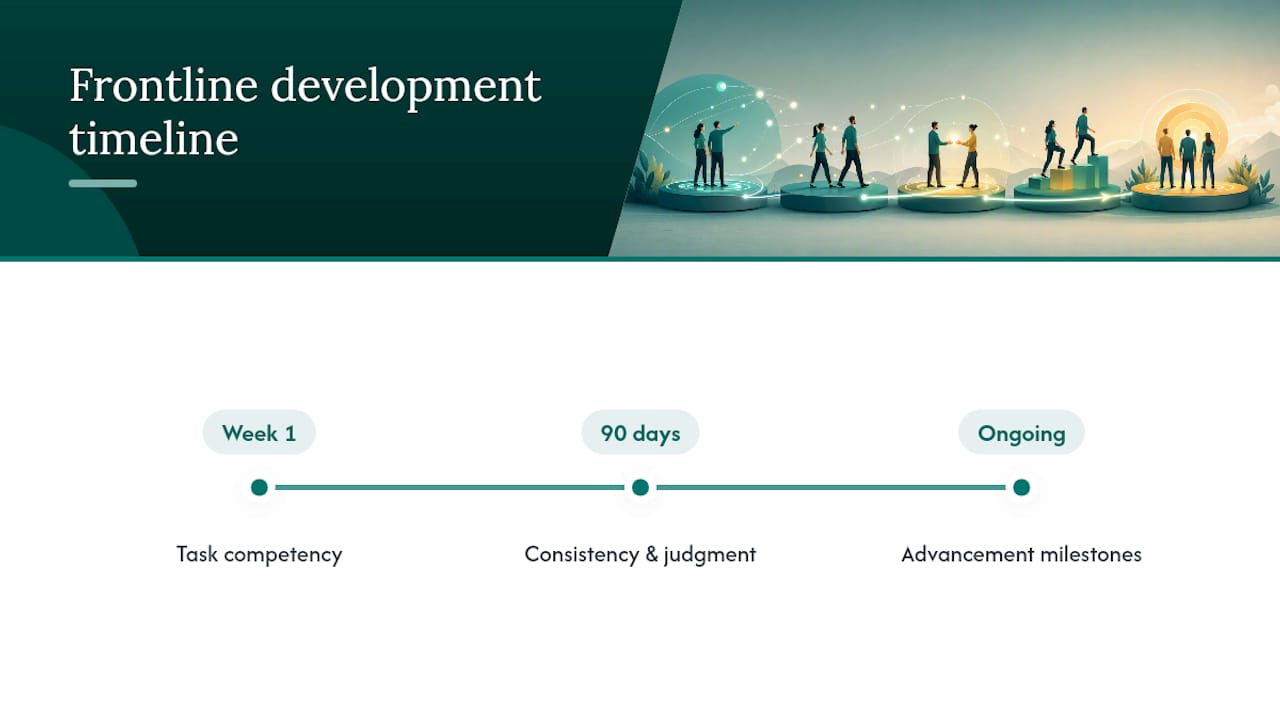
Career pathways only motivate people when they're specific and visible from day one, not something introduced six months in once someone's already frustrated. If a shift lead role exists, a new hire should know what skills lead there and roughly how long it typically takes, even if the exact timeline varies. That clarity is part of why more than 70% of frontline employees who want advancement say they don't have enough information about how to get there.
Some organizations formalize this further by reframing experienced frontline employees as leadership pipeline candidates rather than just senior staff, building structured paths that treat frontline experience as leadership preparation instead of a dead end. That reframe alone changes how both managers and employees think about what the role can become.
Manager Checklist: What to Prioritize This Quarter
Start small. Audit your current onboarding this week, not next quarter, and pick one team for a 30-day pilot. Choose one microlearning series and one coaching routine, the pre-shift brief or the weekly one-on-one, and run both consistently before adding anything else.
Operations platforms and coaching frameworks are only as good as the manager habits behind them. The businesses that get frontline development right aren't the ones with the fanciest content library. They're the ones where a manager shows up every shift and actually coaches.
— Christian
How Bossy Puts This Playbook Into Practice
Bossy is built around the exact model this guide recommends: task verification, cascading goals, and manager coaching in one system, rather than a training library sitting apart from the work itself. When a task gets marked done with photo proof, that's not just a checklist item closing. It's a real signal a manager can use in the next coaching conversation or 1-on-1, tied to the goal that task was actually supporting.
For a restaurant owner or a retail manager juggling twelve moving parts, that means scheduling, task assignment, and growth conversations live in the same place employees already check between shifts, instead of a separate app nobody opens. Bossy's feature set covers exactly the elements this guide walks through: cascading goals that connect daily tasks to bigger targets, built-in 1-on-1s and feedback tools, and analytics that show a manager where coaching actually needs to happen next.
If you're running a team of 3 to 150 frontline employees, you can start on the Free plan to see how task verification and goal cascading work in practice, or move into Operations at $30 per month as your team grows. Restaurants and multi-location retailers looking for sector-specific setups can check the restaurant task management page for a closer look at how it fits day-to-day shift work. Either way, the fastest way to know if it fits your team is to open an account and run one location through it for a week.
Sources
- What frontline employees want—and what employers think they want | McKinsey
- Inside Marriott’s Bet on Growing Leaders From the Frontline | Great Place To Work®
- The Business of Learning — Training the Frontline Workforce | TrainingIndustry
- Development planning template | SHRM
- Frontline onboarding and training guidance | Microsoft
FAQ
What Is a Frontline Employee?
A frontline employee is anyone who interacts directly with customers, products, or core operations rather than working behind the scenes in a purely administrative role. Cashiers, servers, warehouse pickers, and cleaning staff are all frontline roles because their daily work directly shapes what customers or operations experience.
What Are Some Examples of Frontline Staff?
Common examples include retail sales associates, restaurant servers and cooks, salon stylists, warehouse pickers and packers, and cleaning crew members. Any role where the work happens on the shop floor, in front of a customer, or on the operational line counts as frontline staff.
What Are Some Examples of Frontline Managers?
Frontline managers include shift supervisors, assistant store managers, restaurant shift leads, and warehouse team leads, the people directly overseeing frontline staff day to day. Their core job is coaching and verifying work in real time, not managing from a distance.
What Should a Frontline Leader Do?
A frontline leader should run short daily coaching touches, verify that tasks are actually completed correctly, and connect that day-to-day work to each employee's growth plan. Tools that combine task verification with cascading goals make it easier for a leader to do this consistently instead of relying on memory or a clipboard.
How Much Does Frontline Development Software Like Bossy Cost?
Bossy offers a Free plan with no published price, plus paid tiers starting at Growth for $25 per month and Operations at $30 per month. Larger teams can add seats for $5 per month per seat above the included threshold, with current details available on the pricing page.