Avoid a Costly Migration: Homebase Alternatives for 3–150 Frontline Teams
Christian MontenegroOctober 2, 202612 min read

If your team is outgrowing Homebase, the right alternative depends on why you're leaving. Need per-user pricing across multiple locations? Look at platforms like When I Work. Need deeper scheduling and forecasting? Deputy leads there. Need payroll built in? QuickBooks Time fits. Running a restaurant? 7shifts was built for you. If what you actually want is accountability, task verification, and operations tied to real goals, Bossy is our pick. Below, you'll find a full shortlist, a comparison, and a step-by-step way to choose.
TL;DR:
- Most teams outgrowing Homebase need a platform with deeper operational tools or integrated task verification rather than basic scheduling.
- Bossy offers a comprehensive operations system with task proof, cascading goals, inventory management, and geofenced time clocks for teams between 3 and 150 people.
- For multi-location scaling, platforms like When I Work handle per-user pricing, while Deputy provides advanced auto-scheduling and forecasting features.
- Teams with complex payroll requirements should consider QuickBooks Time for seamless hours-to-payroll integration, especially if they already use QuickBooks.
- Before switching, test data exports, overtime calculations, and payroll integrations thoroughly, and pilot the new system to avoid costly migration errors.
Table of Contents
- Your shortlist of Homebase alternatives, one by one
- How the main categories stack up
- What to check before you sign anything
- Where Bossy fits as a Homebase replacement
- What I'd actually do before switching
- A more complete alternative to Homebase
- FAQ
- Sources
Your shortlist of Homebase alternatives, one by one
Homebase built its reputation on a genuinely free plan for single-location teams, and that free tier is a big reason people stick with it. Reviews on Capterra show it's commonly praised for easy basic scheduling and a no-cost entry point for small teams. But most owners only start looking elsewhere once a specific trigger hits: a second location changes your pricing, your scheduling needs outgrow the basics, or your payroll gets complicated enough that you need tighter integration. Here's where each path leads.
Bossy takes a different starting point than most of this list. Instead of treating scheduling as the whole job, it treats scheduling as one part of a bigger operations system. Tasks get assigned with photo proof and go through a manager approval queue, so "done" actually means done, not just marked off a list. Goals cascade from company level down to shift level, so the work people do each day visibly connects to what the business is trying to achieve. Add geofenced time clocks, inventory counts and transfers, and recurring checklists, and you get a single home base (so to speak) for teams between 3 and 150 people who need more than a punch clock. Pricing runs through the Bossy pricing page: Free to start (task verification), Operations at $30 per month (adds scheduling, time clocks, checklists, and inventory; 15 users included), Growth at $25 per month (adds 1-on-1s, feedback, and team chat, but not scheduling; 15 users included), and Scale + at $50 per month (everything in both; 35 users included), with a $5 per month per-seat add-on once you exceed your plan's included users. It's best for frontline teams who need to know work actually got done, not just scheduled.
Deputy is built for operators who have outgrown manual scheduling entirely. Its standout is auto-scheduling paired with labor-cost forecasting, which matters once you're juggling multiple locations and trying to keep labor costs predictable. Review pages on Capterra and G2 consistently flag this scheduling depth as its main differentiator against lighter tools. It's best for multi-location operators who need the software to build the schedule for them, not just hold it.
Connecteam bundles scheduling, task management, and team communication into one app, which appeals to small teams that want fewer tools. It's best for a deskless team that wants one app for shift chat, basic tasks, and scheduling; check its pricing page for how the bill changes as you hire.
Sling keeps things simple: shift scheduling and shift communication, nothing more elaborate. It's best for small hourly teams that just need an easy way to build a schedule and let people swap shifts without phone tag.
QuickBooks Time exists for one reason: tight integration with QuickBooks payroll and accounting. Its standout isn't scheduling depth, it's that your hours flow straight into payroll with minimal manual entry. It's best for teams already running QuickBooks who want timekeeping that talks to their books without extra software gluing things together.
OnTheClock is a budget-focused time clock and scheduling app. Its standout is low cost paired with the basics done well. It's best for cost-sensitive small teams that need a simple, no-frills time clock rather than a full workforce platform.
Clockify runs on a freemium model with a genuinely usable free tier and wide platform support. Its standout is that teams can track time at no cost before deciding whether paid features are worth it. It's best for teams that want to try time tracking without committing budget up front.
Hubstaff adds activity monitoring and productivity analytics on top of time tracking. Its standout is visibility into how remote or distributed teams are actually spending logged hours. It's best for companies managing remote workers where attendance alone doesn't answer the real question.
When I Work is a widely used scheduling and time-tracking app for hourly teams. Check its pricing page for how costs scale with users and locations, since that changes the math for growing multi-location businesses. It's best for operators who want straightforward scheduling across sites.
7shifts is restaurant-specific, with menu-driven labor forecasting and tip management built in. Its standout is operational features that only make sense in food service. It's best for restaurants that need labor planning tied to sales forecasts and tip pooling handled automatically.
Buddy Punch sticks to straightforward punch-in and punch-out tracking with light scheduling add-ons. Its standout is simplicity: there's little to learn. It's best for small teams that just need reliable attendance tracking without a learning curve.
Jibble offers mobile-first clock-ins and a workable free tier. Its standout is how easy it is for staff to clock in from a phone, with simple reporting behind it. It's best for teams that want free or low-cost time capture without asking people to use a terminal.

ZoomShift focuses on shift planning and time tracking for hourly teams. Its standout is keeping shift scheduling simple without the added layers larger platforms carry. It's best for businesses that want shift planning done well and nothing extra to configure.
How the main categories stack up
| Category | Pricing model | Free plan | Best for | Standout feature | Payroll support |
|---|---|---|---|---|---|
| Entry-level free schedulers | Flat or free tier | Yes, limited | Single-location teams starting out | Simple shift building | Basic or none |
| Per-user advanced schedulers | Per user | Limited or none | Multi-location teams scaling headcount | Auto-scheduling and forecasting | Varies by vendor |
| Payroll-first platforms | Per employee | Rare | Teams needing payroll accuracy | Direct accounting integration | Deep, native |
| Restaurant-focused schedulers | Per location or per user | Rare | Restaurants with shift complexity | Menu-based labor forecasting | Tip and POS integration |
| Operations platforms with task verification | Per org plus per-seat add-on | Yes | Frontline teams needing accountability | Photo-proof task verification and cascading goals | Varies (Bossy has no payroll sync) |
Mapped to names: entry-level free schedulers include OnTheClock, Clockify, Jibble, and Buddy Punch. Per-user advanced schedulers include Deputy, When I Work, and ZoomShift. Payroll-first platforms are led by QuickBooks Time. Restaurant-focused schedulers point to 7shifts. Operations platforms with task verification is where Bossy sits, alongside general-purpose bundles like Connecteam and Sling that blend scheduling with light task and communication features.
What to check before you sign anything
Picking the wrong replacement costs you twice: once in the time it takes to migrate, and again when you have to migrate a second time. Work through these questions before you commit.
- How many locations and employees do you have now, and where will you be in a year?
- How complex is your payroll? Multi-state rules, contractors, and overtime calculations all change which platform fits.
- Do you need the software to build schedules for you (auto-scheduling, forecasting), or just hold the schedule you build by hand?
- What else does it need to connect to: your POS, your payroll provider, your HR system?
- Do you need an audit trail for compliance or dispute resolution, and does the platform keep one?
- Does the pricing scale per user or per location, and which shape fits your growth plan better?
When you get a vendor on a demo call, ask directly: "Can you export raw timecards in a format my accountant can use?" Ask how overtime and split shifts are calculated for your state, since rules vary and a platform that gets this wrong creates real liability. Ask whether there's a per-location floor or minimum that penalizes you for opening a smaller site. Ask what's included in onboarding, and what costs extra once you're past the trial.
Watch for a few warning signs: no audit log, no simple way to export your own data, per-location pricing with no discount as you add sites, and no payroll integration if you operate in more than one state. Accurate timekeeping isn't a nice-to-have. The U.S. Department of Labor recovered more than $259 million in back wages for nearly 177,000 workers in fiscal year 2025, a reminder of how costly sloppy hours and pay records can get.
Pro Tip: Run your current pay period's hours through both your old system and the new one before you fully switch. If the numbers don't match, you want to find out before payroll runs, not after.
Where Bossy fits as a Homebase replacement
Bossy earns its place on this list for a specific kind of buyer: the owner or manager who can't be on-site watching every task happen. Scheduling tells you who's supposed to be working. It doesn't tell you whether the prep list got done, the walk-in got restocked, or the closing checklist got followed. Bossy closes that gap.
- Task verification: photo proof plus a manager approval queue means "done" is checked, not assumed.
- Cascading goals: company targets break down into team and shift-level tasks, so daily work ties to something bigger.
- Scheduling and time clocks (Operations plan and up): geofenced clock-ins keep attendance tied to the actual job site.
- Inventory controls: stock counts, ordering, and transfers live in the same system as the schedule.
- Recurring checklists and audit logs: repeatable operational steps get tracked over time, not just once.
Bossy's own positioning statement is that it links daily tasks to company goals and lets managers verify completed work with photo proof rather than relying on checklists alone, according to Bossy's features page. That combination fits multi-site operators in restaurants, salons, fitness studios, retail, and warehouse operations where the owner isn't present at every shift and needs proof, not just a schedule, that the work got done.
What I'd actually do before switching

If I were migrating off Homebase, I'd pilot first: pick one location or one shift type, run it in parallel with your current system for a full pay period, and compare the output before you commit the whole team. Switching software always costs more than the subscription price. There's implementation time, there's the learning curve for managers, and there's the maintenance of whatever integrations you depend on, like payroll or your POS. Those hidden costs are often bigger than the price difference between tools.
Before you flip the switch, work through a short checklist: export your historical data, test-import it into the new system, confirm overtime rules match your state's requirements, train your managers on the new workflow, and run one full overlap payroll cycle to validate the numbers before you drop the old platform entirely.
— Christian
A more complete alternative to Homebase
Most Homebase alternatives solve one piece of the puzzle: better scheduling, better payroll sync, better time tracking. Bossy solves a different problem, which is knowing whether the work actually happened. Scheduling, geofenced time clocks, inventory counts, recurring checklists, and goal tracking live in one place on the Operations plan (Scale + adds team messaging), so you're not stitching together three apps to run one location.
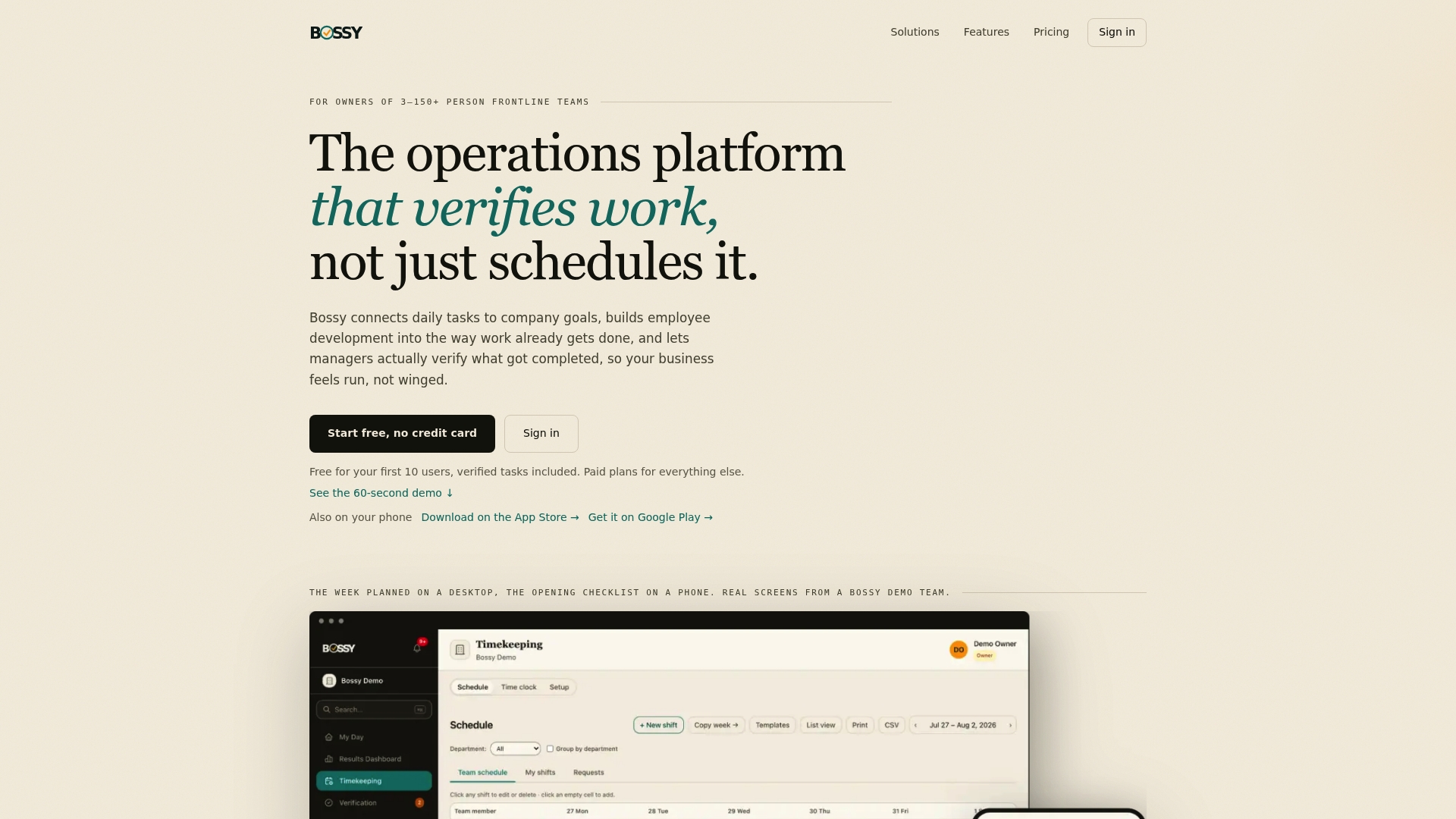
If accountability and visibility are what pushed you to look past Homebase in the first place, start with the Bossy pricing page to see which plan fits your team size, or head to Bossy to try the free plan and see how task verification changes what your managers actually have to check on.
FAQ
Is ADP better than Homebase?
ADP and Homebase serve different jobs: ADP is built primarily around payroll and HR compliance, while Homebase focuses on scheduling and time tracking for small teams. Neither is strictly "better," since the right choice depends on whether your main pain point is payroll complexity or basic scheduling.
What is the best employee scheduling software?
There's no single best option, since the right scheduling software depends on your trigger. Deputy and When I Work lead on advanced scheduling and forecasting, 7shifts is purpose-built for restaurants, and Bossy is our pick when you also need task verification and goal tracking tied to the schedule.
What is an app called Homebase anyway?
Homebase is a scheduling and time-tracking app aimed at small businesses, known for a free plan aimed at basic shift scheduling and timekeeping for a single location (check its pricing page for current limits). It's widely reviewed on Capterra for that free tier and its ease of use for small teams.
What is Workday software similar to?
Workday is an enterprise HR and finance platform, so its closer peers are large-scale HR and payroll systems rather than small-business scheduling apps like Homebase. For small or growing frontline teams, platforms like QuickBooks Time or Bossy address similar needs at a much smaller scale and price point.
Sources
- U.S. Department of Labor news release — WHD recovered back wages (Jan 8 2026)
- Homebase reviews on Capterra