Verify Work Done: 7 Step Internal Communication Plan for Managers
Christian MontenegroSeptember 12, 202615 min read
An internal communication plan is the operational document that turns strategy into who says what, to whom, when, and how, and it should tie directly to business outcomes like retention and productivity. If you don't have one, start today with a one-week communications audit. Trusted frameworks from Poppulo, the GSIC 2026 report, and platforms like Bossy all point the same direction: plan first, then verify the work got done.
TL;DR:
- Effective internal communication plans require clear, measurable goals tied to specific business KPIs, such as reducing shift no-shows by 15%.
- Audience segmentation should account for role, location, device access, language, and shift patterns to tailor messages effectively.
- Tracking metrics beyond open rates, including task completion and behavior change, is essential to measure actual impact on business outcomes.
- Regular governance, assigning content owners, review dates, and expiry triggers, keeps communication accurate and prevents outdated information.
- Prioritizing ownership and resource allocation on key messages yields better results than continuously expanding channels or content volume.
Table of Contents
- What Goes Into an Internal Communication Plan?
- Why an Internal Communication Plan Actually Moves the Needle
- How Do You Build an Internal Communication Plan Step by Step?
- How Do You Segment Frontline and Hybrid Audiences?
- How Do You Choose Channels and Set Cadence?
- How Do You Keep a Communications Calendar and Governance Clean?
- How Do You Measure the Success of an Internal Communication Plan?
- How Do You Build Two-Way Feedback Into the Plan?
- Templates and a 30/60/90 Calendar for a Policy Rollout
- How Bossy Supports Execution, Not Just Messaging
- What Should Leaders Prioritize First When Resources Are Limited?
- Turn Your Communication Plan Into Completed Work
- Sources
- FAQ
What Goes Into an Internal Communication Plan?
An internal communication plan isn't a newsletter schedule. It's the document that translates a strategy into specific, executable decisions, and most credible frameworks agree on the same skeleton. According to Poppulo, the plan needs goals, audience segments, messaging pillars, channel choices, cadence, ownership, and metrics working together, not sitting in separate documents nobody checks.
Here's what a complete plan actually contains:
- Goals written as SMART objectives, tied to a business KPI like retention, safety compliance, or shift coverage, not vague aims like "improve culture."
- Audience map breaking employees into segments by role, location, and access to a computer or shared device.
- Messaging pillars that define the two or three core themes leadership wants repeated all year.
- Channels matched to each audience, so a frontline shift worker isn't relying on an email they'll never open.
- Cadence that spells out how often each message type repeats, so nothing goes stale.
- Ownership assigning a name, not a department, to every recurring message.
- Metrics that go past open rates into whether people actually acted on what they read.
Missing even one of these usually explains why a plan looks good on paper but falls apart in week three. If your current plan can't answer "who owns this" for every message type, that's your gap to close first.
Why an Internal Communication Plan Actually Moves the Needle
Leaders often treat communication plans as a nice-to-have until the data forces a rethink. Organizations using social technology and structured internal communication tools see employee productivity gains of 20% to 25%, largely because employees who understand company goals contribute more directly to operational results.
A 20-25% productivity swing is on the table when communication tools are used well, not just installed. That's the gap between a team that reads an announcement and a team that acts on it.
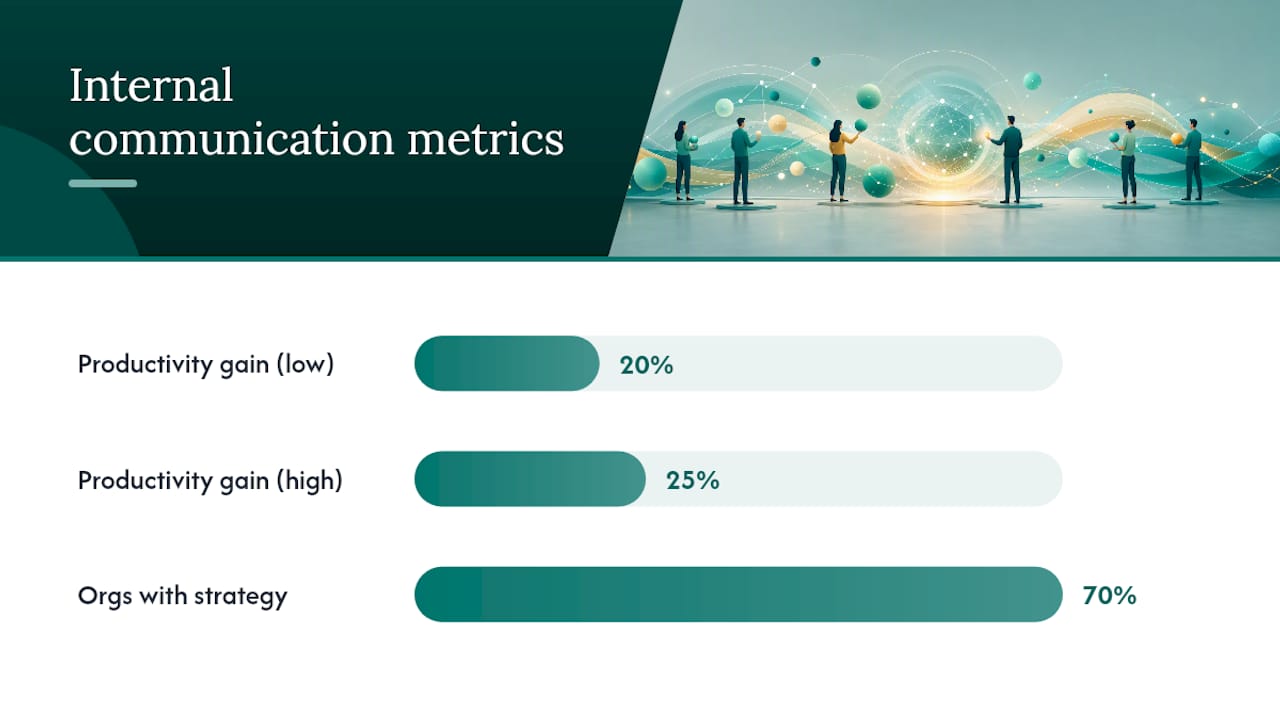
The catch is execution. The GSIC 2026 report finds that 70% of organizations already have a communication strategy, but many lack the resources or systems to actually deliver on it. Having a plan on a slide deck and having a plan that changes behavior are two different things.
A plan built with real ownership and cadence closes that gap in a few concrete ways:
- It cuts through noise by limiting how many "urgent" messages compete for attention in a given week.
- It gives managers a script instead of asking them to improvise leadership talking points on the fly.
- It creates a paper trail, so when engagement dips, you can trace it back to a specific channel or message failure instead of guessing.
- It shifts measurement from "did people open it" to "did people change what they did."
Treating internal communication as a strategic discipline, with visible leadership alignment and consistent follow-through, is what separates a plan that gets read from one that gets ignored, as shown in Business Strategy and Project Management Services.
How Do You Build an Internal Communication Plan Step by Step?
This is the sequence we'd hand to any manager starting from zero, adapted from stepwise models like the SPRC GLS workbook, which built its own 8-step model around assessment, measurable goals, audience segmentation, and iterative testing. Here's a leaner 7-step version built for teams that need to move fast.
-
Run a situation audit. Spend one week mapping every channel currently in use, every recurring message type, and who (if anyone) owns each one. Deliverable: a single spreadsheet listing channel, message, frequency, and owner. Timebox: 5 business days. If you can't name an owner for a channel, that's your first fix.
-
Set outcomes, not just goals. Turn vague intentions ("improve engagement") into SMART objectives tied to a business KPI: reduce shift no-shows by 15% in a quarter, or get 90% of staff to complete a safety training module within two weeks. Deliverable: a one-page objectives sheet, reviewed by whoever owns the connected KPI.
-
Segment your audience by access, not just role. A corporate office worker and a warehouse picker need different plans even if their job title says "operations." Map by device access, shift pattern, language, and location. Deliverable: an audience matrix with 4 to 8 defined segments.
-
Build your message architecture. Decide the two or three pillars every message should reinforce (safety, growth, company direction, whatever fits your business), and write simple language rules: no jargon, one call to action per message, plain sentences a new hire could understand on day one. Deliverable: a one-page style guide.
-
Match channels to cadence. Not every message deserves the same channel or frequency. Urgent shift changes need something immediate; culture updates can wait for a weekly digest. Deliverable: a channel-cadence matrix mapping message type to platform and frequency.
-
Build the calendar and approval workflow. Every message needs a slot, a deadline, and a named approver before it goes out. Deliverable: a shared communications calendar with owner and review-date columns filled in.
-
Set your measurement plan. Decide upfront which metrics you'll track (not after the campaign launches), how often you'll report them, and what triggers a change in strategy. Deliverable: a one-page dashboard template with a monthly review trigger.
Each step produces something tangible. If a step doesn't end with a document, a name, or a date attached, it isn't done yet, and pretesting your messages with a handful of real employees before a full rollout, as recommended in the SPRC GLS workbook, catches confusing language before it reaches everyone.
How Do You Segment Frontline and Hybrid Audiences?
Audience segmentation is where most plans quietly fail. A plan written for desk workers, then applied to a frontline retail or warehouse team, will underperform no matter how good the messaging is.
Map your audience against these dimensions before you write a single message:
- Role: manager, supervisor, hourly worker, contractor. Each needs different depth and different framing.
- Location: single site, multi-site, or remote. A multi-site retail chain can't rely on one bulletin board.
- Device access: does this person carry a company phone, use a shared tablet, or have no device at all during shifts?
- Language: don't assume English-only if your workforce is multilingual, especially in hospitality, cleaning, and warehouse operations.
- Shift pattern: a message sent at 9 AM misses anyone on a night shift entirely.
For a restaurant crew, that might mean a printed bulletin at the timeclock plus a short voice note in the team chat, rather than a long email nobody has time to read between orders. For a hybrid marketing team, a Slack update might be enough. For a cleaning company with staff working alone across multiple client sites, a quick check-in call or app notification tied to task completion often beats any written update. Low-bandwidth channels combined with a way to confirm the message landed tend to outperform frequent email blasts for teams without regular screen time.
How Do You Choose Channels and Set Cadence?
Channels aren't interchangeable, and picking the wrong one for the wrong message is the fastest way to train employees to ignore you. Think in four categories: broad reach (email, intranet, digital signage), immediate or urgent (SMS, push notification, team chat), depth or reference (a wiki, an intranet page, a policy document), and face-to-face (team huddles, one-on-ones, town halls).
Cadence rules matter as much as channel choice:
- Urgent operational changes go out immediately, on the fastest channel your audience actually checks.
- Reinforcement messages (culture, values, recurring reminders) repeat weekly or biweekly, but should rotate format so they don't feel like spam.
- Reference material (policies, handbooks) lives on a stable channel and gets referenced, not resent, every time it's relevant.
- One-time announcements get a single push plus one reminder, never a constant drip.
A shift change notice works as a two-line SMS. A quarterly strategy update works as a recorded town hall plus a written recap. Matching format to urgency is half the battle.
Pro Tip: If a message needs to be read AND acted on, don't just publish it. Pair it with a task or a checklist item someone has to physically mark complete. A read receipt tells you it was seen. A completed task tells you it worked.
How Do You Keep a Communications Calendar and Governance Clean?
A calendar without governance turns into a graveyard of outdated announcements. Every entry needs enough structure that anyone on the team can see what's happening and who's accountable, without asking around.
Track these fields for every calendar entry:
- Message topic and the pillar it supports
- Target audience segment
- Channel and format
- Owner (a name, not a team)
- Deadline for publishing
- Review or expiry date
Approval workflows bottleneck when too many people sign off on low-stakes content. A useful pattern: routine updates need one approver, sensitive topics (layoffs, policy changes, safety incidents) need two, and nothing sits in a review queue longer than 48 hours without an escalation.
| Governance Element | Purpose | Review Frequency |
|---|---|---|
| Content owner assignment | Accountability for accuracy | At publish and at every review date |
| Expiry or review date | Prevents stale info from misleading staff | Set at creation, checked quarterly |
| Approval tier (low/medium/high sensitivity) | Speeds up routine content, slows down risky content | Reviewed per message |
Assigning an owner and an expiry date to every piece of content is what keeps an intranet or hub credible as a single source of truth. When content passes its review date, mark it unverified or take it down. Don't let outdated policy pages sit live just because nobody remembered to check them.
How Do You Measure the Success of an Internal Communication Plan?
Most communicators measure the easy things: employee feedback, open and click rates, engagement scores. GSIC 2026 data shows 77% track feedback, 65% track open rates, and 61% track engagement scores, but far fewer can show a direct line to business outcomes.
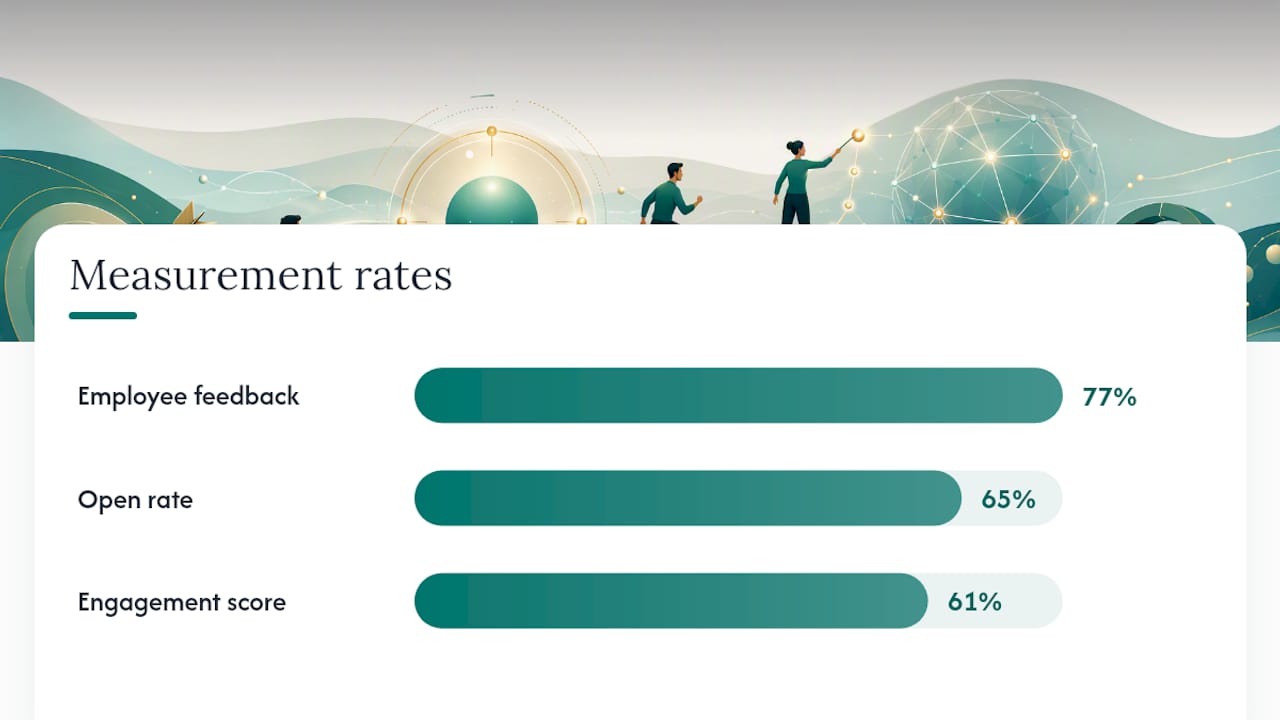
Most plans stop measuring at "did they open it" instead of "did it change what they did." That gap is exactly where credibility with leadership gets lost.
Track metrics in tiers, not just one flat list:
- Reach: delivery rate, open rate, view count.
- Engagement: click rate, poll response rate, comment activity.
- Behavior: task completion rate, training completion, policy acknowledgment.
- Business outcome: retention rate, safety incidents, shift coverage, sales metrics tied to a campaign.
Build a one-page dashboard that reports reach and engagement weekly, behavior metrics monthly, and business outcomes quarterly. When a metric stalls, that's your signal to reallocate effort, maybe a channel needs replacing, or a message needs rewriting, rather than just sending the same update more often.
How Do You Build Two-Way Feedback Into the Plan?
A plan that only broadcasts isn't a communication plan, it's a bulletin board. Structured feedback loops, through short surveys and open Q&A sessions, help leaders catch problems early and prove that employee input actually changes something.
Keep the mechanism simple:
- Pulse surveys sent monthly, capped at 3 to 5 questions so completion stays high.
- Quick polls embedded directly in team chat or app notifications, answerable in seconds.
- Manager check-ins on a fixed schedule, not just when something's wrong.
- Open AMA sessions with leadership quarterly, with questions submitted anonymously ahead of time.
Route every response through a clear triage: a designated reviewer sorts feedback within 48 hours, an accountable owner acts on anything flagged urgent within a week, and a summary of what changed goes back to the team within two weeks. Skipping that last step is why most feedback surveys stop getting honest answers after the first round.
Templates and a 30/60/90 Calendar for a Policy Rollout
Copy these into your calendar as starting points, not finished copy:
- CEO update: "This quarter we're focused on [goal]. Here's what changes for your team and why it matters."
- Manager cascade: "Here's what leadership shared this week. Your team needs to know [specific point] by [date]."
- Frontline bulletin: "Starting [date], [policy change]. Questions? Ask your shift lead or check the board."
A sample rollout for a new scheduling policy:
- Day 1-30: Audit current scheduling complaints, draft the new policy, pretest language with a handful of shift leads.
- Day 31-60: Announce via manager cascade, post printed bulletins at timeclocks, run a short Q&A session.
- Day 61-90: Measure adoption through schedule adherence data, collect feedback, adjust wording if confusion persists.
Before anything ships, run it through a short checklist: reviewed by the message owner, translated if your workforce needs it, and tested on one real employee outside the leadership team.
How Bossy Supports Execution, Not Just Messaging
A plan is only as good as the follow-through, and that's where most execution gaps show up in GSIC 2026 data. Bossy's platform features exist specifically to close that gap for frontline and hybrid teams.
- Task verification with photo proof confirms a message led to completed work, not just a read receipt.
- Cascading goals connect a company-wide objective down to what a single shift worker does today.
- Scheduling and geofenced time clocks make sure the right message reaches the right person during their actual shift.
- Team chat, announcements, and polls give managers one place to send, and measure, communication instead of juggling five apps.
Pro Tip: If your current plan can't tell you whether a message resulted in a completed task, you're measuring attention, not results. Verification closes that gap.
What Should Leaders Prioritize First When Resources Are Limited?
Start with ownership, not more channels. GSIC 2026 shows most organizations already have a strategy; the gap is resourcing and follow-through. Pick one recurring message with no clear owner, assign one, and add a single behavior metric. Review progress quarterly before adding anything new.
— Christian
Turn Your Communication Plan Into Completed Work
A written plan tells people what should happen. Bossy is built for the part that actually determines whether it does: task verification with photo proof, cascading goals that connect a company priority to a single shift task, scheduling that puts the right message in front of the right person, and built-in chat and announcements so managers aren't juggling five separate apps to say one thing.
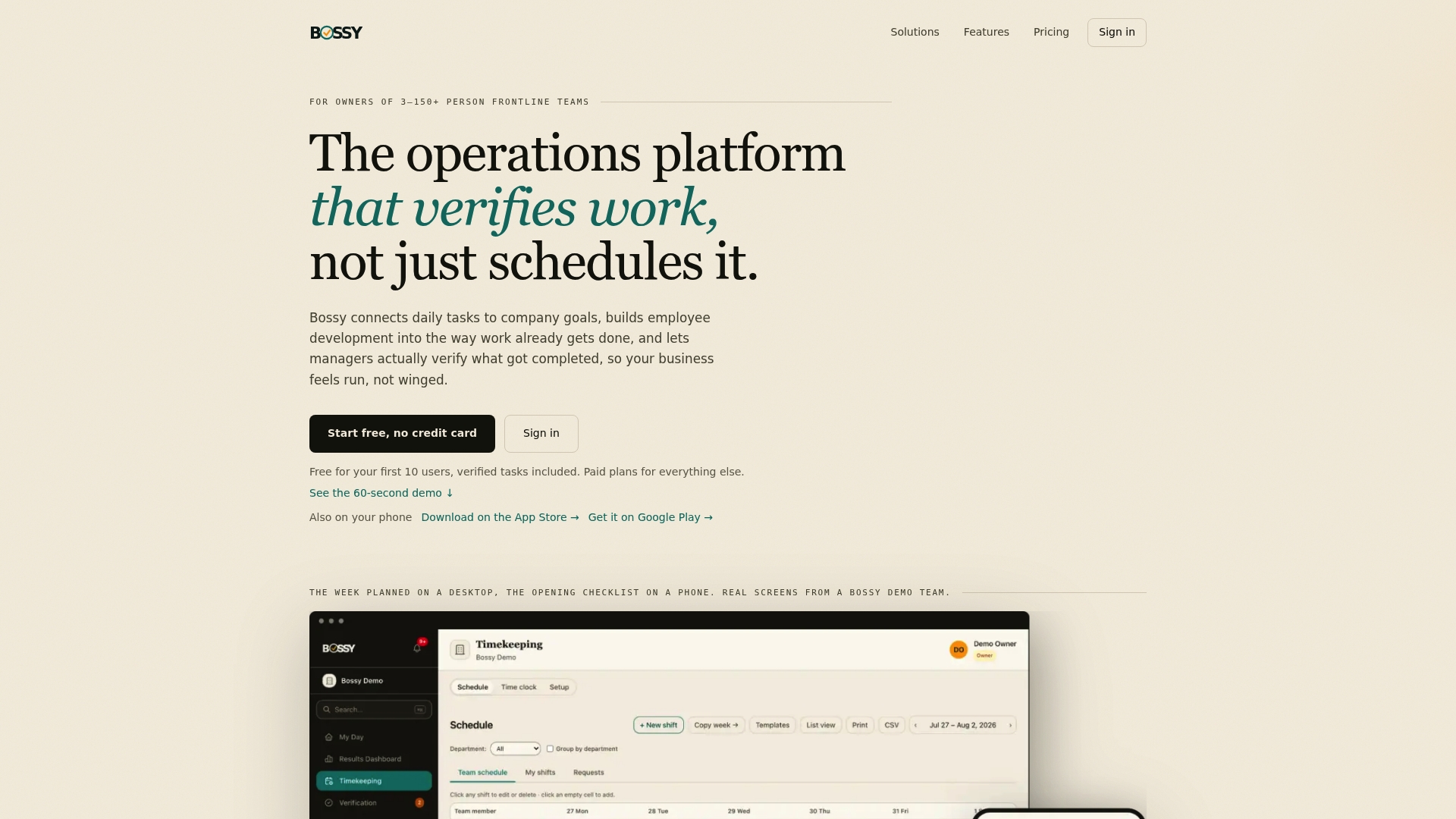
If you run a restaurant, retail location, salon, or any team with frontline staff between 3 and 150 people, Bossy's platform maps directly onto the plan you just built: ownership assigned per task, cadence tracked automatically, and a record of what actually got done instead of just what got sent. Restaurant operators can see how this plays out on the restaurant-specific page. Explore available operations platforms to turn this quarter's communication plan into completed work you can verify.
Sources
- Global State of Internal Communications (GSIC 2026)
- What is an Internal Communication Plan and How to Build One | Poppulo
- McKinsey productivity finding (via Jazzcode summary)
- GLS Communication Planning Workbook | SPRC
FAQ
What are examples of internal communication?
Common examples include team chat messages, manager cascades, town halls, printed shift bulletins, intranet policy pages, pulse surveys, and one-on-one check-ins.
What are the 5 C's of effective communication?
Definitions vary across sources, but most versions emphasize being clear, concise, consistent, complete, and courteous when crafting any workplace message.
What are the four types of internal communication?
Most frameworks group internal communication into leadership-to-employee updates, manager-to-team cascades, peer-to-peer collaboration, and employee-to-leadership feedback channels.
What should be included in a communication plan?
A complete plan needs clear goals, an audience map, messaging pillars, channel and cadence decisions, named ownership, and metrics that track behavior and business outcomes, not just open rates.
How do you measure whether an internal communication plan is working?
Track reach and engagement weekly, behavior metrics like task completion monthly, and business outcomes like retention or safety incidents quarterly, since GSIC 2026 data shows most teams stop at feedback and open rates rather than outcomes.