Photo Verified Lattice Alternatives for 3–150 Frontline Teams
Christian MontenegroOctober 5, 20268 min read

Bossy is our pick as a Lattice alternative for businesses with frontline teams, because it links daily tasks directly to company goals and verifies that the work actually got done, not just scheduled. Lattice and similar platforms were built for desk-based performance reviews, not shift-based operations. Below, we compare Bossy against six other options so you can see what fits your team.
TL;DR:
- Bossy effectively verifies task completion with photo proof and manager approval, ensuring accountability for frontline work environments.
- Mobile access using SMS or mobile web significantly increases staff adoption, especially compared to native app requirements.
- A phased, short-term pilot over 2 to 4 weeks with micro-training minimizes operational disruption and accelerates staff onboarding.
- General HR platforms are typically more affordable initially but lack the operational verification features needed for shift-based tasks.
- Bossy’s integration of scheduling, time clocks, and inventory management reduces reliance on multiple systems, streamlining frontline operations.
Table of Contents
- The shortlist: Lattice alternatives worth comparing
- How to pick the right alternative for your frontline team
- Rolling out a new platform without disrupting your team
- Why operations-first beats performance-first for frontline teams
- See Bossy's plans and get started
- FAQ
- Sources
The shortlist: Lattice alternatives worth comparing
Lattice does performance reviews well for office teams, but most frontline businesses need something that tracks whether the walk-in cooler got checked, not just whether a quarterly review got filed. That's the gap this shortlist addresses.
Bossy is our pick because it treats operations and people development as one system (Operations covers checklists, photo proof, and cascading goals; Growth covers 1-on-1s and feedback; Scale + includes both). Instead of separate modules for goals and a separate checklist app for tasks, it cascades company goals down into the daily tasks your team actually completes, then verifies completion with photo proof and a manager approval queue. For a restaurant, salon, or multi-location retail operation, that's the difference between hoping work got done and knowing it did.
The other six options split roughly into two camps: specialist performance platforms and general HRIS systems with performance features bolted on.
- 15Five focuses on continuous feedback and structured review templates, built for organizations centered on people-development cycles rather than daily task tracking.
- Leapsome pairs performance management with OKRs and learning paths, a fit for companies that want goal-setting tied to formal training programs.
- Profit.co is an OKR-first platform, strongest for organizations that want to standardize goal-setting and measure alignment across departments.
- HiBob (HRIS) combines core HR data with performance and engagement tools, suited to companies that want one system for people data and reviews.
- BambooHR (general HRIS) bundles payroll, recruiting, and basic performance tools, a pick for teams that want broad HR coverage without paying for a specialist suite.
- Zenefits (general HRIS) centers on payroll and benefits, with performance modules available at higher tiers for teams that prioritize compliance basics first.
General HR platforms often start at lower per-user prices than specialist performance suites, which makes them attractive when a team only needs surface-level reviews alongside payroll. The trade-off is that none of them verify whether a task on the floor actually happened.
Bossy also offers a Free plan with task verification and a manager approval queue, which gives SMBs a low-risk way to test the approach before committing to a paid tier.
How to pick the right alternative for your frontline team
Choosing among these options comes down to five questions you should be able to answer before you sign anything.
- Does it work without a native app download? Frontline staff often resist installing another app on their personal phone. SHRM reporting on mobile engagement finds that SMS or mobile-web access tends to see higher adoption than platforms that require a native app, largely because of privacy and battery concerns.
- Can it verify task completion, not just assign it? Look for photo proof and a manager approval queue, not just a checklist that anyone can tap "done" on without accountability.
- What's the real cost once you add seats? Per-seat add-on fees stack fast once you cross the included user band, so ask for the total at your actual headcount, not the advertised starting price.
- Does it connect to scheduling, payroll, POS, and inventory? A tool that lives apart from your other systems becomes one more login nobody checks.
- How fast can a new manager get a team running on it? A long implementation window is a red flag for a frontline business that can't pause operations to train.
Watch for vendors who dodge questions about per-user fees above a certain tier, or who can't explain mobile access without mentioning a native app download.
Pro Tip: Ask every vendor to show you their mobile interface on a personal phone during the demo, not just the desktop dashboard. That's what your team will actually use.
Rolling out a new platform without disrupting your team
A phased rollout beats a company-wide flip. Run a 2 to 4 week pilot with one location or one shift, refine based on what breaks, then expand team by team.
- Week 1 to 2: Train managers first and let them run the tool alongside their current process.
- Week 3 to 4: Add staff with short, text-based micro-training rather than a long classroom session.
- Week 5 onward: Expand to additional locations once the pilot team shows steady task completion.
SHRM research on frontline training finds that text-based and micro-training approaches accelerate adoption among hourly workers more than formal sessions do. Keep mobile use opt-in and clearly outside paid hours to avoid turning a convenience into an unpaid obligation.
Training is usually what decides whether a new tool sticks. Track activation rate, task completion verified by photo proof, manager approval turnaround, and whether staff retention improves once accountability becomes visible.
Why operations-first beats performance-first for frontline teams

Most performance platforms assume someone sits at a desk long enough to fill out a review form. Frontline work doesn't run that way. A shift supervisor cares whether the prep list got done before the lunch rush, not whether a quarterly self-assessment got submitted on time.
That's the case for building goal tracking into daily task completion instead of treating it as a separate HR exercise. When a cascading goal shows up as a task a shift lead can check off with photo proof, managers get real visibility into whether the business is actually moving toward its targets, not just whether paperwork got filed. Task verification through photo proof and an approval queue turns "I think it got done" into "I can see that it got done," and that shift in visibility is what tends to improve both accountability and retention on frontline teams.
— Christian
See Bossy's plans and get started
If your team needs to see work get done, not just scheduled, a short trial on Bossy will show you the difference within a pilot cycle. Our plans page lists every tier, including a Free plan for task verification and paid plans ranging from $25 to $50 per month depending on features and team size (photo proof, scheduling, and inventory start on Operations at $30).
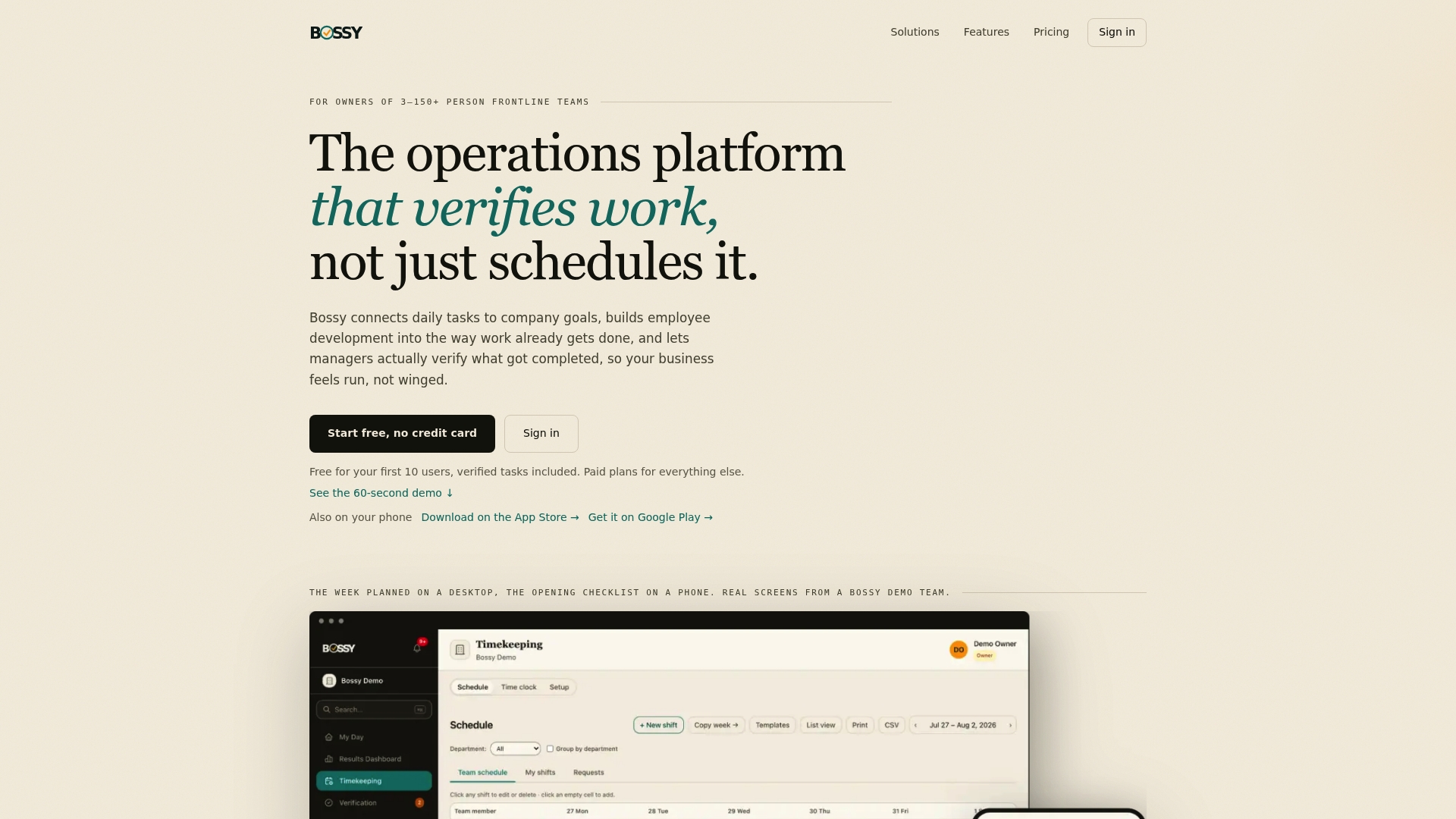
Visit our product overview to see how task verification, scheduling, and cascading goals work together, or check out our dedicated page for restaurant teams if that's your setting. Starting a trial takes a few minutes and no long-term contract.
FAQ
What is the best Lattice alternative for small frontline teams?
Bossy is built specifically for frontline teams between 3 and 150 employees, linking daily tasks to company goals with photo-proof verification. A Free plan covers task verification; paid plans run $25 to $50 per month, with photo proof and cascading goals on Operations ($30) and Scale + ($50), all listed on our pricing page.
Do Lattice alternatives work well on mobile for hourly staff?
Mobile adoption tends to be higher when a platform uses SMS or mobile web instead of requiring a native app download, according to SHRM research on frontline engagement. Native apps raise privacy and battery concerns that reduce uptake among hourly workers.
Are general HRIS platforms cheaper than specialist performance tools?
General HR platforms like BambooHR or Zenefits often advertise lower starting per-user prices than specialist suites, according to a Lattice review from Business.org. The trade-off is usually a simpler feature set with less focus on operations.
How long does it take to roll out a new frontline operations platform?
A phased rollout over 2 to 4 weeks, starting with one pilot team before expanding, tends to minimize disruption. Manager-first training followed by short micro-training sessions for staff speeds up adoption more than a single company-wide launch.
Does Bossy integrate with scheduling and inventory tools?
On the Operations and Scale + plans, Bossy combines scheduling, geofenced time clocks, and inventory control directly in the platform rather than relying on separate integrations for those functions. Details are available on our features page.