Retail Teams: Fix Inventory Tracking in Two Weeks
Christian MontenegroSeptember 26, 202615 min read

The best approach to retail inventory tracking is perpetual, item-visible tracking supported by a POS and backend system that actually talk to each other. If you're still counting on paper or eyeballing shelves, start smaller: pick your highest-velocity SKUs, run a two-week cycle count pilot with mobile scanning, and build from there.
TL;DR:
- Perpetual inventory tracking with real-time POS and backend communication is best for growing retailers, especially across multiple channels.
- Cycle counting using ABC analysis is an efficient way to maintain accuracy, focusing on top-selling SKUs weekly and slow movers quarterly.
- Accurate item-level tracking is essential for perishables, regulated goods, and products with expiry dates, enabling effective recall and FEFO rotation.
- Proper backend integration and staff training are critical; at least a four-week pilot can identify issues before full implementation.
- Using task verification with photo proof and routine reconciliation improves accuracy and closes the gap between software adoption and actual stock correctness.
Table of Contents
- What Should You Check Before Choosing a Tracking Method?
- Periodic, Perpetual, or Cycle Counting: Which Fits Your Store?
- Do You Need RFID, or Will Barcodes Do the Job?
- What Should You Demand From Retail Inventory Software?
- How Do You Roll Out Inventory Tracking Without Disrupting Operations?
- Why Is "Total Retail Loss" a Better Metric Than Shrink?
- What Actually Determines Whether This Works?
- How Bossy Helps You Verify Inventory, Not Just Count It
- FAQ
What Should You Check Before Choosing a Tracking Method?
Before you pick software, method, or hardware, run through a short scope check. It's the difference between building a system that fits your store and buying a tool that solves someone else's problem.
Start with the questions that shape everything else. How many SKUs do you carry, and across how many channels? A boutique with 200 SKUs and one register has different needs than a five-location retailer selling online, in-store, and through marketplaces. Do any of your products expire, spoil, or carry recall risk? If you sell food, cosmetics, or supplements, item-level tracking stops being optional.
From there, map your must-have integrations. Your tracking system is only as good as what it connects to:
- POS integration so sales automatically decrement stock in real time
- E-commerce sync if you sell online, so a sale on your website doesn't overstate what's left in the store
- Accounting software connection to keep your books and your shelves telling the same story
- Warehouse management links if you run a distribution center or backroom stockroom feeding multiple locations
Then rank your operational priorities. Most retailers get more value from fixing receiving controls and training staff on cycle counts than from buying the most expensive software on the market. Bigger investments, like RFID tagging or a full warehouse management system, make sense once your basics are solid and your volume justifies the cost.
Pro Tip: Run your decision checklist against your top 10 SKUs first. If a tracking method or software can't handle your bestsellers cleanly, it won't handle your whole catalog either.
Periodic, Perpetual, or Cycle Counting: Which Fits Your Store?
Periodic and perpetual are the two core tracking models, and most retail inventory tracking problems trace back to picking the wrong one.
Periodic tracking means you count inventory at set intervals, often monthly or quarterly, and update your records in one batch. It's cheap and simple, but it leaves you blind between counts. You won't know you're out of stock on a bestseller until a customer tells you, or worse, until the sale is lost silently.
Perpetual tracking updates stock levels continuously as items sell, get received, or move between locations. Every transaction touches the record immediately. This is the model most growing retailers need, especially once you sell across more than one channel, because it gives you a live picture instead of a monthly snapshot.
Cycle counting bridges the two. Instead of shutting down the store for a full physical count, you count a rotating subset of inventory on a regular schedule. The most common method uses ABC analysis, often called the 80/20 rule: your "A" items (roughly 20% of SKUs that drive about 80% of sales or value) get counted weekly or biweekly, "B" items monthly, and "C" items quarterly. This keeps your highest-risk, highest-value stock accurate without burning labor hours on slow-moving items.
Here's a simple cadence framework to adapt:
- A-tier SKUs (top sellers, high value): count weekly, use mobile scanning to speed it up
- B-tier SKUs (moderate movers): count monthly, spot-check for damage or shrink
- C-tier SKUs (slow movers, low value): count quarterly, focus more on shelf accuracy than precision
- Regulated or perishable goods: move to item-level tracking regardless of tier, using batch, lot, or expiry data
Item-level tracking becomes necessary the moment expiry dates, recalls, or serialized goods enter the picture. Grocery, pharmacy, cosmetics, and electronics retailers all hit this wall eventually. Tracking at the batch or serial level lets you enforce first-expired-first-out (FEFO) rotation and, more importantly, lets you isolate exactly which units are affected during a recall instead of pulling your entire shelf.
The signal that it's time to leave spreadsheets behind is usually a specific moment, not a gradual feeling. It's the day a spreadsheet formula breaks because two people edited it at once, or the day you can't tell if a stockout is real or just a data entry lag. Practitioner guidance from GS1 suggests prioritizing cycle counts by SKU velocity and known loss risk, and reserving item-level tracking for cases where regulatory exposure or shrink actually justifies the added cost.

Do You Need RFID, or Will Barcodes Do the Job?
Barcodes, 2D codes, and RFID all solve the same core problem differently, and picking the wrong one wastes money either way.
Traditional 1D barcodes (the black-and-white stripes you already know) work fine for basic SKU-level scanning. They tell you what the item is, but not much else. GS1's guidance on 2D barcodes points to a bigger shift: modern 2D codes, like QR-style Data Matrix codes carrying GS1 Digital Link data, can hold batch numbers, expiry dates, and serial numbers in the same scan. That's the technical foundation that makes FEFO rotation, targeted recalls, and full traceability possible.
Here's the catch almost nobody talks about: scanning richer data does nothing if your backend can't use it. A 2D barcode can carry an expiry date, but if your inventory software only reads the GTIN and ignores everything else, you've paid for capability you're not using. Backend readiness, meaning your POS, warehouse system, or inventory platform can actually persist and act on batch and expiry data, is what determines whether GS1-compliant barcodes deliver real value or just look sophisticated on the shelf.
RFID sits at a different price and use point. It reads multiple items at once without line-of-sight scanning, which makes it powerful for full-store cycle counts or high-shrink categories. NRF reporting shows retailers increasing investment in item-level identification like RFID as loss and theft become bigger enterprise concerns. But RFID tags cost more per unit than printing a barcode, so it tends to make financial sense for apparel, electronics, and other higher-theft categories before it makes sense for a corner grocery.
Before you go live with any of these, test the mechanics that quietly break implementations:
- Scan test every barcode type across your actual lighting and shelf conditions, not just at a demo desk
- Check print quality on labels, since a smudged barcode defeats the whole system
- Validate data at receiving, confirming that what the scanner reads matches what your backend records
- Confirm your mobile scanning app works offline, since stockroom Wi-Fi dead zones are more common than most people expect
What Should You Demand From Retail Inventory Software?
Feature lists are easy to write and hard to evaluate. Focus on what actually changes your day-to-day operations, not what sounds impressive in a sales deck.
Real-time visibility across every channel is the baseline, not a bonus. If you sell in-store and online, your software needs available-to-promise logic, meaning it knows what's genuinely sellable right now versus what's already reserved for a pending order. Without this, you'll oversell online what's already walked out the door in-store.
Lot, serial, and expiry support matters even if you don't think you need it yet. Once you add a perishable line, a warranty-tracked electronics category, or a regulated product, you'll want software that already supports FEFO and FIFO enforcement rather than one you have to migrate away from under pressure.
Receiving and returns workflows deserve more attention than most buyers give them. Look for:
- Quarantine workflows that hold damaged or disputed returns separate from sellable stock
- Audit logs that record who changed a count and when, which matters for both accountability and loss investigation
- Photo verification at receiving, so discrepancies get caught before stock hits the floor, not weeks later
Mobile-first design with offline capability isn't a nice extra, it's what determines whether your staff actually uses the system. A stock count app that requires perfect Wi-Fi in a concrete stockroom will get abandoned within a month. Role-based permissions matter too: a part-time cashier doesn't need the same access as your inventory manager, and limiting access reduces both errors and shrink risk.
Integration readiness ties it all together. Before you sign anything, ask specifically how the software connects to your POS, e-commerce platform, supplier ordering systems, and analytics tools. A platform like Atherya illustrates why backend readiness for warehouse and order management matters just as much as the front-end scanning experience. Ask vendors directly about onboarding support, too. A powerful system with no implementation help just becomes shelfware.
Pro Tip: Ask any inventory software vendor to show you, live, what happens when a barcode scan fails or a count doesn't match expectations. How a system handles errors tells you more than any feature list.
How Do You Roll Out Inventory Tracking Without Disrupting Operations?
Retailers who succeed at this treat it as a phased rollout, not a weekend overhaul. Here's a six-step version that balances speed against accuracy.
- Audit your baseline. Count what you actually have, map every SKU to every location, and be honest about where your current records are wrong. Most retailers are often surprised by how far off their "known" numbers actually are.
- Build your identifier strategy. Assign stable SKUs if you haven't already, and decide where GTINs, batch numbers, or lot codes are necessary. This is the unglamorous groundwork that makes everything downstream easier.
- Check integration and backend readiness. Confirm your POS, any warehouse system, and your receiving process (including advance shipping notices from suppliers, if you use them) can actually pass data to each other.
- Run a pilot. Pick one location or one category, train staff specifically on the new counting cadence and scanning process, and measure accuracy weekly for four to eight weeks. This mirrors NRF's own guidance that small retailers pairing stable SKUs, perpetual POS tracking, mobile scanning at receiving, and weekly reconciliation on high-velocity items often see measurable accuracy gains within that same window.
- Scale with automation rules. Once your pilot proves out, extend reorder points, allocation logic, and fulfillment rules like ship-from-store or click-and-collect across your full catalog and locations.
- Govern it ongoing. Set KPIs, schedule reconciliation cadences, and revisit your process quarterly. Inventory tracking isn't a project with an end date. It's a routine you maintain.
Pro Tip: Don't skip the pilot to save time. A four-to-eight week test on one category catches training gaps and integration bugs while the stakes are still small.
Why Is "Total Retail Loss" a Better Metric Than Shrink?
Store-level shrink percentage tells you less than most retailers assume. It's a single number that hides where loss actually happens: in returns fraud, supply chain damage, e-commerce discrepancies, or administrative errors that never show up on a sales floor walkthrough.
NRF industry leaders now recommend moving beyond a single shrink percentage to a total retail loss model that aggregates loss across every channel and function. This matters because it forces a different kind of conversation. Instead of asking "how much did we lose in-store," you ask "where across our entire operation are we bleeding value," and that question routes loss to finance, operations, and asset protection teams together instead of leaving it as a store manager's problem alone.
Better tracking feeds directly into this. Reconciliation between what your system says you have and what a physical count finds becomes a diagnostic tool, not just a compliance exercise. Returns validation catches fraud before it compounds. Item-level traceability, when your backend actually uses the batch and serial data your barcodes carry, lets you pinpoint exactly where in your supply chain loss is occurring rather than guessing.
A few operational levers move the needle fastest:
- Tightening receiving controls so discrepancies get flagged the moment goods arrive, not weeks later
- Adopting item-level IDs for high-theft or high-value categories, which NRF data ties to retailers' rising investment in identification technology
- Training staff specifically on shrink indicators, not just general customer service
- Deploying physical security tech (cameras, EAS tags) where the loss data actually justifies the cost
Once you've implemented tracking, watch four KPIs: inventory accuracy rate, stockout frequency, days of inventory on hand, and your total retail loss figure across channels. Track them monthly, not quarterly. Loss trends hide easily in longer reporting windows.
What Actually Determines Whether This Works?
Most retailers overinvest in software and underinvest in the habits around it. That's the uncomfortable truth buried in every inventory tracking failure I've seen dissected after the fact. A retailer buys a capable system, runs one training session, and then wonders six months later why the numbers still don't match the shelves.
The technology matters, but adoption is what determines the outcome. Cycle counts only work if someone actually does them on schedule. Photo-verified receiving only catches discrepancies if a manager reviews the photos and approves or flags them, rather than letting them pile up unread. This is the exact gap between "we bought inventory software" and "we have accurate inventory," and it's a gap software alone cannot close.
The fastest wins I'd point any retail manager toward: put cycle counts on a fixed calendar instead of "whenever we get to it," require photo proof at receiving so damage and shortages get caught immediately, and build a weekly reconciling routine that's simple enough that nobody skips it under pressure. Linking those daily tasks to a manager's actual review, not just a checklist that gets marked done, is what turns a good system into an accurate one.
— Christian
How Bossy Helps You Verify Inventory, Not Just Count It
Bossy is built for the exact gap most retail teams hit: buying inventory software but never closing the loop on whether staff actually did the count, the receiving check, or the reconciliation. It combines inventory control (stock counts, ordering, transfers) with task verification, so a cycle count isn't just marked complete, it's confirmed with photo proof and routed through a manager approval queue.
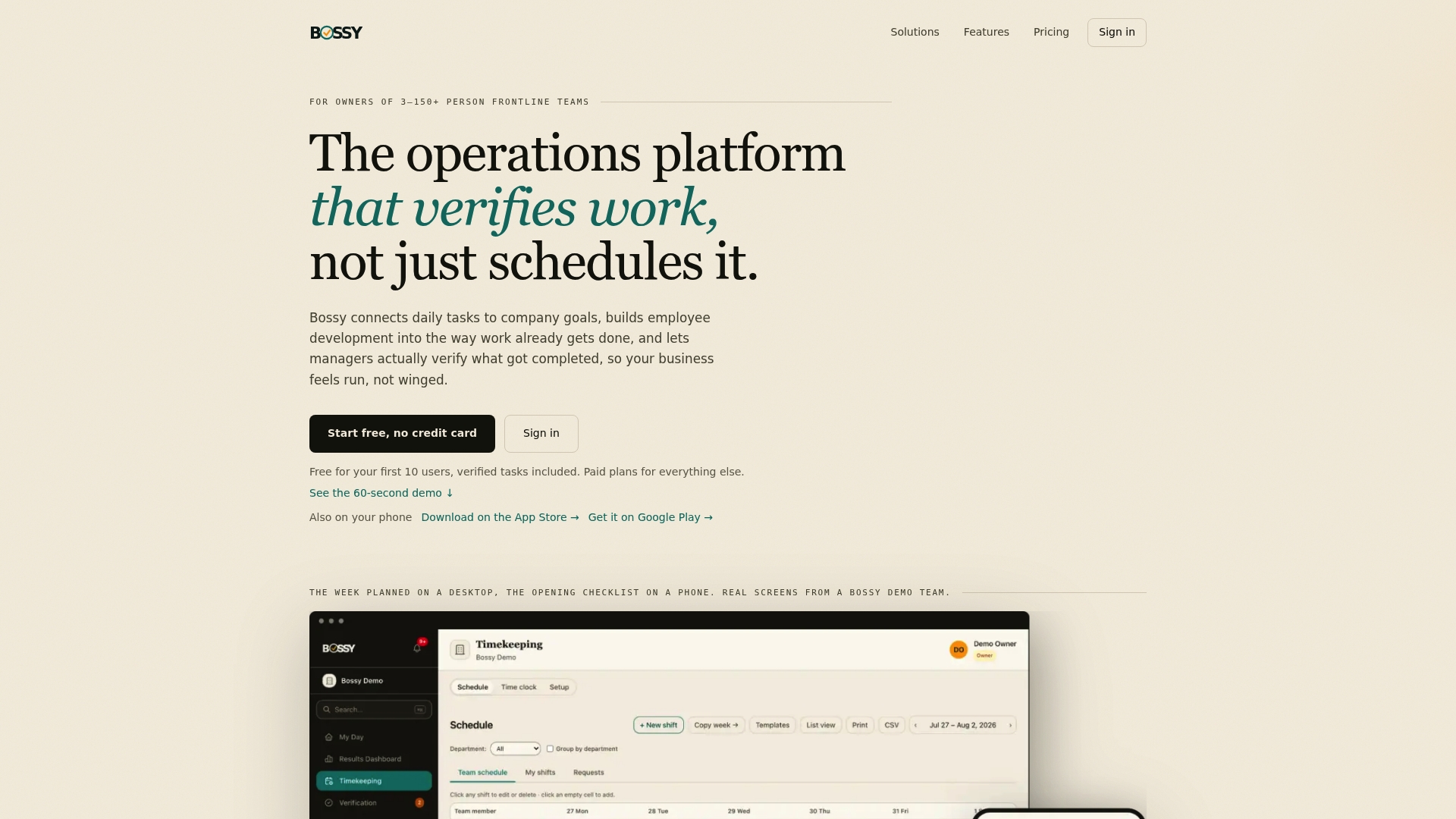
Map it against the checklist earlier in this article: recurring tasks for your cycle-count cadence, geofenced time clocks for accountability at each location, and count records that show who counted each line. Recurring checklists cover your receiving controls, and cascading goals connect daily inventory tasks back to the bigger operational targets you're actually trying to hit. For multi-location retailers specifically, Bossy's retail solutions show how task verification and inventory workflows work together across stores.
Inventory, photo proof, and recurring checklists come with the Operations plan at $30 per month. Current prices and plan details are available on the pricing page. Check the plans and pick the one that fits your store count today.
FAQ
How Do You Keep Track of Retail Inventory?
The most reliable method combines perpetual tracking (real-time updates as items sell or arrive) with regular cycle counts on your highest-velocity SKUs. Pair mobile scanning at receiving with a POS system that updates stock automatically, and reconcile discrepancies weekly rather than waiting for a full physical count.
Can Excel Track Retail Inventory?
Excel can handle inventory for a very small catalog with a single location, but it breaks down fast once you add multiple locations or online sales. Spreadsheets lack real-time sync, so two people editing the same file, or a sale happening while someone else updates counts, creates errors that compound over time.
What Is the 80/20 Rule in Inventory?
The 80/20 rule, also called ABC analysis, assumes roughly 20% of your SKUs drive about 80% of your sales or value. Those top SKUs get counted most often, often weekly, while slower-moving items get counted monthly or quarterly, which keeps labor focused where accuracy matters most.
What Is the Best Program to Track Inventory?
The best software depends on your catalog size, channel count, and whether you need item-level tracking for perishables or regulated goods. For retailers that also need to verify staff actually completed counts and receiving checks, a platform like Bossy pairs inventory control with photo-verified task completion, which closes the adoption gap that causes most tracking failures.
When Should a Retailer Move to Item-Level Tracking?
Item-level tracking, using batch, lot, or serial data, becomes necessary once your products involve expiry dates, recalls, or regulatory requirements. Signals include selling perishable goods, carrying warranty-tracked electronics, or facing enough recall risk that isolating specific units matters more than tracking at the SKU level alone.