7 Shift Swap Policy Rules Managers Can Copy Into Their Handbook
Christian MontenegroAugust 30, 202613 min read
A shift swap policy is a written set of rules that says who can trade shifts, how they request it, who approves it, and how you record it. Without one, you're guessing on overtime, coverage, and fairness. With one, you get fewer coverage gaps, lower overtime risk, and a paper trail that holds up if anyone ever questions a schedule change.
TL;DR:
- A formal shift swap policy reduces coverage gaps, overtime surprises, record errors, and discrimination risks by ensuring clear documentation and approval processes.
- Requirements include specific role-based eligibility, 24 to 72 hours' notice, approval deadlines, shift equivalence, and accountability rules to maintain operational integrity.
- Managers should verify skill match, overtime impact, and coverage completeness through a consistent five-step approval process before finalizing any swap.
- Employers must closely monitor overtime laws, as hours moved through swaps count toward overtime in all jurisdictions, regardless of voluntary agreements.
- Automated scheduling tools improve compliance, track swap frequency, and maintain comprehensive logs, making policy enforcement reliable and scalable.
Table of Contents
- What Is a Shift Swap, and Why Does It Need a Formal Policy?
- Weighing the Benefits Against the Risks
- What Rules Belong in Every Shift Swap Policy?
- How Should Managers Process a Swap Request Step by Step?
- What Payroll and Legal Traps Should HR Watch For?
- How Do You Keep Swaps Documented and Auditable?
- Seven Rules and Sample Language for Your Handbook
- Why Clear Swap Rules Fix More Than Just Scheduling
- Let Bossy Enforce the Policy So You Don't Have To
- Where to Check Local Rules Before You Finalize Your Policy
- Sources
What Is a Shift Swap, and Why Does It Need a Formal Policy?
A shift swap happens when two employees trade assigned shifts, usually because of a conflict, a family emergency, or a request for time off that didn't get approved in advance. It sounds simple. It rarely is.
Left informal, shift swapping creates real problems fast. Picture two servers texting each other Friday night, swapping Saturday shifts, and never telling a manager. Nobody checked if the replacement knew how to close out the register. Nobody flagged that the swap pushed one of them past 40 hours for the week.
That's how informal swaps go sideways:
- Coverage gaps: the "replacement" never actually shows up, and nobody finds out until the shift starts.
- Overtime surprises: a swap quietly pushes someone into overtime territory without anyone noticing until payroll runs.
- Record errors: timecards don't match who actually worked, which is a mess if you're ever audited.
- Discrimination exposure: approving swaps for some employees and denying others, with no consistent criteria, invites complaints.
Documenting the process, and requiring sign-off before the swap happens, closes most of these gaps before they cost you money or trust. SHRM's reporting shows schedule flexibility has become the norm rather than the exception since the pandemic, which means your team already expects some version of this. The question is whether you're managing it or just reacting to it.
Weighing the Benefits Against the Risks
Letting employees trade shifts is one of the cheapest retention levers you have. It costs nothing to administer well, and it tells your team you trust them to manage their own lives.
The upside for employers is concrete: fewer no-shows because someone found coverage instead of just not showing up, more scheduling agility during peak seasons, and a team that feels less micromanaged. For employees, the benefit is autonomy. A parent who needs to make a school pickup, a student juggling exam week, a worker covering a second job, all get a release valve without burning a paid day off.
The drawbacks are just as real, though:
- Fairness disputes when the same people always get swap approvals and others don't.
- Overtime cost creep when swaps aren't checked against weekly hour totals.
- Skill mismatches when a swap puts an unqualified person on a shift that needs specific training.
Every one of these drawbacks has a policy fix. Eligibility rules solve skill mismatches. Notice windows and approval logs solve fairness disputes. A payroll check before approval solves overtime creep. The policy is the mitigation.
What Rules Belong in Every Shift Swap Policy?
Your policy needs six components to actually function day to day, not just look good in a handbook.
- Eligibility criteria. Spell out who can swap with whom, using specific role titles or named certifications rather than something vague like "similarly qualified." A cashier can swap with another cashier. A licensed forklift operator can only swap with another licensed operator. Vague language is where disputes start.
- Notice and lead-time requirements. Most workplaces land somewhere between 24 and 72 hours of advance notice, giving managers time to check coverage and payroll impact before approving. Emergency exceptions should exist, but as a named exception, not the default.
- Approval authority and deadlines. Name who approves swaps (usually the direct supervisor) and set a response deadline, like 24 hours, so requests don't sit in limbo.
- Equivalence rules. A swap should generally match shift length and shift type, and it should never be approved without checking whether it tips either employee into overtime for that workweek.
- Cancellation and accountability rules. If the swap falls through, define who's responsible for the shift. The employee who originally owned it, unless the policy says otherwise, still owns the outcome.
- Consequences and documentation. State plainly what happens for unauthorized swaps (a no-show, essentially) and require every approved swap to be logged with names, dates, times, and the approving manager's sign-off.
Pro Tip: Write your eligibility rules by role and certification, not by seniority or friendship. "Any barista can swap with any barista" is enforceable. "Swap with someone equally experienced" is an argument waiting to happen.
This structure mirrors what LegalClarity's policy framework recommends: capture who, what, when, and who approved it, every single time.
How Should Managers Process a Swap Request Step by Step?
A consistent approval workflow is what turns a policy from a document nobody reads into a habit your team actually follows. Run every request through the same five checks.
- Verify role and skill match. Confirm the replacement employee is qualified for the shift, including any required licenses or certifications.
- Check overtime exposure for both employees. Look at each person's total hours for the relevant workweek, not just the day of the swap. A swap that's fine on Tuesday might push someone over 40 hours by Sunday.
- Confirm coverage impact. Make sure the swap doesn't leave a shift short on a required skill (a keyholder, a certified operator, someone who can legally serve alcohol).
- Update the roster, time clock, and payroll systems. The swap isn't real until it's reflected everywhere someone might look, including whatever system tracks clock-ins.
- Communicate the confirmation. Tell both employees, and anyone else who needs to know, that the swap is approved and finalized.
Build in a fallback for requests that arrive too late or too incomplete to review properly: an auto-deny window (say, anything submitted under 12 hours out gets escalated to a supervisor for a case-by-case call) keeps the process moving instead of stalling. NSW Health's guidance on managing shift swaps recommends monitoring swap frequency over time too, since a pattern of frequent swaps by the same person or team is worth a conversation, not just an approval.
What Payroll and Legal Traps Should HR Watch For?
The single biggest legal mistake in shift swap policies is assuming public-sector substitution rules apply to private employers. They don't.
Some government agencies allow employees to substitute for each other without counting the swapped hours toward overtime for the person covering the shift. The Department of Labor is explicit that the Fair Labor Standards Act includes no equivalent carve-out for private employers: hours actually worked count toward overtime, full stop, regardless of whose shift it originally was.
A swap doesn't erase hours from the ledger. It just moves who's standing where. If that movement pushes someone over 40 hours in the workweek, the employer owes overtime, whether the swap was voluntary or not.
Here's where it gets tricky in practice: the same swap can create overtime in one workweek and not another, purely based on where your workweek boundary falls. An employee who picks up a Sunday night shift that falls into a new workweek won't trigger overtime. The same shift, if your workweek runs Sunday to Saturday, might push them past 40 hours in the week that's ending. Check both employees' running totals, not just the shift being swapped.
Some jurisdictions layer on predictive-scheduling or fair-workweek ordinances that require extra pay or specific documentation when an employer changes a published schedule on short notice. LegalClarity notes that documenting a swap as employee-initiated, rather than employer-driven, is what typically preserves your exemption from those rules. That documentation only works if you actually collect it every time.
One more trap: never ask employees to state a personal reason for requesting a swap. Base every approval decision on operational compatibility, skills, hours, overtime exposure, not on why someone wants the day off. Asking why opens the door to discrimination claims you don't need.
How Do You Keep Swaps Documented and Auditable?
The manual version of this works fine for small teams: a form, an email, or a shared spreadsheet where every swap gets logged with the same fields every time. Where it breaks down is scale. Once you've got dozens of employees across multiple shifts, tracking approvals by memory or inbox search stops being reliable.
Scheduling software closes that gap. Automated eligibility filters catch skill mismatches before a manager even sees the request, and built-in overtime flags catch payroll problems before they become payroll mistakes. RosterLab's research on shift swap management points out that these automated checks cut manager review time and reduce the kind of human error that comes from checking hours by hand at 11 p.m.
Whatever system you use, capture the same minimum fields every time:
- Who requested the swap and who's covering.
- The original shift date/time and the new shift date/time.
- The manager who approved it and when.
- Any overtime or skill flags that came up during review.
Pro Tip: If you're still running swaps by paper or email, build a simple template with those four fields as required blanks. An incomplete request should be an automatic bounce back, not a judgment call.
Good scheduling systems that survive last-minute changes also handle the notification side. Both employees and their manager get confirmation the moment a swap clears, which cuts down on the "wait, did that actually get approved?" conversations.
Seven Rules and Sample Language for Your Handbook
If you're writing this into a handbook today, here are the seven rules worth including, in order:
- Employees may swap shifts only with others who hold the same role or required certification.
- Swap requests must be submitted at least 24 hours in advance, except in documented emergencies.
- A direct supervisor must approve every swap before it takes effect.
- Swapped shifts must match in length and type, and overtime exposure for both employees must be checked before approval.
- If a swap falls through, the original shift owner remains responsible unless the manager states otherwise in writing.
- Unauthorized swaps are treated as unapproved absences and may result in disciplinary action.
- Every swap, approved or denied, is logged with names, dates, and manager sign-off.
Sample handbook language: "Employees wishing to swap a scheduled shift must submit a request through [your system] at least 24 hours before the shift begins. Requests are reviewed based on role eligibility, certification match, and overtime impact, and are not evaluated based on the reason for the request."
| What to Track | Why It Matters |
|---|---|
| Swap frequency by employee | Flags fairness issues or overuse before they become disputes |
| Coverage failures after approval | Shows whether your notice window is actually long enough |
| Overtime hours tied to swaps | Catches payroll risk before it shows up in a paycheck |
Pilot new rules with one location or team, track those three numbers for a month, then roll out.
Why Clear Swap Rules Fix More Than Just Scheduling
Most of the friction I see between managers and frontline staff isn't about the schedule itself. It's about the ambiguity around who's allowed to change it. A written policy removes that ambiguity, and removing ambiguity is most of what good management is.
Bossy's approval queues and audit logs exist for exactly this reason: they turn a policy from a PDF nobody reads into a workflow people actually follow, because the system won't let a swap through until the checks pass. That's the difference between a policy and a habit.
If you're rewriting your swap rules this year, don't roll them out company-wide on day one. Pilot them with one team, watch what breaks, then expand.
— Christian
Let Bossy Enforce the Policy So You Don't Have To
Writing the policy is half the job. Enforcing it consistently, every shift, every location, is the other half, and that's where most handbooks quietly fail. Bossy's scheduling tools apply your eligibility rules automatically, route every swap request through an approval queue instead of a group chat, and keep an audit log of who requested what and who signed off, so you're never reconstructing a timeline from memory when a question comes up.
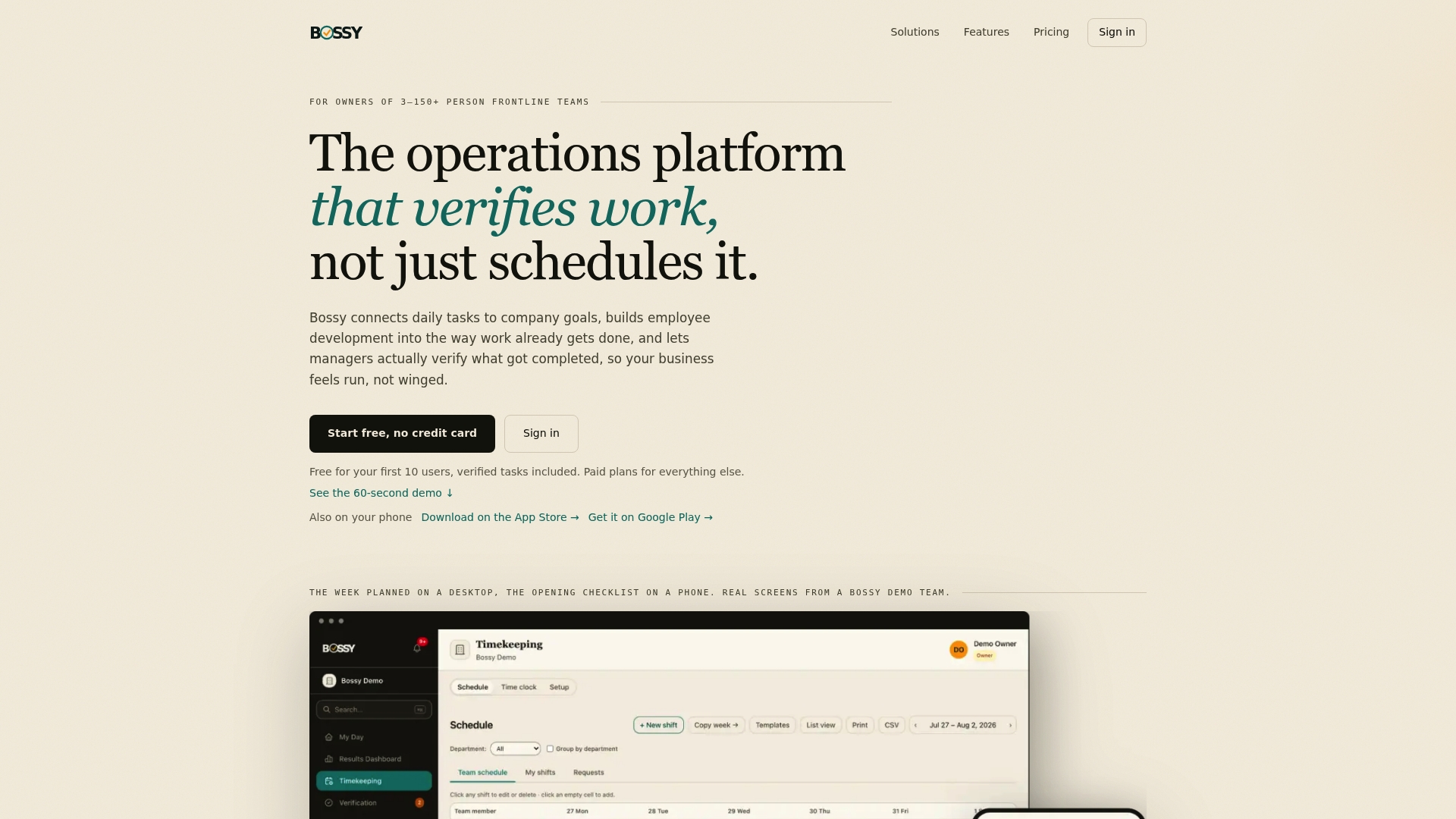
If you manage a restaurant, retail floor, or any team where coverage gaps hurt immediately, Bossy's scheduling and approval features map directly onto the checklist above: role-based eligibility, overtime flags, and a record of every decision. See how it fits your team by starting with Bossy and running it against your next week's schedule.
Where to Check Local Rules Before You Finalize Your Policy
Shift swap rules interact with local labor law in ways that vary by jurisdiction, so treat these as starting points, not final answers, for your specific situation.
- U.S. Department of Labor: the authority on FLSA overtime counting and why private employers can't rely on public-sector substitution rules.
- SHRM: tracks how flexible scheduling norms have shifted since the pandemic.
- LegalClarity: breaks down policy language and predictive-scheduling documentation needs.
- NSW Health: a practical operational checklist for approving and monitoring swaps.
Sources
- Why work schedule flexibility is here to stay — SHRM
- Shift swap policy example: rules and requirements — LegalClarity
- Managing shift swaps — NSW Health
- Flexible schedules — U.S. Department of Labor