Prove Fixes in a Week with a Warehouse Daily Checklist for Supervisors
Christian MontenegroSeptember 10, 202611 min read
A warehouse daily checklist is a short, repeatable set of checks a supervisor runs each shift to catch safety hazards, equipment issues, and inventory errors before they become real problems. The verdict is simple: start a short daily round today, log every failure with a photo, an owner, and a due date, and you'll know within a week whether you're running a tight operation or just hoping you are.
TL;DR:
- Regular daily safety checks on fire extinguishers, aisles, PPE, and CCTV are essential to prevent incidents and ensure emergency readiness.
- Pre-shift inspections of forklifts and tools identify small malfunctions early, supporting maintenance without replacing formal scheduled reviews.
- Spot-checking inventory accuracy and label integrity daily helps catch errors quickly, reducing the risk of stock discrepancies or regulatory issues.
- Consistent housekeeping and workplace order through a daily 5S routine maintain safety, improve productivity, and ensure high-traffic zones stay clear.
- Assigning specific owners, capturing photo evidence, and setting urgent escalation paths ensure issues are addressed promptly and tracked effectively.
Table of Contents
- What a Warehouse Daily Checklist Actually Covers
- Core Daily Checklist: Safety and Emergency Readiness
- Core Daily Checklist: Equipment and Powered Industrial Trucks
- Core Daily Checklist: Inventory, Labeling, and Pick Accuracy
- Core Daily Checklist: Housekeeping, 5S, and Workplace Order
- Opening and Closing Tasks: Start and End of Shift
- How to Make Daily Checks Actually Stick
- A Sample Warehouse Checklist Template You Can Print Today
- Bossy's Approach to Daily Checks and Verification
- What the Checklist Habit Actually Proves
- Digitize Your Daily Checks with Bossy
- Sources
- FAQ
What a Warehouse Daily Checklist Actually Covers
A warehouse daily checklist exists to protect three things: people, uptime, and inventory accuracy. It's not a monthly audit shrunk down. A monthly audit digs into racking certifications, fire suppression testing, and structural items. A daily round is faster and narrower. It checks whether aisles are clear right now, whether the forklift's brakes work this morning, and whether yesterday's pick counts match what's on the shelf.

The case for running one daily isn't just intuition. Research from MIT Sloan Management Review found that leaders who treat safety routines as a performance lever, not a compliance chore, see measurably better operational outcomes. OSHA points to the same pattern in warehouse-specific guidance: aisle clearance and materials-handling controls checked routinely prevent the incidents that formal audits only discover after the fact.
Core Daily Checklist: Safety and Emergency Readiness
Safety checks come first because they're the ones that cost you the most when skipped. Run these at the start of every shift, before anyone touches a pallet.
- Confirm fire extinguishers are charged, unobstructed, and mounted with visible signage.
- Walk every aisle and emergency exit to confirm nothing blocks the path.
- Check PPE stations are stocked and safety signage is legible, not faded or missing.
- Verify CCTV feeds are live and entry points were properly locked overnight.
- Note any near-miss reports from the prior shift that haven't been closed out.
Every failure needs three things attached to it: a photo, a named owner, and a due date. A checkbox that says "aisle blocked" tells you nothing useful three days later. A photo with a timestamp and a name tells you exactly what happened and who's fixing it.
Pro Tip: Assign the safety walk to the same supervisor every day for two weeks before rotating it. Consistency in who's looking catches patterns that a rotating cast of checkers misses.
Core Daily Checklist: Equipment and Powered Industrial Trucks
Forklifts and powered equipment fail in small ways long before they fail in big ways. A pre-shift check on every unit in operation catches most of it.
- Check fluid levels, brake response, fork condition, horn, and seatbelt on every forklift before it moves a single pallet.
- Inspect battery charge status and charger connections on electric units.
- Test small tools and dock equipment (pallet jacks, dock plates, strapping tools) for visible wear or malfunction.
- Tag out anything defective immediately and route it to maintenance rather than parking it "for later."
Routine visual checks like these support formal inspection programs but don't replace them. Structural racking inspections and certified equipment reviews still need to happen on their own schedule, as warehouse audit guidance makes clear.
Pro Tip: Keep a laminated tag-out card in every forklift cab. If an operator has to hunt for the form, they'll skip it and just mention it verbally, which means it never gets tracked.
Core Daily Checklist: Inventory, Labeling, and Pick Accuracy
Inventory errors compound fast, and they're almost always caught late unless someone's spot-checking daily.
- Pull a small random sample of SKUs and compare physical counts against your warehouse management system.
- Check inbound receiving holds for damaged goods and confirm they're tagged and quarantined, not shelved by mistake.
- Verify label and lot codes on a sample of received or picked items, especially for regulated or perishable stock.
- Log any discrepancy as a cycle-count follow-up with a named owner, rather than fixing it silently and moving on.
The goal isn't a full count. It's a fast enough sample that if something's drifting, you notice it in days rather than at the next quarterly count.
Core Daily Checklist: Housekeeping, 5S, and Workplace Order
Clutter is a safety issue wearing a productivity costume. A quick 5S pass through high-traffic zones each day keeps both problems in check.
- Confirm packaging waste and trash have been cleared from pick paths, not just piled at the end of an aisle.
- Check that lighting is functional in every active zone and floor markings are visible.
- Verify spill kits are stocked and staff know the response protocol, including required PPE for cleanup.
- Spot-check that tools and materials are returned to marked storage locations, not left on the floor.
If housekeeping is outsourced, a shared task list with your cleaning provider keeps expectations visible instead of assumed.
Opening and Closing Tasks: Start and End of Shift
Handover is where accountability usually breaks down, unless it's structured.
- At start of shift, confirm entrances are secure by following best practices recommended by Door Openers, ensure systems (WMS, scanners, time clocks) are online, and overnight alerts are reviewed.
- At end of shift, walk the floor to confirm entrances are locked, unresolved actions from the day are logged (not verbally passed along), and system backups have run.
- Capture sign-off with a timestamp, either on paper or in a digital log, so the next supervisor knows exactly what's outstanding.
A structured closing routine turns handover from a hallway conversation into a record you can actually check later.
How to Make Daily Checks Actually Stick
A checklist only works if someone owns it and something happens when it fails. That means naming who checks what, capturing proof, and setting a clear escalation path.
- Assign each check to a specific role, not "whoever's around," and require a sign-off at the end of the round.
- Attach a photo and timestamp to every failed item, plus a corrective-action owner and due date.
- Set an escalation threshold: unresolved safety items go to the site manager within hours, not at the next weekly meeting.
- Roll daily results into a weekly trend review, and feed that into the monthly full audit.
Checklists paired with photo evidence and assigned corrective actions close out dramatically faster than checkbox-only systems, according to Inspectly360's inspection guidance. Paper works for small sites. Once you're running multiple zones or shifts, a digital format with built-in task verification makes the audit trail something you can actually search instead of something buried in a binder.
A Sample Warehouse Checklist Template You Can Print Today
Here's a compact structure you can adapt to your own floor plan. Print it, laminate it, or move it into a digital tool once the habit sticks.
Larger facilities or regulated inventory (pharmaceuticals, food, hazardous materials) should add rows for lot-code verification and temperature logs. Once the paper version proves out, moving these rows into a digital format lets you attach photos directly to each line instead of stapling printouts together.
Bossy's Approach to Daily Checks and Verification
A checklist is only as good as the proof behind it. Task verification lets a supervisor assign each daily check, require photo proof on completion, and route failures into a manager approval queue instead of a sticky note. The workflow runs in order: assign the task, capture the photo, log the corrective action, verify closure, and see it reflected in the analytics dashboard. That last step matters more than people expect. It's the difference between knowing a fix happened and just hoping it did.
What the Checklist Habit Actually Proves
Here's what most advice on this topic gets backwards: it treats the checklist itself as the win. It isn't. A checklist that gets filled out and filed away proves nothing except that someone spent five minutes with a clipboard. The real value shows up in the corrective-action loop, whether the blocked aisle from Tuesday actually got cleared, or whether it's still blocked on Friday with three more checkmarks on top of it.
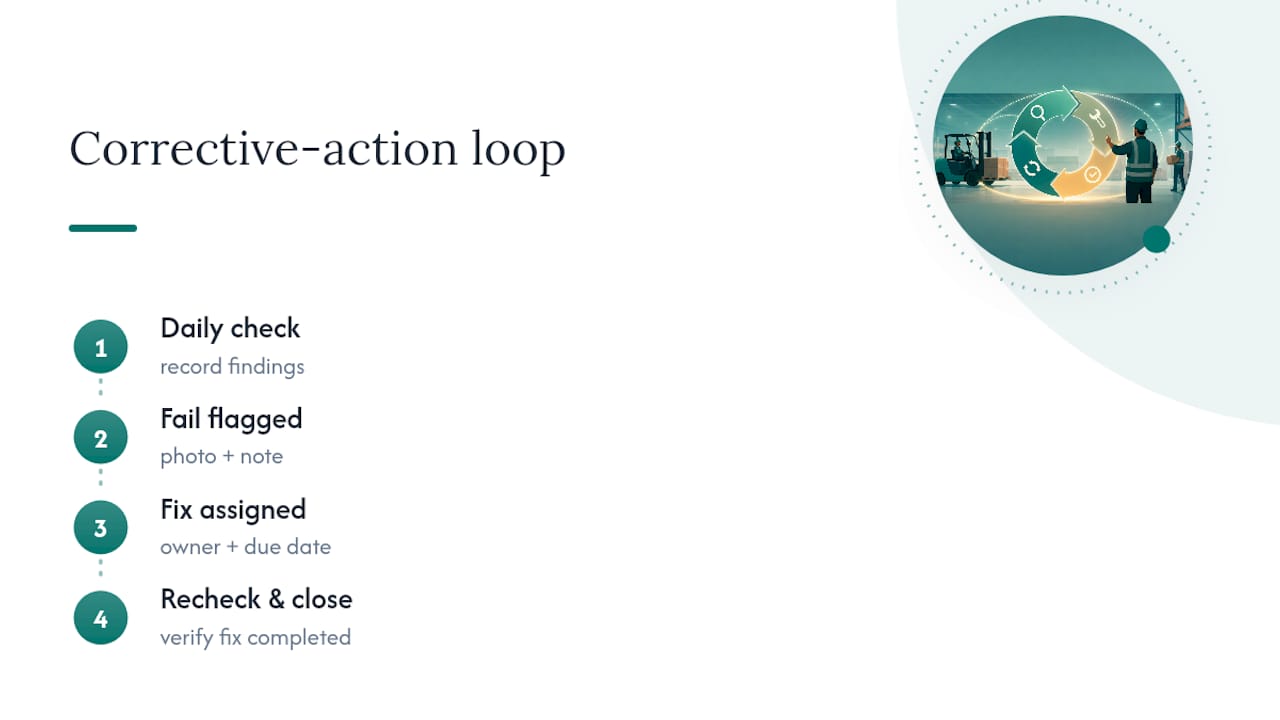
Most warehouses already have some version of a daily walk. Where they fall short is treating a failed item as the end of the process instead of the start of one. A photo of a damaged pallet with no owner and no due date is just documentation of a problem you're choosing not to fix.
If you're setting this up for the first time, don't start with the most detailed template you can find. Start with a handful of items most likely to hurt someone or cost you a shipment, run those daily for two weeks, and only then add rows. A checklist people actually complete beats a comprehensive one they abandon by Thursday.
— Christian
Digitize Your Daily Checks with Bossy
Paper checklists work until they don't, usually right when you need to prove a fix actually happened. This is a practical next step for warehouse teams ready to move past clipboards. It combines task assignment with photo-proof verification, so a failed check doesn't just get noted, it gets assigned, evidenced, and closed with a manager sign-off you can pull up weeks later.
The features page breaks down how task verification, scheduling, and inventory controls work together for teams juggling multiple zones or shifts. If you're comparing options, see how it stacks up against other team management tools. Start a free trial at Bossy and run your first digital daily round this week.
Sources
For primary guidance beyond this article, see OSHA's warehouse safety guidance, UNC's ergonomics resources, and MapTrack's audit template.
- How workplace safety improves performance — MIT Sloan Review
- Warehouse audit checklist template — MapTrack
- Warehouse Inspection Daily Checklist — Inspectly360
FAQ
What should a daily warehouse checklist include?
At minimum, it should cover safety checks (fire, aisles, PPE), equipment pre-checks (forklifts, chargers), inventory spot-checks, housekeeping, and opening/closing security tasks, each logged with an owner and evidence.
What are the 7S rules in a warehouse?
Definitions vary by source, but the common version extends the standard 5S framework (Sort, Set in order, Shine, Standardize, Sustain) with Safety and Security, both of which belong in a daily walk.
What are the key safety checklists for a warehouse?
The core ones cover fire extinguishers and exits, aisle clearance, PPE availability, forklift pre-start inspections, and manual-handling checks, all backed by OSHA guidance and ergonomics recommendations.
How often should a warehouse run a full audit versus a daily check?
Run the short daily round every shift and reserve deeper structural and compliance audits for monthly or quarterly cycles, feeding daily trends into that larger review.
Should a warehouse daily checklist be digital or paper?
Paper works for small, single-shift sites, but digital capture with photo evidence and task verification scales better once you're tracking multiple zones, shifts, or corrective actions across a week.