Safety Managers: Seven Area Warehouse Safety Checklist That Forces Fixes
Christian MontenegroSeptember 9, 202610 min read
A warehouse safety checklist earns its keep only when it covers seven areas — racking, forklifts and material handling equipment, pedestrian traffic, fire and egress, hazardous materials, manual handling, and electrical/lockout points — and runs on a set schedule. Daily pre-starts, weekly walkdowns, monthly system checks, and regular structural racking reviews form the backbone. Every failed item needs a recorded owner, a due date, and photo evidence, or the checklist is just paperwork.
TL;DR:
- Warehouse safety inspections must include clear thresholds for failure, such as specific deflection limits for racking and wear indicators for forklifts.
- Inspection frequency should be role-based, with daily pre-starts for forklift operators, weekly walkdowns for supervisors, and monthly system reviews, especially for sites storing hazardous materials.
- When a hazard is identified, immediate action protocols like quarantining damaged racking or removing defective equipment are essential before closing the inspection cycle.
- Digital platforms with photo evidence and approval workflows significantly reduce skipped steps and ensure timely fixes, unlike traditional paper checklists.
- Compliance is strengthened by adherence to OSHA and ANSI standards, regular third-party audits, and maintaining an organized, accessible record of inspection results.
Table of Contents
- Warehouse Safety Checklist Overview: Categories and Fields That Matter
- Inspection Frequency: Who Checks What, and When
- Area-by-Area Checklist Items With Failure Thresholds
- Turning Failed Checks Into Fixes: Evidence, Owners, and Escalation
- Why Enforcement Beats the Checklist Itself
- Put Your Checklist on Autopilot With Bossy
- Where to Find the Official Standards and Free Templates
- Sources
- FAQ
Warehouse Safety Checklist Overview: Categories and Fields That Matter
A checklist template only works if it captures the right fields, not just the right questions. Before you touch category items, build the frame: site, zone, inspector name, date, and asset ID for anything with a serial number, like a forklift or a racking bay.
Each check item needs more than a pass or fail box. You want:
- Pass/fail/not-applicable status
- Photo evidence attached to the line item
- Severity rating (minor, major, critical)
- Assigned owner and due date
- Inspector signature or digital sign-off
With that structure in place, drop in your eight primary categories: pallet racking, forklifts and MHE, traffic and pedestrian separation, emergency egress and fire protection, hazardous materials, manual handling, electrical and lockout/tagout, and housekeeping. Free templates that follow this format, like the warehouse safety inspection checklist from MapTrack, consistently pair each category with an owner and due date field for failed items. That pairing is what separates a working document from a form nobody looks at twice.
Inspection Frequency: Who Checks What, and When
Cadence is where most warehouse safety inspection programs fall apart. Too many sites run one big annual audit and call it done. Assign frequency by role instead:
- Daily. Forklift operators run pre-start checks (forks, hydraulics, horn, lights, seatbelt) before the first pallet moves. A quick housekeeping sweep, clear aisles, no leaks, no blocked exits, takes five minutes and catches most of the obvious stuff.
- Weekly. Shift supervisors walk the floor for visual racking checks, looking for bent uprights, missing safety pins, and overloaded beams.
- Monthly. A maintenance or safety lead reviews fire suppression systems, emergency lighting, and electrical panel access, plus anything flagged from weekly walks that needs a closer look.
- Annual, or after any impact. A competent-person structural racking inspection and a full property condition assessment, often third-party.
Sites running high throughput, storing hazardous goods, or operating automated equipment should tighten that cadence rather than loosen it. A site moving pallets around the clock cannot rely on a once-a-week visual check to catch a cracked upright before it fails.
Area-by-Area Checklist Items With Failure Thresholds
Generic "check the racking" instructions do not help an inspector standing in front of a bent upright. You need thresholds that tell someone exactly when to act, not just what to look at.
Pallet racking. Inspect uprights, beams, and diagonal bracing for deformation, corrosion, and missing safety clips. A useful working rule: if column deflection exceeds roughly L/200 (the span length divided by 200), or an upright shows visible bowing, quarantine the bay immediately. Tag it, unload it, and keep it empty until a competent person clears it. Industry guidance from ANSI and SEMA backs a two-tier model here: weekly visual checks by trained staff, plus at least one annual inspection by a qualified competent person.
Forklifts and material handling equipment. Confirm operator training and certification status before anyone touches the controls. OSHA's standard under 29 CFR 1910.178 requires documented training, pre-use inspection, and periodic performance evaluation. Objective wear limits help here too: fork thickness loss beyond roughly 10 percent means the fork gets pulled from service, not flagged for "later." Check charging area ventilation and confirm PPE, gloves and face shields, is stocked and used during battery changes.
Traffic and pedestrian controls. Marked travel routes, physical barriers or bollards separating foot traffic from forklift lanes, posted speed limits, and functioning dock restraints all belong on the walk. A dock plate that shifts under load is a failed item, not a maybe.
Emergency egress and fire protection. Exits stay clear, always, no exceptions for seasonal overflow stock. Test emergency lighting on schedule and confirm sprinkler heads have the required clearance from stored goods.
Manual handling and ergonomics. Confirm mechanical aids (hand trucks, lift tables, conveyors) are available and functioning where lifting tasks would otherwise strain workers. Task-specific ergonomic assessments matter most for repetitive picking and packing stations.
Electrical and lockout/tagout. Panel access stays clear of storage, arc-flash labels are legible, and LOTO kits are stocked at every point workers might service equipment.
Hazardous materials. Safety Data Sheets need to be on hand and current, incompatible chemicals segregated, spill kits stocked and accessible, and container labeling intact.
Housekeeping. Clear aisles, no storage blocking egress paths, adequate ventilation, and no signs of pest activity. OSHA's warehouse hazard guidance repeatedly flags blocked aisles and poor battery-charging ventilation as recurring findings across audits.
Turning Failed Checks Into Fixes: Evidence, Owners, and Escalation
A checklist that flags a hazard and moves on has not made your warehouse safer. The value comes from what happens after the "fail" box gets checked.
For every defect, record:
- A clear description of the issue
- Severity (minor, major, critical)
- A time-stamped photo
- The person responsible for the fix
- A target completion date and inspector name
From there, convert the failed item into an actual work order, and require someone to verify the fix before marking it closed. A "fixed" status with no follow-up photo is not a closed loop. Set escalation rules ahead of time: anything overdue, anything critical-severity, or anything touching a safety-critical system (racking, fire suppression, LOTO) should trigger an immediate stop-work order or restricted access to that zone until it clears.
Pro Tip: Require a photo and a manager approval before any checklist item can be marked complete. It sounds like a small friction point, but it is the single biggest lever for stopping steps from getting skipped under time pressure.
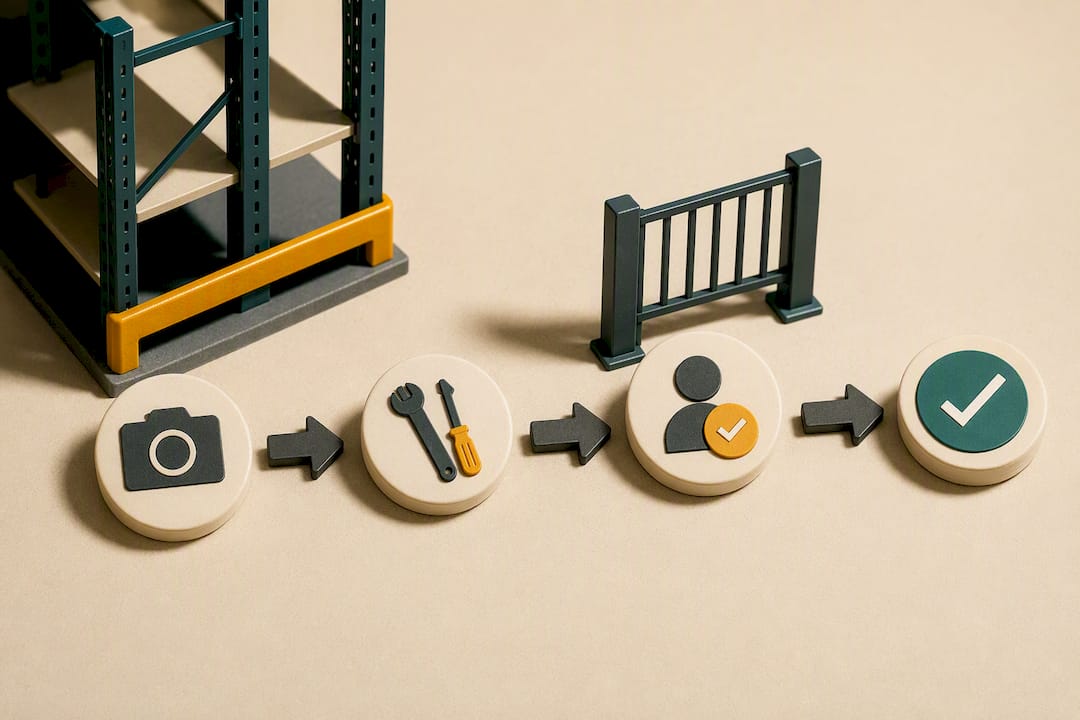
Digital enforcement matters here more than most safety managers expect. Paper checklists get signed off in a hurry, sometimes without anyone actually walking the floor. Mandatory photo fields and an approval queue close that gap, because a supervisor cannot approve what was never checked.
Why Enforcement Beats the Checklist Itself
The checklist is never the hard part. Any safety manager can build a spreadsheet with racking, forklifts, and egress routes listed down the side. What separates a warehouse that actually reduces incidents from one that just generates paperwork is whether a failed item ever turns into a completed repair.
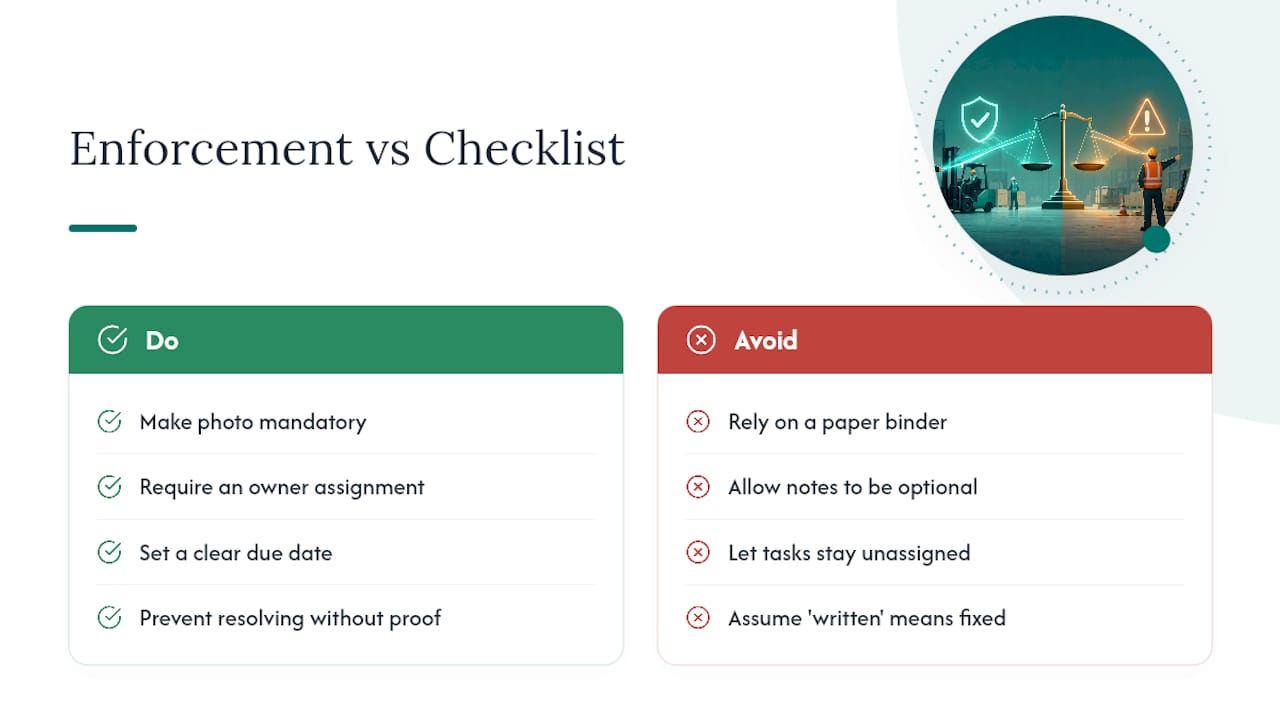
That gap is where most programs quietly fail. A supervisor flags a damaged upright, writes it in a binder, and three weeks later nobody remembers whose job it was to fix it. Digital tools close that gap by making the photo, the owner, and the due date mandatory fields, not optional notes. When a task cannot be marked "resolved" without proof, the incentive to skip it disappears.
The uncomfortable truth is that most warehouse injuries do not come from a hazard nobody saw. They come from a hazard somebody saw, wrote down, and then nothing happened. Fix that workflow gap and the checklist itself becomes almost secondary.
— Christian
Put Your Checklist on Autopilot With Bossy
Building a great checklist is only half the job. Getting every shift to actually run it, photograph the proof, and hand off failed items to someone accountable is the part that usually falls apart. The platform is built for exactly that gap: task verification with photo proof, a manager approval queue that catches skipped steps before they become incidents, due dates tied to every corrective action, and dashboards that show you which zones keep failing the same checks.
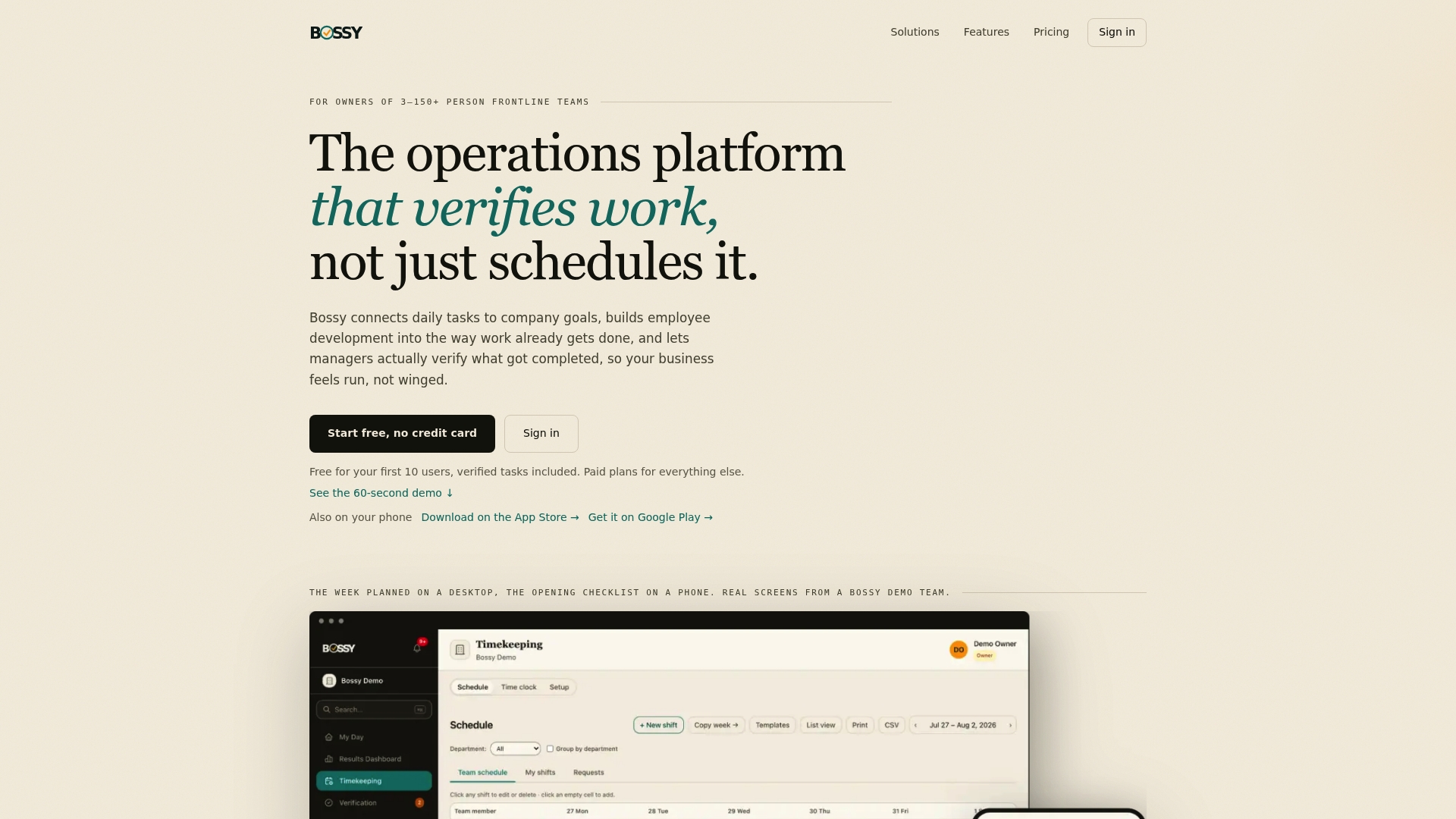
Instead of a binder full of signed paper forms nobody reviews until something goes wrong, your racking checks, forklift pre-starts, and egress walkdowns live in one system with a full audit trail attached. Compare how Bossy stacks up against other workforce tools on the Bossy vs Connecteam breakdown, or head straight to the Bossy features page to see task verification and photo evidence in action. Consider starting a trial to run your next inspection cycle through the platform.
Where to Find the Official Standards and Free Templates
- OSHA's warehousing page covers the National Emphasis Program and links to core hazard guidance.
- OSHA publication 3220 lists detailed inspection items and common findings.
- The MapTrack checklist template offers a free, ready-to-use format.
Sources
OSHA has sharpened its focus on warehousing specifically. The agency's National Emphasis Program on warehousing directs inspection attention toward forklift hazards, ergonomics, and material handling risks, with an updated emphasis effective July 31, 2026. That is not a reason to panic, but it is a reason to have your paperwork in order before an inspector shows up.
Keep these standards on your radar: OSHA 29 CFR 1910 (powered industrial trucks, walking-working surfaces, hazard communication), NFPA storage guidance for fire protection, ANSI/SEMA recommendations for racking, and PUWER/LOLER where equipment falls under European work equipment directives.
Auditors typically want to see:
- Warehousing - Overview | Occupational Safety and Health Administration
- Powered industrial trucks | OSHA
- Warehouse hazards and controls (OSHA publication 3220)
- Warehouse Safety Inspection Checklist | Free | MapTrack
- Article summarizing racking inspection guidance and NEP extension
Time-stamped photo evidence tends to carry more weight than a handwritten note in a logbook, mainly because it cannot be filled in after the fact.
FAQ
What Should a Warehouse Safety Checklist Cover?
It needs to cover racking, forklifts and MHE, pedestrian traffic separation, fire and egress, hazardous materials, manual handling, electrical/LOTO, and housekeeping, with each item tied to an owner and due date.
How Often Should Warehouse Safety Inspections Happen?
Run daily operator pre-starts, weekly supervisor walkdowns, monthly system checks, and at least one annual competent-person racking inspection, scaling frequency up for high-risk sites.
Who Is Responsible for Warehouse Safety Inspections?
Forklift operators handle daily pre-starts, shift supervisors run weekly visual checks, a maintenance or safety lead covers monthly system reviews, and a qualified third party performs the annual structural racking assessment.
What Happens When Racking Fails Inspection?
Quarantine the affected bay, unload it immediately, and keep it empty until a competent person completes a structural assessment and clears it for use.
Can Digital Tools Replace a Paper Warehouse Safety Checklist?
Yes, and they typically improve compliance because mandatory photo fields and manager approval queues, like those in Bossy, prevent inspectors from skipping steps under time pressure.