Bossy First: When I Work Alternatives for 3–150 Frontline Teams
Christian MontenegroSeptember 27, 202619 min read

If your team has outgrown simple shift scheduling, Bossy is the alternative worth trying first: it pairs scheduling with task verification, so you know shifts happened and the work actually got done. Most other alternatives fix one piece of the puzzle: a cleaner roster, a better time clock, deeper payroll sync. If your real problem is scheduling plus proof of work, start with a trial of Bossy, then compare the specific features you still need.
TL;DR:
- Bossy offers a combined platform for scheduling and task verification, ideal for teams needing proof that work was completed accurately.
- It best suits frontline teams from 3 to 150 employees, especially where managers cannot supervise every shift in person.
- Unlike pure scheduling apps, Bossy emphasizes mobile usability, geofenced clock-ins, and photo-based task proof, reducing hidden operational gaps.
- The platform integrates with inventory and goals tracking, making it suitable for industries like retail and restaurant operations.
- Testing Bossy with a pilot run during a normal week can ensure staff adoption and verify system effectiveness before full deployment.
Table of Contents
- Where Bossy fits versus other scheduling platform categories
- How to choose and test an alternative before you commit
- Why Bossy's approach holds up under scrutiny
- Who benefits from switching from When I Work
- Where When I Work falls short
- How long a switch actually takes
- Payroll and HR system integrations to check first
- What most buyers get wrong about switching
- Try Bossy without disrupting your current schedule
- Key references for this comparison
- FAQ
Where Bossy fits versus other scheduling platform categories
When I Work does one job well: it builds a schedule and lets staff swap shifts. What it does not do is tell you whether the work scheduled actually got done, and that gap is exactly what pushes managers to look elsewhere.
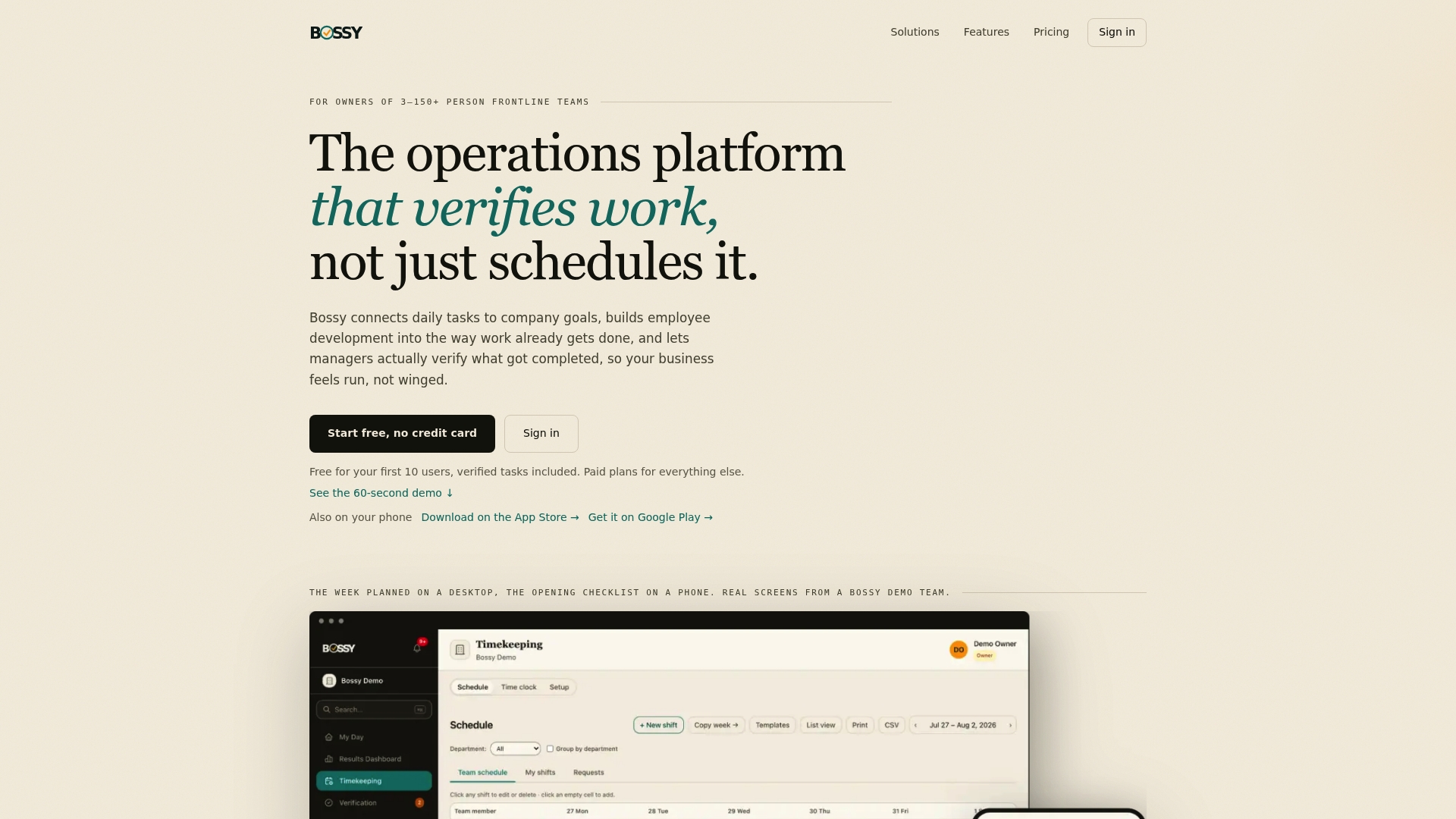
Bossy was built to close that gap. It combines scheduling with task verification (photo proof plus a manager approval queue), geofenced time clocks, inventory control, and cascading goals that connect daily tasks back to what the business is actually trying to achieve. For a restaurant manager who schedules a closer and still has to walk the floor to check the closing list got done, or a retail owner running three locations and juggling five apps to see who worked and what they finished, that combination solves two problems with one login. It fits frontline teams of 3 to 150 employees best, especially where the owner or manager cannot physically watch every shift.
Beyond Bossy, the rest of the market splits into a few recognizable categories, and each one solves a different version of the scheduling problem.
All-in-one HR and payroll platforms (ADP RUN, ADP Workforce Now, Rippling, Zoho People, greytHR) bundle scheduling and time tracking into a broader HR suite that also handles hiring, benefits, and payroll runs. They fit businesses that want one vendor for everything HR-related and are willing to trade scheduling depth for that consolidation.
Restaurant and hospitality-focused schedulers (7shifts, Hotschedules) build around tip pooling, labor-to-sales forecasting, and POS integrations. They fit multi-location restaurant groups where covers and sales data need to drive the schedule directly.
Lightweight roster and shift-swap apps (Sling, Zoomshift, Social Schedules, Shifts by Everhour, ShiftFlow) focus on fast setup and simple swaps for small teams that do not need inventory, task management, or deep compliance tools.
Enterprise workforce management suites (Ceridian Dayforce, UKG Ready (formerly Kronos Workforce Ready), UKG Pro Workforce Management) handle multinational labor law, complex union rules, and detailed labor forecasting, at the cost of longer implementation and higher overhead. Gartner advises weighing evaluation and contracting terms, integration depth, and support service levels heavily when comparing options in this tier.
Time tracking and productivity tools (QuickBooks Time, DeskTime, Clockify, Hubstaff, Buddy Punch, OnTheClock) start from time capture rather than scheduling, and fit teams that already schedule elsewhere but need better clock-in accuracy or productivity data.
Homebase, Deputy, and Connecteam sit closest to Bossy in market position: general small-business scheduling apps with add-on modules for HR, payroll, or communication. They are worth a look if scheduling and payroll sync are your only pain points, though their task tools differ from Bossy's photo-proof and manager-approval workflow.
| Option | Best for | Pricing shape | Scheduling & time tracking depth | Compliance & break handling | Mobile experience |
|---|---|---|---|---|---|
| Bossy | Frontline teams (3 to 150) needing verified task completion alongside scheduling | Per-organization base plus per-seat add-ons | Scheduling, geofenced time clocks, and task verification in one system | Geofencing and approval queues support accountability, not a compliance engine | Built mobile-first for daily task and clock-in use |
| Workforce.com | Businesses wanting free scheduling paired with compliance-labor-cost tools | Free core tier with paid add-ons | Solid scheduling and labor cost tracking | Includes labor law and overtime alerts | Functional app, fewer task features |
| ADP RUN | Small businesses that want payroll and HR bundled with basic scheduling | Per-payroll-run pricing, quoted per business | Basic scheduling tied to payroll runs | Payroll-driven compliance, not shift-level break tracking | Adequate for payroll tasks, thinner for scheduling |
| Sling | Simple teams that only need shift building and swaps | Free tier with paid per-user tiers | Lightweight scheduling, basic time tracking | Minimal break enforcement | Simple, easy-to-adopt app |
| QuickBooks Time | Teams already on QuickBooks needing better time capture | Per-user monthly pricing | Strong time tracking, scheduling is secondary | Overtime alerts tied to timesheets | Reliable clock-in app |
| 7shifts | Restaurant groups needing labor-to-sales forecasting | Per-location tiered pricing | Deep restaurant scheduling and forecasting | Built-in break and overtime rules for food service | Purpose-built for restaurant staff |
| Hotschedules | Large restaurant and hospitality chains | Quoted enterprise pricing | Deep forecasting, POS integration | Strong compliance tooling for hospitality | Widely used, mixed reviews on speed |
| Homebase | Small businesses wanting a free scheduling and payroll starting point | Free tier with paid upgrades per location | Solid scheduling, integrated payroll and hiring | Basic break reminders | Popular, well-rated for ease of use |
| Ceridian Dayforce (Dayforce) | Large enterprises needing unified HR, payroll, and WFM | Quoted enterprise pricing | Deep scheduling tied to full HR suite | Strong multinational compliance | Capable but built for enterprise IT support |
| UKG Ready | Mid-market businesses needing HR plus workforce management | Quoted per-employee pricing | Strong scheduling and time tracking | Configurable compliance rules | Solid but feature-dense app |
| Shifts by Everhour | Teams already using Everhour for time tracking | Add-on pricing tied to Everhour plans | Basic scheduling layered onto time tracking | Minimal compliance tooling | Simple, tied to desktop workflow |
| DeskTime | Office and remote teams tracking productivity | Per-user monthly pricing | Time and productivity tracking, not shift scheduling | Not built for break compliance | Desktop-first, lighter mobile app |
| Buddy Punch | Small teams wanting simple time clock software | Per-user monthly pricing | Time clock focused, basic scheduling | Break reminders, GPS tracking | Straightforward app |
| Deputy | Small to mid-size businesses wanting scheduling plus compliance | Per-user monthly pricing | Strong scheduling and time tracking | Configurable break and overtime rules | Well-reviewed mobile app |
| Zoomshift | Small teams needing basic shift scheduling | Per-user monthly pricing | Lightweight scheduling | Minimal compliance features | Simple app for shift swaps |
| Social Schedules | Very small teams on tight budgets | Free tier with paid upgrades | Basic scheduling and messaging | Minimal compliance tooling | Simple, low learning curve |
| Connecteam | Teams wanting scheduling bundled with training and communication | Per-user monthly pricing with a free small-team tier | Solid scheduling, time tracking, and checklists | Configurable break rules | Well-built mobile app with broad feature set |
| Workstream | Hourly workforce hiring plus onboarding and scheduling | Quoted pricing per business | Scheduling tied closely to hiring workflows | Basic compliance tooling | Built for high-volume hourly hiring |
| Rippling | Growing companies wanting HR, IT, and payroll unified with scheduling | Per-module per-user pricing | Scheduling as one module in a larger HR suite | Compliance handled at the HR platform level | Full-featured but broader than scheduling alone |
| ADP Time & Attendance | Businesses on ADP payroll wanting matched time tracking | Quoted pricing bundled with ADP services | Time tracking depth, scheduling is secondary | Overtime and break rules tied to payroll compliance | Functional, payroll-focused app |
| Zoho People | Businesses already in the Zoho ecosystem | Per-user monthly pricing | Basic scheduling within a broader HR suite | Configurable HR policy rules | Adequate but not scheduling-specific |
| UKG Pro Workforce Management | Large enterprises needing full workforce management | Quoted enterprise pricing | Deep scheduling and labor forecasting | Strong compliance and audit tooling | Enterprise-grade, IT-supported rollout |
| greytHR | Businesses needing HR and payroll compliance in specific regional markets | Per-employee monthly pricing | Basic scheduling within HR suite | Region-specific statutory compliance | Adequate mobile app |
| ADP Workforce Now | Mid-size to large businesses wanting HR, payroll, and scheduling together | Quoted per-employee pricing | Scheduling as part of a broader HCM suite | Compliance handled at the HCM level | Functional but broad, not scheduling-first |
| OnTheClock | Small businesses wanting simple time tracking | Per-employee monthly pricing | Time tracking focused, lighter scheduling | Basic overtime alerts | Simple, easy-to-adopt app |
| Clockify | Freelancers and teams tracking billable hours | Free tier with paid upgrades per user | Time tracking focused, minimal scheduling | Not built for shift compliance | Clean, simple app |
| Hubstaff | Remote and field teams tracking time and location | Per-user monthly pricing | Time tracking with GPS, light scheduling | Not built for break compliance | Solid app for remote tracking |
| ShiftFlow | Small teams wanting simple shift scheduling and time tracking together | Per-user monthly pricing | Combined scheduling and time tracking | Basic break tracking | Straightforward app |
| Humanity Schedule by TCP | Businesses needing forecasting-driven shift scheduling | Quoted per-employee pricing | Strong scheduling with demand forecasting | Configurable compliance rules | Functional, feature-rich app |
A few quick guidelines for picking a category:
- Choose an all-in-one HR platform when payroll, benefits, and hiring matter as much as the schedule itself.
- Choose a restaurant-focused scheduler when tip pooling, POS data, or labor-to-sales ratios drive your staffing decisions.
- Choose a lightweight roster app when your team is small and swaps are the only real pain point.
- Choose an enterprise WFM suite when multinational compliance or union rules make a simple scheduler insufficient.
- Choose Bossy when the missing piece isn't the schedule, it's knowing the scheduled work actually happened.
How to choose and test an alternative before you commit
Picking a scheduling tool by feature list alone is how teams end up switching twice. Test the tool the way your staff will actually use it, not the way a sales deck presents it.
- Match the tool to your size and industry first. A ten-person salon and a 120-person warehouse operation need different depth, so weigh how each platform handles your specific mix of locations, shift patterns, and industry quirks.
- Understand the pricing model before you sign anything. Per-user pricing punishes growth, while per-location pricing can work out cheaper once your employee-to-location ratio climbs, so run the math for your actual headcount before comparing sticker prices.
- Check integrations with your existing payroll and HR stack. A platform that doesn't sync cleanly with what you already run will cost you hours of manual entry every pay period.
- Confirm compliance and mobile quality hold up under real use, not just in the sales demo.
On the demo call itself, Gartner's guidance to weigh evaluation, integration, and support quality translates into a few direct questions: how does the system handle a missed break or unapproved overtime, does the geofence actually stop a clock-in outside the job site, can you pull an audit log entry for a specific overtime correction, and can you export your full schedule and time data without a support ticket. Asking to see that audit log entry live is one of the fastest ways to tell a mature time tracking system from a shallow one.
Watch for a few red flags along the way: mobile app reviews that mention crashes or slow sync, pricing pages that hide the real cost behind per-feature add-ons, support teams that quote multi-day response times for basic setup questions, and any platform that can't show you an audit trail at all.
Once you've picked a finalist, run a real migration plan instead of a flip-the-switch cutover. Pilot with one store or team for two to four weeks, export everything you'll need from your current system (schedules, time cards, employee contact records, any historical reporting), build a short training session for managers before staff ever see the new app, and track adoption with three numbers: what share of staff install and open the app in week one, how many clock-ins happen through the app instead of on paper, and how many shift swaps get completed through the system within the first 30 days. Our guide to scheduling that survives a call-out walks through building that pilot plan in more detail.
Pro Tip: Run your pilot during a normal week, not your busiest one. A quiet week shows you whether the tool works before you find out the hard way during a rush.
Why Bossy's approach holds up under scrutiny
Bossy's product pages describe a platform built around one core idea: a schedule tells you who's supposed to work, but it doesn't tell you what got done. Bossy addresses that gap directly through task verification (photo proof plus a manager approval queue), cascading goals that tie daily work to bigger targets, scheduling, geofenced time clocks, inventory control, and analytics dashboards, all documented on its features page.
That combination speaks to the three most common reasons frontline teams start looking for a When I Work alternative in the first place:
- Managers need proof that scheduled tasks actually happened, not just a record that someone clocked in.
- Owners running multiple tools (a scheduler, a separate task app, a separate time clock) want to consolidate into one system.
- Staff won't use a tool that feels clunky on a phone, so mobile adoption has to work from day one.
The Bossy blog covers frontline operations topics in more depth for managers weighing this kind of switch. As with any platform comparison, the strongest proof of fit comes from seeing the tool run against your own team's shift patterns and task lists rather than a features page alone, which is exactly what a trial period is for.
Who benefits from switching from When I Work
Not every When I Work user needs to switch, but a few situations come up constantly. Multi-location owners who can't be on-site everywhere tend to hit a wall first: a schedule confirms who was supposed to work, not whether the closing checklist got done or the walk-in cooler got checked. Managers juggling a separate task app, a separate time clock, and a separate scheduler on top of When I Work usually switch to cut down on the number of logins their staff need to remember.
Restaurant and retail operators scaling past a single location often outgrow generic scheduling once labor forecasting, tip pooling, or inventory counts become part of the daily routine. Teams that have started running into break compliance questions, or that are paying more as they add staff, also tend to be the ones actively comparing alternatives rather than staying put.
If your team's real complaint is "the schedule works fine, I just can't tell if the work is getting done," that's the clearest signal you've outgrown a pure scheduling tool and need something that verifies completion, not just attendance.
Where When I Work falls short
When I Work handles the basics of building a schedule and letting staff swap shifts, and it does that well for teams whose only need is exactly that. Where it runs into trouble is everything adjacent to the schedule itself: task tracking, inventory, and verification that work got done all require separate tools layered on top.
Guides comparing scheduling platforms consistently point to the same friction points pushing teams to look elsewhere: break compliance features that feel thin for businesses in stricter labor markets, a desire for one consolidated platform instead of several, and costs that climb faster than expected once a team adds locations or staff. None of that makes When I Work a bad scheduler, it just means the tool was built to solve scheduling, not the operational visibility problem that tends to show up once a business grows past a handful of employees.
How long a switch actually takes
Migrating off any scheduling platform takes longer than the sales page suggests, mostly because the schedule itself is the easy part. Exporting historical shift and time data, re-entering employee records, and rebuilding recurring shift patterns typically takes a few days to a couple of weeks depending on team size and how many locations you're running.
The part that actually determines success is staff adoption, not data migration. A pilot with one team or location, run over two to four weeks, gives you a realistic read on whether people will actually open the new app before you commit the whole business to it. Platforms with a simpler mobile experience tend to see faster adoption, which is why testing the app on an actual phone, not just a desktop demo, matters more than any feature checklist.
Plan for a short overlap period where both systems run in parallel for the pilot group, then expand once you've confirmed clock-ins, shift swaps, and manager approvals are happening through the new system rather than falling back to old habits.
Payroll and HR system integrations to check first
Scheduling software is only as useful as its connection to the systems you already run payroll and HR through. Before committing to any alternative, confirm it syncs cleanly with your payroll provider, whether that's a dedicated payroll service or a broader HR platform, since manual re-entry of hours is exactly the kind of workaround a new tool should eliminate rather than create.
All-in-one platforms like ADP RUN, ADP Workforce Now, and Rippling build payroll sync directly into the product, since payroll is part of what they sell. Dedicated scheduling and time tracking tools instead rely on integrations or exports to connect with whatever payroll system you already use, so the depth of that connection varies a lot from one vendor to the next.
Ask specifically whether hours worked, overtime, and approved time off flow into your payroll run automatically or require a manual export and upload each pay period. That single question tends to reveal more about a platform's real integration depth than anything on its marketing page, and it's worth confirming on a live demo rather than taking on faith.

What most buyers get wrong about switching
Most comparisons of When I Work alternatives treat this as a feature checklist exercise: more integrations wins, more compliance settings wins, more reporting wins. That misses the actual failure point. The tool that loses adoption isn't the one with fewer features, it's the one your staff won't open on their phone during a busy shift.
The bigger blind spot is treating scheduling and task completion as separate problems that live in separate tools. They're not separate for the manager standing in the middle of a shift trying to figure out whether the prep list actually got done. A schedule tells you who was supposed to show up. It says nothing about whether the work happened.
If you take one thing from this comparison, prioritize the platform that closes that gap over the one with the longest integration list. Test mobile adoption before you test reporting depth, because reporting on work that never got verified is reporting on a guess.
— Christian
Try Bossy without disrupting your current schedule
If verified task completion is the piece missing from your current setup, Bossy's Operations plan puts that alongside scheduling, geofenced time clocks, and inventory control in one place, at $30 per month. Current prices and plan details are available on the Bossy pricing page.
Restaurant operators can see the industry-specific fit on the restaurant task management page, and retail teams running multiple locations can check the retail solution page for the same kind of detail. If your team runs on inventory counts and daily checklists alongside a schedule, run a trial and see whether task verification changes how much follow-up your managers have to do.
Key references for this comparison
- Gartner Peer Insights: outlines the evaluation categories buyers use when comparing When I Work alternatives
- G2's competitor listing: tracks the fuller competitor set and user-reported reasons for switching.
- Bossy features page: source for Bossy's own product capabilities referenced throughout.
- Businesses evaluating deeper labor forecasting projects sometimes bring in outside expertise; AdaptAI's AI consulting practice is one option for that kind of forecasting work.
FAQ
What are some alternatives to WhenIsGood?
WhenIsGood is a meeting-scheduling tool, not an employee shift scheduler, so it solves a different problem than When I Work. For staff scheduling and shift management, look at the categories covered above, including all-in-one HR platforms, restaurant-focused schedulers, and operations platforms like Bossy that add task verification on top of the schedule.
What is the best free employee scheduling software?
Several platforms, including Sling, Social Schedules, and Homebase, offer free tiers for small teams doing basic shift scheduling. Bossy's free plan covers task verification rather than scheduling; scheduling and time clocks start on its Operations plan, which is worth weighing if you need more than just shift building. Compare the free tier's employee limits and feature caps directly on each provider's pricing page before choosing.
Does When I Work have a free version?
When I Work's plan lineup has changed over time, so check its pricing page for whether a free tier or only a free trial is currently offered. If you're comparing costs, weigh it against Bossy's Operations plan, which bundles scheduling and time clocks with task verification.
When to Work versus When I Work: what's the difference?
"When to Work" and "When I Work" are sometimes confused in search, but When I Work is the more widely used shift scheduling platform with mobile shift swaps and time tracking. If you're evaluating either one, the more useful question is whether a pure scheduler covers your needs or whether you also need task verification and operations tools layered on top of the schedule.