Staff Accountability Methods That Work Without Micromanaging
Christian MontenegroNovember 9, 202614 min read

The staff accountability methods that work all do the same thing: they make it obvious who owns what, by when, and how everyone will know it got done. Then they follow up on a steady rhythm instead of only when something breaks. You don't need to hover. You need clear expectations, visible proof of work, regular conversations and a fair way to handle a miss.
If you run a team you can't watch all day, such as a restaurant, a salon, a fitness studio or a few retail shops, this guide walks through the methods in the order you'd put them in place.
TL;DR
- Accountability means people own their commitments and outcomes. It is not blame, and it is not constant checking.
- Start with specific expectations: a named owner, a measurable result and a deadline, written down.
- Connect daily tasks to bigger goals, and ask for proof that work is done, not just a tick in a box.
- Check in often, give feedback right away and recognize good work. Save formal consequences for last.
- When someone misses a commitment, talk privately, find the root cause, agree on a fix and follow up.
Table of Contents
- What accountability at work really means
- Method 1: Say exactly what each person owns
- Method 2: Connect daily tasks to bigger goals
- Method 3: Put expectations in writing and revisit them
- Method 4: Verify the work, not just the schedule
- Method 5: Check in on a steady rhythm
- Method 6: Recognize the follow-through
- Method 7: Handle a missed commitment fairly
- How to tell if your methods are working
- Common mistakes to avoid
- Our perspective
- Putting these methods into one system
- FAQ
- Sources
What accountability at work really means
Accountability means individuals and teams take ownership of their commitments, are open about progress and setbacks, and accept responsibility for outcomes, according to Slack's workplace guide. Blame is a different thing. Accountability is about owning the result. Blame is about punishment.
The quickest way to tell which one you have is to watch what happens when something goes wrong. In a blame culture, people hide mistakes, point at someone else and keep problems quiet until they're too big to ignore. Where people feel safe, they flag issues early, ask for help and admit errors. If your team only tells you about the empty walk-in cooler after the lunch rush, you have a blame problem, not a people problem.
Micromanagement is the other trap. Gallup's 2020 analysis found that micromanaging can create fear and paralysis rather than personal responsibility. Accountable teams, by contrast, work with more autonomy and take ownership with the mission, the customer and the results in mind.
So the goal is shared clarity. When everyone knows the standard, people can hold themselves and each other to it, and you stop being the only checkpoint.

Method 1: Say exactly what each person owns
Vague expectations are the most common root cause of accountability gaps, and Slack describes clear ones as specific, measurable goals with defined owners and deadlines, documented role responsibilities and shared plans that show handoffs before they become bottlenecks (Slack). Gallup's first recommendation is the same: define what people are accountable for.
In a frontline business, that usually means three questions per task:
- Who owns it? One name, not "the closing crew."
- What does done look like? Describe the result, not the activity.
- When is it due? A time, not "before you leave."
Here is the difference in practice. "Keep the stockroom tidy" is a wish. "Every item on shelves labeled by category, floor swept, and a photo posted by 6:30 p.m. on closing days" is something a person can own and you can see.
Use behavior-specific language
Jonathan H. Westover, PhD, recommends swapping broad goals for behavioral ones. Instead of "improve customer service," write "respond to 95% of emails within one business day." The same idea works on a floor: instead of "be on top of cleanliness," write "restrooms checked and logged every hour during open."
Method 2: Connect daily tasks to bigger goals
People take ownership more easily when they can see why a task matters. Gallup's second recommendation is to set goals and cascade them throughout the organization, so each person's work links to what the business is trying to achieve.
SHRM suggests using objectives and key results for this. Setting quarterly objectives with actionable key results reduces the need for micromanagement and gives employees autonomy over their own responsibilities. If you want to compare approaches, these goal setting frameworks lay out several options for teams.
A simple version for a small business:
- Company goal: Raise repeat visits this quarter.
- Location goal: Every guest greeted within a minute of arrival.
- Daily task: Host checks the entry area at open and every hour, and logs it.
When the daily task rolls up to a goal, a missed task stops being a nuisance and becomes something the team can see matters.
Let people help set the target
Westover also advises involving employees in goal-setting to build commitment to the targets. People defend numbers they helped choose far better than numbers they were handed.
Method 3: Put expectations in writing and revisit them
Said out loud, an expectation fades by Thursday. Written down, it stays. Westover's guidance is to document expectations in writing with sign-off and revisit them periodically.
That doesn't mean a 20-page handbook. It can be:
- A one-page role description per position, with the five or six things that person owns.
- Recurring checklists for opening, closing and handoffs. Our post on opening and closing checklists that actually get followed goes deeper on making these stick.
- A short note after every kickoff or schedule change stating who is doing what.
SHRM's Tammy Perkins of PMI Worldwide adds that managers make people accountable by following up, establishing shared goals and setting milestones so the team can gauge progress. Milestones matter on anything longer than a day. A weekly inventory reset is easier to own when it has a Tuesday checkpoint and a Friday finish.
Method 4: Verify the work, not just the schedule
A checklist tells you someone tapped "done." It doesn't tell you the walk-in is organized or the fryer is clean. That gap is where trust quietly erodes, because you either assume everything is fine or you go look yourself.
Verification closes the gap without you standing there. A few ways to do it:
- Photo proof on tasks where the result is visible: a cleaned station, a restocked shelf, a finished display.
- A manager approval step for tasks where someone should confirm the standard was met.
- Spot checks with a specific standard, so the conversation is about the photo and not about opinions.
We wrote a full walkthrough on how to know the work actually got done if you want practical examples.
Done well, verification feels fair to your team. Everyone is held to the same visible standard, good work gets seen, and nobody has to wonder whether the boss will notice the effort they put in.
Method 5: Check in on a steady rhythm
Gallup advises that holding people accountable starts with clear expectations and following up through frequent coaching conversations rather than waiting for problems. Managers who check in regularly, recognize the behaviors behind great results and connect each person's strengths to their work help people take personal responsibility.

The SHRM Foundation's performance management guidance says the same thing from another angle: regular communication of expectations plus real-time feedback when performance is exceptional or poor. Its guide also states that informal, continuous feedback is the most valuable type, because people can adjust right after good or poor performance.
For a busy frontline manager, that could look like this:
| Rhythm | What it covers | Time |
|---|---|---|
| Start of shift | Today's priorities and who owns what | 5 minutes |
| During the shift | Quick feedback tied to a specific task | 1 to 2 minutes |
| Weekly 1-on-1 | Wins, blockers, next week's commitments | 15 minutes |
| Monthly or quarterly | Goal progress and growth | 30 minutes |
If you need ideas for the weekly one, see our 15-minute weekly employee feedback examples.
Keep it two-way
Westover points out that when monitoring happens through respectful two-way communication instead of "gotchaism," employees tend to see it positively and see managers as invested in their success. The difference between a check-in and surveillance is mostly whether the person gets to talk, ask for help and shape the plan.
Method 6: Recognize the follow-through
Accountability that only shows up when something is wrong feels like punishment. Gallup's fifth recommendation is to recognize and celebrate progress, and it notes that praise for good work is the most motivating form of feedback.
There's a retention angle too. Featured Leaders reports that Deloitte found organizations with highly effective recognition programs had 31% lower voluntary turnover.
Make the praise specific. "Great job tonight" fades. "You caught the low stock on oat milk before open and ordered it, so we never ran out" teaches the behavior you want more of.
Method 7: Handle a missed commitment fairly
Even with great systems, someone will miss something. What you do next decides whether the team trusts the process. Westover lays out a sequence:
- Have a private, candid conversation to find the root cause.
- Agree on specific, measurable actions and a deadline for improvement.
- Document the discussion and the plan.
- Follow up with frequent feedback.
- Use formal consequences only as a last resort, after real support and no improvement.
The University of Minnesota's HR office frames it as four steps: define the behavior or outcome you need, communicate expectations, assess the consequence (positive or negative) when it is or isn't met, and follow through.
A script you can borrow
The Project Management Institute describes a method called INSPIRE for accountability conversations. In plain words:
- Initiate the conversation.
- Notice the behavior you saw.
- Support it with specific evidence.
- Probe by asking what's going on.
- Invite the person to suggest a remedy.
- Review the commitment.
- Enforce by setting a follow-up meeting to see if it was kept.
A real example: "Hey, can we talk for five minutes? The closing photos for the bar were missing Friday and Saturday. What's been getting in the way? What would help you get them in on time? Let's check again next Wednesday." That is short, calm and specific. It also leaves room for an answer you didn't expect, such as a broken phone, an unclear task or a short-staffed close. You can only fix those if you ask.
How to tell if your methods are working
Don't wait for a gut feeling. Pick three to five numbers and watch them weekly. Our guide to team performance metrics that drive decisions covers how to choose them. For accountability specifically, useful signals include:
- Share of tasks completed on time, and share verified as done to standard.
- Problems reported early versus discovered late.
- How often the same task slips for the same reason.
- Turnover and call-outs on the teams where you've made the changes.
Research backs the idea that how you run the process matters as much as having one. A study of 3,192 employees found that participation in performance management was positively related to how effective the system was (B = .47, p < .01), and reviews focused on development were linked to higher effectiveness than reviews focused only on evaluation (B = .25, p < .01). The takeaway: involve people and focus on growth.
Trust is part of the picture as well. Research by Paul J. Zak in Harvard Business Review, cited by Speakwise, found that employees at high-trust organizations reported 50% higher productivity and 76% more engagement than peers at low-trust companies.
Common mistakes to avoid
- Vague asks. "Be more proactive" can't be owned. Name the behavior.
- Checking only when things go wrong. People start to read every check-in as a warning.
- Holding people to goals they never saw. If you didn't share the standard, you can't fairly measure against it.
- Skipping the recognition. Accountability with no praise feels like surveillance.
- Jumping to consequences. Diagnose first. The cause is often a missing tool, an unclear task or a scheduling problem. Our piece on scheduling that survives a call-out shows how one gap can cascade.
- Being the only checkpoint. If every approval runs through you, you've built a bottleneck, not accountability. Our post on building managers you can actually trust is about sharing that load.
Our perspective
Many owners feel they have two choices: stay on the floor all day, or cross their fingers and hope. Neither is a plan. Trust runs on your presence, and you can't be everywhere.
In our view, accountability breaks at the gap between the goal and the daily task. The goal lives in your head or in a slide. The task lives on a clipboard. Nobody connects them, and nobody can see whether the task was done well.
That's why we built Bossy around three habits: link daily tasks to company goals, ask for photo proof with a manager approval queue instead of relying on checklists alone, and build development into the same workflow through 1-on-1s, feedback and growth tasks. Our aim is to give managers in businesses where the owner doesn't oversee every worker a clear picture of what got done, and give team members a clear picture of what good looks like.
Accountability isn't about catching people. It's about making doing the right thing the easy, visible thing, and noticing when someone does it.
Putting these methods into one system
You can run most of these methods with notebooks and group texts, but they tend to drift when things get busy. Bossy puts task assignment and verification, scheduling, recurring checklists, team chat, cascading goals, analytics and development tools in one place, built for frontline teams of roughly 3 to 150 people.
There is a Free plan to start, which covers task assignment and verification. Paid plans on our pricing page include Growth at $25 per month, Operations at $30 per month and Scale + at $50 per month, with each additional user at $5 per month. Operations adds photo proof, scheduling, recurring checklists and cascading goals; Growth adds Loop team chat, 1-on-1s, feedback and growth tasks; Scale + includes both, and every paid plan has analytics dashboards. You can also see what's included on the features page.
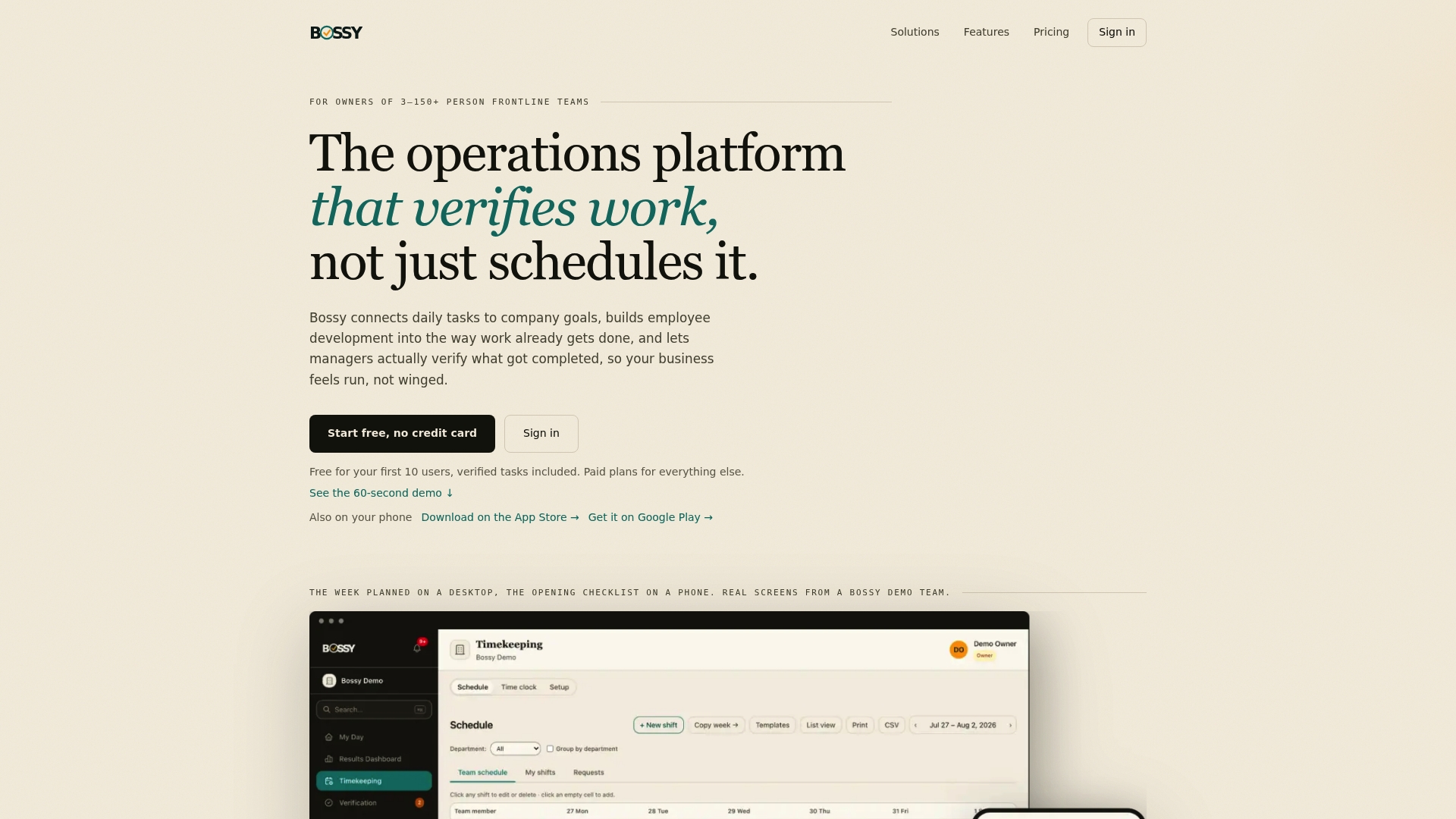
If you want to see how task proof and goals fit together before you decide, start with the Bossy homepage.
FAQ
How do you hold employees accountable without micromanaging?
Agree on the outcome, the owner and the deadline up front, then check on a regular rhythm instead of constantly. Gallup's research suggests micromanagement tends to produce fear rather than ownership, while frequent coaching conversations build it. Visible proof of completed work lets you confirm results without standing over anyone.
What is the first step to improve accountability at work?
Make expectations specific. Vague expectations are a leading root cause of accountability gaps, so write down who owns each responsibility, what done looks like and when it's due. Then share it with the team and revisit it regularly.
What should I do when an employee misses a commitment?
Talk privately and ask what got in the way before deciding anything. Then agree on specific actions and a deadline, document the plan and follow up soon. Formal consequences make sense only if there is no improvement after real support.
How often should managers check in with frontline staff?
Short and often beats long and rare. A quick start-of-shift briefing, real-time feedback on specific tasks and a short weekly 1-on-1 give people regular touchpoints. SHRM's guidance says informal, continuous feedback is the most valuable kind, because people can adjust right away.
Sources
- Tools for Creating Accountability in the Workplace, Slack
- How to Build Accountability at Work, Gallup
- 5 Ways to Promote Accountability, Gallup
- Managing Performance Through Accountability, Innovative Human Capital
- 6 Tips on Setting Expectations for Employees, SHRM
- Building a High-Performance Culture, SHRM Foundation
- Four Steps to Driving Accountability, University of Minnesota
- Pushover No More, Project Management Institute
- Performance management study, IJSRM
- Micromanagement Statistics, Speakwise
- Strategies for Building Accountability on Your Team, Featured Leaders
- 8 Goal Setting Frameworks for Tech Teams