Manager One-on-One Questions That Work on the Frontline
Christian MontenegroNovember 15, 202617 min read

The best one-on-one questions are short, open and tied to the work your person did this week: "What's on your plate?", "What's getting in your way?" and "What do you need from me?" Ask those, then write down what you promised and do it. The question is only half the job. The follow-through is what makes your team believe the next meeting is worth showing up for.
This guide is for people who run frontline teams: restaurants, salons, studios, shops, warehouses, agencies. You don't have a desk job's worth of quiet time, so the questions below are grouped by what you need from the conversation, with notes on when each one earns its place.
TL;DR
- Start with a person question, then move to priorities, obstacles, feedback and growth. Five or six questions is plenty for a 15 to 30 minute meeting.
- Open questions ("what", "how") beat yes/no questions. "What's getting in your way?" gets a real answer where "Any problems?" gets "nope."
- Let the employee own most of the agenda, and finish by agreeing on one or two actions, including at least one that is yours.
- Psychological safety changes what people tell you: in APA's 2024 survey, workers with higher safety reported 27% stress versus 61%, and 19% intent to job-hunt versus 41%.
- Write down every promise and check it at the start of the next meeting. That habit does more than any question list.
Table of Contents
- Why one-on-ones matter more on a frontline team
- How to pick questions before you ask them
- Opening questions: start with the person
- Priorities and expectations
- Obstacles and support
- Feedback questions, in both directions
- Growth and development questions
- Questions for new hires
- Making it safe to answer honestly
- Closing questions and follow-through
- A simple 20-minute agenda you can reuse
- Common mistakes to avoid
- Turn one-on-one answers into actions with Bossy
- FAQ
- Sources
Why one-on-ones matter more on a frontline team
On a frontline team you are rarely in the same room as everyone at once. Shifts overlap, people work different days, and the quietest person on the floor is often the one holding a problem you'd want to hear about. A one-on-one is the one place where that person talks to you without customers, coworkers or a rush in the background.
It is also where most people's voice at work actually happens. In a CIPD survey of employees, 62% said they expressed their views through one-to-one meetings with a line manager, making it the most common channel. (The survey was run in the UK in 2018, but the pattern is familiar to any manager: people tell their boss things long before they tell HR or fill out a form.)
So the questions matter. A weak list turns the meeting into a status report you could have read on a clipboard. A good one surfaces the thing that would have become a no-show, a missed standard or a resignation letter in three weeks.
How to pick questions before you ask them
A long list is useful only if you choose from it. Guidance from the University of California, Irvine's one-on-one guide boils down to a few habits: handle urgent or time-sensitive topics first, balance what you want to cover with what the employee wants to cover, pick a place where the person feels safe talking, and agree on action items for the next conversation.
Here is how that looks in practice:
- Decide the one thing you need. Maybe it's how a new hire is settling in, or why one location keeps missing its opening checklist. Pick the two or three questions that get you there.
- Leave room for their topic. Ask early, "What do you want to make sure we talk about?" If they say "nothing," you still have your own list.
- Pick the place. A back office with the door open, a walk to the bank, or a corner table before service all work. Talking at the host stand mid-rush does not.
- Keep the cadence. Weekly for new people and anyone struggling, every other week for steady performers. Cancelling is the fastest way to tell someone they don't matter.
If you want a ready-made structure, our five-part one-on-one template for frontline managers lays out the order of a short meeting step by step.
Opening questions: start with the person
Don't open with the numbers. People who feel rushed or judged give you the shortest answers possible. Spend the first two minutes on the human being in front of you.
- How are you doing, outside of work stuff?
- What's occupying you most this week?
- What's on your plate right now?
- What's worrying you?
- What's one thing from this week you're proud of?
- What went better than you expected?
Openers like "What's occupying you most this week?" work because they invite the employee to name what matters to them instead of giving a stock "fine." If you only ever ask "How's it going?", you'll only ever hear "good."
One caution: if someone shares something personal, listen first. You don't need to fix it. "Thanks for telling me. Is there anything that would make this week easier at work?" is enough.
Priorities and expectations
Most frontline frustration comes from not knowing what matters most when everything feels urgent. These questions clear that up. The University of Minnesota's guide on asking powerful questions points managers toward questions that clarify expectations, uncover obstacles, celebrate accomplishments and support career development. Priorities come first in that list for a reason.
- What do you think your top priority is right now?
- What would a great week look like for you?
- Which tasks feel most important to you, and which feel like busywork?
- What upcoming deadlines, events or busy shifts should we plan for?
- Are we both clear on what "done" looks like for your main task?
- How will you know when you've done this well?
That last pair is worth slowing down on. "Done" means different things to different people. In a restaurant, "closed the kitchen" might mean wiped down for one cook and fully broken down for another. Agree on the picture, and if the work has a checkable result, say how you'll check it. If you're sorting out how you confirm work was completed, see how to know the work actually got done.
A worked example from a salon: the manager asks, "What's your top priority this week?" The stylist says client retention. The manager follows up: "What would a win look like?" The answer, rebooking at least half of her clients before they leave the chair, is now something you can both see. It was not in the job description.
Obstacles and support
If you only ask one section's worth of questions, make it this one. This is where you find the broken scale, the unclear schedule, the coworker who never restocks, or the process that wastes ten minutes every shift.
- What's the biggest challenge you're facing right now?
- What's getting in your way?
- Where do you feel blocked or slowed down?
- What resources or tools would make your job easier?
- What feels urgent but isn't actually important?
- What feels most at risk right now?
- What do you need from me?
Always follow with the same four words: "How can I help?" Then stop talking. The silence feels long, and it is usually where the real answer arrives.
A few ways this goes wrong:
- You solve it instantly. Sometimes you should. More often, ask "What have you tried?" first. You'll learn what they already know and avoid handing down a fix that won't survive the next shift.
- You get defensive. If the obstacle is you ("I never know my schedule until Thursday"), say thank you. Then fix it or explain honestly why you can't.
- You nod and forget. See the follow-up section below. This is the most common failure.
The schedule one comes up constantly. If shifts and call-outs keep landing on the same people, our piece on employee scheduling that survives a call-out is worth a read before your next round of meetings.
Feedback questions, in both directions
Feedback in a one-on-one should feel like a normal part of the conversation, not a surprise. Start by asking for theirs.
Questions for the employee to answer about you:
- Do I give you enough feedback?
- What can I do to support you better?
- What should I start, stop or keep doing as your manager?
- When did you last feel I didn't have your back?
Some managers freeze at the question about what they could do better. Try it anyway. Even a small answer, like "I wish you'd tell me about changes sooner," is something you can act on this week.
Questions for you to ask about their work:
- How do you think the last busy weekend went from your side?
- What's one thing you'd do differently next time?
- Is there a part of the job you'd like more coaching on?
When you do have something critical to say, the University of California's STEP check-in guide for managers suggests a simple frame: "I am telling you this because..." and then name the reason, which should be that you want them to succeed. It reminds both of you that the goal is growth, not a mark against them.
If you see something that conflicts with how your team is supposed to work, avoid guessing at motives. Neutral wording like "Help me understand, this is what I thought I saw" opens the door without closing it. For short weekly feedback lines you can borrow, see our 15-minute weekly feedback examples.
Growth and development questions
Frontline roles get stuck being "just the job." People leave when they can't see where they're going. You don't need a formal program to change that. You need to ask.
- What are you getting better at right now?
- What do you want to be doing in six months? In a year?
- Which part of the business would you like to learn more about?
- Is there a task you'd like to take over from me or a teammate?
- What skill would make the biggest difference to your day?
- What's something you did well recently that I might have missed?
The CIPD describes coaching and mentoring as development approaches built on one-to-one conversations that grow a person's skills, knowledge or work performance. That is exactly what you're doing when a barista says she'd like to learn ordering, and you hand her the next order count.
The move that makes growth real is turning an answer into a small task with an owner and a date. "Shadow the inventory count Friday" beats "let's talk about your development" every time. Our guide to one-page development plans for frontline managers shows how to fit that into 30 to 60 minutes.
Questions for new hires
The first 90 days are when people quietly decide whether to stay. Short, early check-ins catch confusion before it hardens. Keep them light:
- What's been confusing so far?
- Who has been most helpful to you?
- What do you wish someone had told you on day one?
- Is the job what you expected?
- What would make next week easier?
Treat day 10, day 30 and day 60 as natural checkpoints. If you want a structure to hang those conversations on, an employee onboarding checklist for managers can help you remember what to cover.
Making it safe to answer honestly
An employee who fears consequences will give you the polite answer. That's not a character flaw. It's a reasonable response to a boss who controls their schedule.

The APA's 2024 Work in America survey puts numbers on why it matters. Among workers with higher psychological safety, 27% reported stress compared with 61% of those with lower safety, and 19% intended to look for a new job within a year versus 41%. Workers also said employers should listen to their ideas and act on their suggestions.
What builds that safety on a small team:
- Respond calmly to bad news. The first time someone admits a mistake, your reaction sets the rule for everyone.
- Thank people for hard answers. "I'm glad you told me" costs nothing.
- Keep it private. What's said in the meeting stays there, unless safety or the law requires otherwise, and you say that upfront.
- Skip the loaded questions. Asking someone to rank a coworker or confess what they hate about the job turns the meeting into an interrogation. Ask about their experience instead.
If you want to go deeper on building a team that speaks up, psychological safety training for leaders is a good place to start.
Closing questions and follow-through
End every meeting the same way:
- What are we each going to do before next time?
- Is there anything I haven't asked that I should have?
- How was this meeting for you? Is there anything you'd change about it?
Then write down the actions. Not in your head. In a place you will actually look. At the start of the next meeting, read them back: "Last time I said I'd fix the Saturday opener rotation. Here's where that stands."
This is the part most one-on-one advice skips, and it's the part your team notices. Showing accountability means acknowledging what you heard, being honest about constraints ("I can't add headcount, but I can change who opens"), and following through next time. A "no, and here's why" you deliver is far better than silence.
For the mechanics of structure, agenda and cadence, effective one on ones covers the basics of keeping the loop closed.
A simple 20-minute agenda you can reuse
| Minutes | Focus | Sample question |
|---|---|---|
| 0 to 3 | The person | What's occupying you most this week? |
| 3 to 8 | Their agenda | What do you want to make sure we cover? |
| 8 to 13 | Priorities and obstacles | What's getting in your way? How can I help? |
| 13 to 17 | Feedback and growth | What can I do to support you better? What do you want to learn next? |
| 17 to 20 | Actions | What will each of us do before next time? |
If a meeting runs short, drop the growth block before you drop the obstacles. If it runs long, that's usually a good sign.
Common mistakes to avoid
- Using the meeting to fix schedules and tasks. Those belong at the start of a shift. A one-on-one is for the conversation that doesn't fit anywhere else.
- Asking all the questions. If you do 80% of the talking, you're giving a briefing.
- Reading from the list. Pick questions you can say like a human. If one sounds stiff out loud, rephrase it.
- Skipping the quiet performers. The reliable person who never complains is often the one most likely to leave without warning.
- Holding it only when something is wrong. If every one-on-one is a bad-news meeting, people dread them. Hold them on good weeks too.
Our take: questions don't change a team, follow-through does
We build Bossy for managers who can't be everywhere at once, and the same pattern shows up in every kind of frontline business. Great questions get asked. Then the answer lives in a notebook, a text thread or someone's memory, and by next week it's gone.
That's why we think a one-on-one shouldn't sit off to the side of daily work. When a conversation ends with "I'll learn the ordering process" or "I'll fix the closing checklist," that should turn into a task with an owner, a due date and proof it happened. Employee development, feedback and one-on-ones belong in the same place as the schedule and the checklists, because that is where people's days actually happen.
Trust runs on your presence, and you can't be present everywhere. A system that holds the line on what you agreed, so the promise doesn't depend on your memory, is how you stay trustworthy when you're busy.
Turn one-on-one answers into actions with Bossy
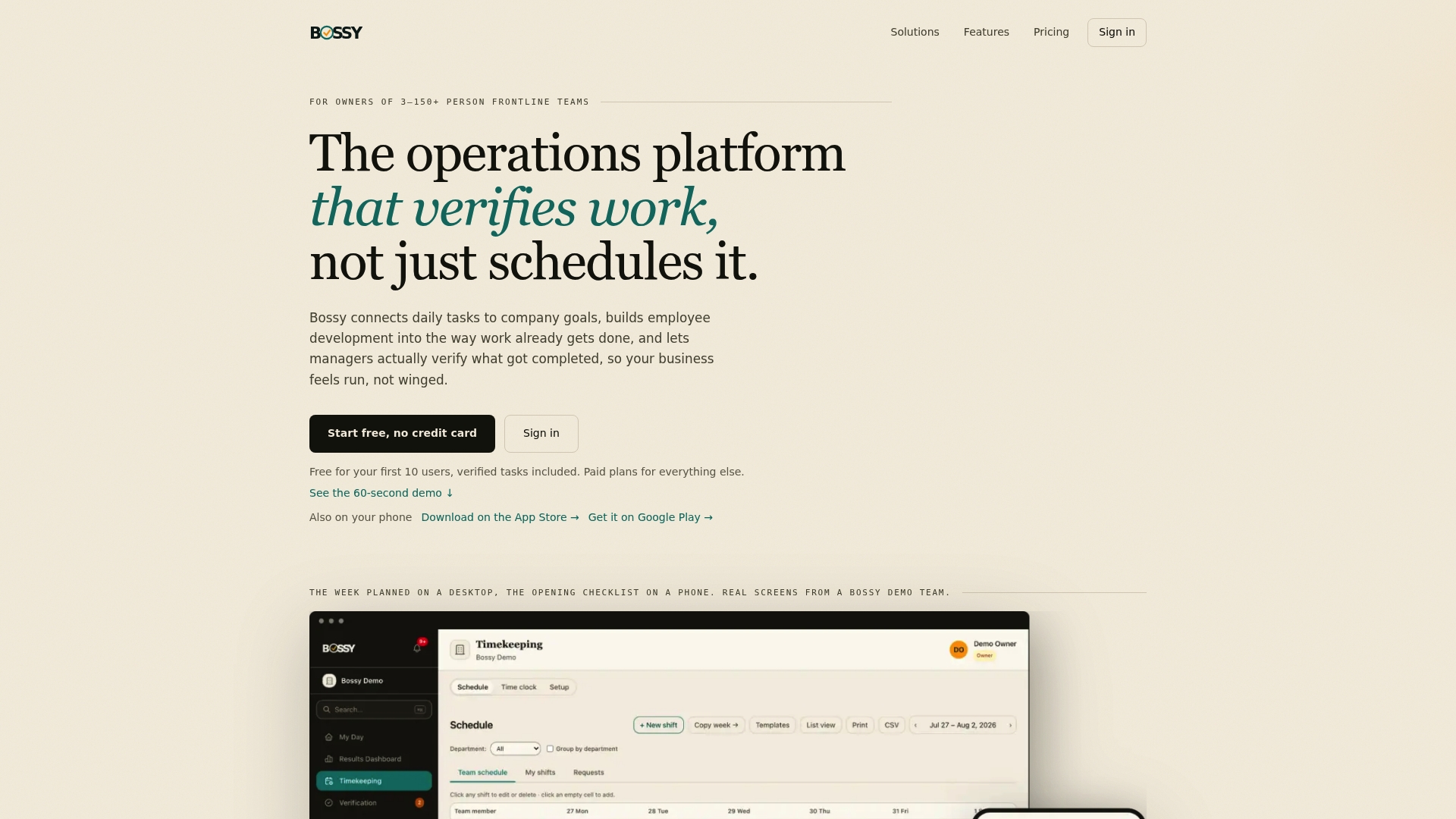
Bossy is an operations platform for businesses with frontline teams of 3 to 150 people. It includes built-in employee development tools (one-on-ones, feedback and growth tasks) alongside task assignment with photo proof and a manager approval queue, scheduling, checklists, team chat and goal tracking, so what you promise in a conversation can become a task you can follow. One-on-ones, feedback, growth tasks and team chat come with the Growth plan; photo proof, scheduling, checklists and goals come with Operations; Scale + includes both.
The Free plan covers task assignment and verification; one-on-ones start on Growth. Paid plans are listed on the Bossy pricing page: Operations at $30 per month and Growth at $25 per month, each with 15 users included, and Scale + at $50 per month with 35 users included, plus $5 per month for each additional user. If you want to see how the pieces fit together, start at the Bossy homepage. You can also read about building managers you can actually trust.
FAQ
How many questions should I ask in a one-on-one?
Five or six is plenty for a 15 to 30 minute meeting. Choose one opener, one or two on priorities or obstacles, one on feedback or growth, and a closing question about actions. If the employee is talking freely, let them keep going and skip the rest.
How often should I hold one-on-ones with frontline employees?
Weekly works well for new hires and anyone who is struggling. Every two weeks suits steady performers, and monthly is the longest gap that still feels like a relationship. Whatever you choose, keep the schedule, because cancelled meetings send a louder message than any question.
What if my employee says they have nothing to discuss?
That's common, especially early on. Start with a concrete prompt like "What's one thing that slowed you down this week?" or "What's on your plate right now?" Specific questions about the last few shifts are easier to answer than broad ones about how things are going.
What are good one-on-one questions for employees to ask their manager?
Employees get the most from questions like "What is my top priority right now?", "How will my success be measured?" and "What should I be doing differently?" It helps to say upfront that you welcome these, since many frontline workers assume the meeting is only for you to talk.
Should I take notes during a one-on-one?
Yes, briefly, and tell them why. Jot down actions and anything you promised, not a transcript. Reading the notes back at the start of the next meeting shows that you listened.
Sources
- Asking Powerful Questions, University of Minnesota Office of Human Resources
- Talking about voice: employees' experiences, CIPD
- One-on-One Guide, UC Irvine Human Resources
- STEP Check Ins Guide for Managers, University of California Office of the President
- 2024 Work in America Survey: Psychological Safety in the Workplace, American Psychological Association
- Coaching and mentoring factsheet, CIPD