15Five Alternatives for 3–150 Frontline Teams: Ops or OKRs?
Christian MontenegroOctober 9, 202610 min read

If you manage frontline teams of 3 to 150 people, Bossy is our pick to test first, since it ties daily task verification and cascading goals straight into the operational work your team already does. If your teams are mostly desk-based and you need deeper OKR tracking, performance reviews, or a broader HRIS, you will want to look at the dedicated performance and engagement platforms, OKR-focused tools, or full HRIS suites covered below.
TL;DR:
- Bossy’s listed monthly plans range from $25 for Growth to $50 for Scale +; extra seats cost $5 each above included limits.
- Desk based teams should match the platform to the job: Lattice or CultureAmp for reviews, Profit.co or Betterworks for OKRs, and Workday for broader HRIS needs.
- Survey tools can launch in a day or two, review platforms take weeks, and full HRIS deployments may take months; Bossy checklists start within days.
- Track participation, task verification, and manager adoption during a 30 to 90 day pilot; confirm both hold by day 60 before wider rollout.
Table of Contents
- Alternatives to 15Five Worth Comparing
- How to Choose the Right 15Five Alternative
- Why Bossy Fits Frontline Teams Specifically
- How Long Onboarding and Implementation Actually Take
- What the Total Cost Really Looks Like
- What a Realistic Pilot Should Measure
- Get Started With Bossy
- FAQ
Alternatives to 15Five Worth Comparing
Most 15Five alternatives fall into three buckets: operations-first platforms that connect daily work to goals, performance and engagement suites built for office-based teams, and OKR-focused tools for cross-functional alignment. Here is how the leading names stack up.
We built Bossy for businesses where the owner cannot watch every worker directly: restaurants, salons, cleaning companies, multi-site retail, and similar frontline operations. Task verification with photo proof, manager approval queues, and cascading goals mean a shift checklist connects to a real company target, not just a to-do list. Scheduling, geofenced time clocks, and inventory control live in the same system, so managers are not juggling five apps to run a location. The Operations plan runs $30 a month, Growth is $25 a month, and Scale + is $50 a month, with a $5 per month per-seat add-on above included limits. Scheduling, the time clock, and inventory are on Operations; 1:1s and feedback are on Growth; Scale + includes both.
Outside operations-first tools, the shortlist typically includes:
- Lattice: structured performance reviews and manager coaching tools built for mid-market and enterprise HR teams.
- Betterworks: OKR alignment and enterprise reporting for companies running continuous performance cycles at scale.
- Profit.co: OKR-first workflows with strong integrations for teams focused on cross-functional goal tracking.
- EvalFlow: a simpler, connected performance platform built around transparent, single-plan pricing for growing teams.
- Viva Goals and Tability: lightweight OKR tracking tools aimed at teams that want goal visibility without a full performance suite.
- Leapsome and CultureAmp: engagement survey and performance review platforms common in knowledge-worker HR stacks.
- Quantum Workplace, Officevibe, and TINYpulse: pulse-survey and engagement measurement tools, often paired with a separate performance system.
- Workday and BambooHR: full HRIS suites where performance and engagement are modules inside a broader people-management system.
According to Gartner Peer Insights, buyers researching 15Five commonly evaluate Profit.co, Lattice, Tability, Viva Goals, Asana, and Betterworks side by side, comparing them on evaluation and contracting, integration and deployment, service and support, and product capabilities. Verified reviews on Gartner and G2 are worth checking before you book a demo, since they surface support quality and rollout friction that a sales call will not.
How to Choose the Right 15Five Alternative
Picking the right tool starts with naming your actual buyer job: do you need to verify that frontline work got done, or do you need to track OKRs across departments? Those are different problems, and few platforms solve both well.
- Core focus: confirm whether the tool is built for performance reviews, engagement surveys, OKRs, or day-to-day task verification.
- Manager enablement: check whether it gives managers structured prompts for 1:1s and feedback, not just a survey dashboard.
- Frontline task alignment: ask whether daily tasks or shifts connect to any measurable goal, or whether goals live in a separate module.
- Reporting and analytics: look for dashboards that show trends over weeks, not just a single snapshot score.
- Integrations: verify compatibility with your HRIS, Slack, or Jira before you sign anything.
- Implementation effort: ask how long setup takes with your current team size and data.
- Security: confirm data handling and access controls match your industry's requirements.
In a demo, ask these questions directly: How does data export work if we switch tools later? Does the mobile app work offline for frontline staff without reliable WiFi? How is task or work completion verified, photo proof, manager sign-off, or self-report? What onboarding support is included, and is it a one-time session or ongoing? What is the uptime guarantee? How customizable are checklists, review cycles, and goal structures? How does pricing change as our headcount grows? Is there a minimum contract length? What happens to our historical data if we downgrade?
Pricing shape matters as much as the sticker price. A free tier usually caps users or features, per-seat add-ons scale cost as you grow, and longer contracts sometimes lock in a lower rate but reduce your flexibility to switch.
Pro Tip: Run your demo questions past the manager who will use the tool daily, not just the person signing the contract. They will catch friction a sales demo glosses over.
Why Bossy Fits Frontline Teams Specifically
Most performance platforms assume a desk, a calendar, and a manager who sees their team in a daily stand-up. Frontline teams rarely work that way, and that gap is exactly what we built Bossy to close.
- Task verification ties to accountability: photo proof and manager approval queues mean "done" actually means done, not just checked off.
- Cascading goals create alignment: a shift task links up to a location or company goal, so staff see how their work matters.
- Scheduling and inventory fit the operational reality: geofenced time clocks and stock counts live next to the task list, not in a separate app.
- 1:1s and feedback tools build manager habits (on the Growth and Scale + plans): growth tasks and structured feedback turn occasional check-ins into a routine.
This setup works whether you run a single restaurant location or manage cleaning crews across a dozen sites. Our features page breaks down each module, and our piece on cascading goals for frontline HR walks through how daily work connects to company strategy in practice.
How Long Onboarding and Implementation Actually Take
Implementation timelines vary by how much of your team's work the platform touches. A pulse-survey tool like Officevibe or TINYpulse can go live in a day or two since it mostly needs an employee list and a survey schedule. A performance review platform like Lattice or CultureAmp typically takes a few weeks, since review cycles, competency frameworks, and manager training need setup before the first cycle runs.
OKR-focused tools such as Betterworks, Profit.co, or Viva Goals often take longer, since goal structures need to cascade correctly across departments before the data means anything. Full HRIS platforms like Workday or BambooHR can take months when payroll, benefits, and performance modules all need to sync.
Operations-first platforms built for frontline teams tend to move faster on the ground floor. With Bossy, most teams start running verified task checklists and schedules within days, since the core workflow mirrors shifts and tasks staff already know. Cascading goals and development tools typically get layered in over the following weeks as managers get comfortable with the daily workflow. Some vendor comparisons highlight free implementation support as a differentiator worth asking about directly in a demo, since paid setup fees can add real cost before you see any value.

What the Total Cost Really Looks Like
The sticker price on a pricing page rarely reflects what you pay in year one. Setup fees, training time, and per-seat add-ons all stack on top of the base plan, and skipping that math is how budgets get surprised in month three.
With Bossy, the published costs are straightforward: Operations runs $30 a month, Growth is $25 a month, and Scale + is $50 a month. Add-on seats cost $5 a month per seat above the plan's included count, and the free plan allows additional seats at $10 per month per 10 seats. There is no separate implementation fee on top of the plan price.
Enterprise suites like Workday or Betterworks often price per seat with custom enterprise quotes, and those quotes frequently bundle in implementation support, training sessions, and a dedicated account manager, costs that are real but rarely itemized up front. Training time is its own hidden cost regardless of platform: plan for manager training hours in your first month, since a tool only pays off once managers actually run reviews, check-ins, or verification workflows inside it consistently. Ongoing costs to watch include per-seat growth as you hire, add-on modules for extra reporting, and contract renewal terms that may lock in a rate increase.
What a Realistic Pilot Should Measure
Skip the 12-month contract until you have run a 30 to 90 day pilot. Track participation rate, how many tasks actually get verified versus just assigned, and whether managers adopt the checklist habit without reminders from you.
If verified completion and manager adoption both hold steady by day 60, you have a real signal to roll out company-wide. If either stalls, that is worth knowing before you sign anything longer.
— Christian
Get Started With Bossy
If verified task completion, cascading goals, and manager development are what you actually need, we built Bossy to cover all three in one system instead of three separate tools: the Scale + plan includes all of them. Every plan, including Free, includes the core task verification workflow from day one; scheduling starts on Operations.
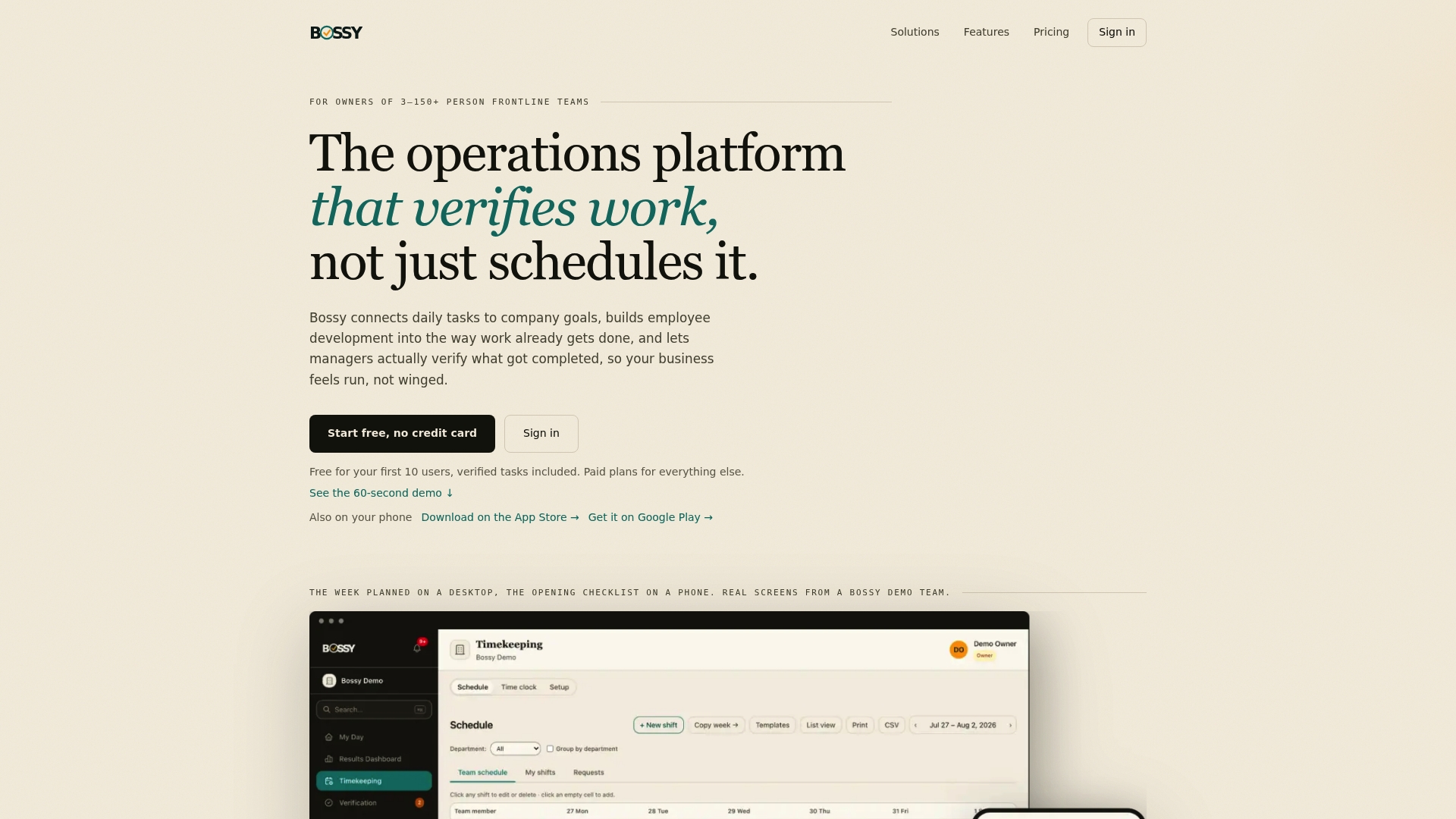
Check our pricing page for the full plan breakdown, or visit Bossy to see how the platform fits your team before you book a call.
FAQ
Is 15Five an HRIS system?
No, 15Five is a performance and engagement platform, not a full HRIS. It focuses on check-ins, reviews, and feedback rather than payroll, benefits administration, or core employee records.
What is Workday software similar to?
Workday is a full HRIS suite covering payroll, benefits, and performance management in one system, which makes it comparable to other large HR platforms like BambooHR, though Workday generally targets larger enterprise deployments. Teams that only need performance or engagement tracking usually find a dedicated tool, rather than a full HRIS, a better fit for their scope.
Who are Workhuman's main competitors?
Workhuman focuses primarily on employee recognition, a category that overlaps with the broader engagement and performance space covered in this article, including tools like CultureAmp and Officevibe that also track engagement signals. The right comparison depends on whether you need recognition specifically or broader performance and engagement tracking.
How much does 15Five cost?
15Five's pricing is not covered in our sourced pricing data here, so check its current plans directly on its pricing page before comparing costs. For context, Bossy's paid plans run from $25 a month for Growth up to $50 a month for Scale +, and there is a free plan.