Onboarding Plan for Employees: A 30-60-90 Day Guide
Christian MontenegroNovember 16, 202611 min read

A good onboarding plan is a written timeline that says what a new hire learns, does and proves by day one, day 30, day 60 and day 90, with a named person checking each step. If you run a restaurant, salon, studio, shop or warehouse, the plan only works when someone can see each step was actually done. We built Bossy so a task can require photo proof and manager approval, so your plan doesn't live in your head or on a forgotten sheet of paper.
TL;DR
- Onboarding is a process that can run from a couple of days to 12 months, not a single orientation day (SHRM).
- Use three phases: before day one, the first week, and the first 90 days with a 30-60-90 structure.
- Give every new hire a go-to buddy, written expectations and regular one-on-one check-ins.
- In the U.S., complete Form I-9 and tax withholding paperwork on time (RemotePeople's new hire paperwork checklist).
- Turn each step into a task with proof of done, so you know it happened.
Table of Contents
- Why a plan beats "just shadow Sam"
- The three phases of an onboarding plan
- Before day one: preboarding
- Week one: orientation that sticks
- The first 90 days: a 30-60-90 plan you can write in an hour
- An employee onboarding checklist by role
- U.S. paperwork to get right
- Make the manager the engine
- How to tell whether your plan works
- Where Bossy fits
- Our take
- FAQ
- Sources
Why a plan beats "just shadow Sam"
Most small teams onboard by shadowing. It feels fine until Sam is out sick, and the new hire learns half the job from whoever happened to be on shift.
The numbers say the first months matter. A Lehigh University onboarding guide cites research that 86% of new hires decide how long they will stay in their first six months, and that 20% of turnover happens within the first 45 days. SHRM's report found organizations believe effective onboarding improves retention (52%) and time to productivity (60%). Those are perceptions from surveyed organizations, but they point the same way: early weeks decide a lot.
The Partnership for Public Service and Booz Allen Hamilton make a useful distinction. Many organizations treat day one as a transactional orientation event, while stronger ones plan onboarding as a longer process. That's the shift you want: from "first day" to "first 90 days."

The three phases of an onboarding plan
SHRM describes three parts: preboarding, orientation, and foundation building, where buddies or mentors help new hires learn the unwritten rules (SHRM guide). For a frontline team, it helps to map those to a calendar.
| Phase | When | Goal |
|---|---|---|
| Preboarding | Before day one | No surprises, everything ready |
| Orientation | Day one to week one | Safe, welcomed, clear on the job |
| Ramp-up | Days 1 to 90 | Independent, measured, supported |
The University of Minnesota notes that a 30-60-90 day plan is common, but timing should fit the role and the person, so move people forward at a speed that lets them succeed. A line cook and a shop associate won't need the same pace.
Before day one: preboarding
Columbia University's toolkit suggests that about a week before the start date you set up equipment and accounts, tell the team, assign a buddy, and draft a first-week training plan and first-day agenda.
For a frontline team, translate that into:
- Send the first shift's time, location, dress code and who to ask for.
- Add them to the schedule and team chat so their name is already there.
- Pick the buddy and tell the buddy what the job is (it's more than "keep an eye on them").
- Prepare the uniform, locker, login, key or POS access.
- Gather paperwork you can collect early.
In Bossy, you can schedule the new hire, add them to team chats and announcements, and assign their first tasks before they arrive, so the plan is ready when they walk in. (Scheduling comes with the Operations plan, team chat with Growth, and announcements with every paid plan.)
Week one: orientation that sticks
Columbia's first-week list includes going over policies, defining roles, reviewing the job description and expectations, sharing a contact list, scheduling meetings with key people and setting weekly one-on-ones. Baylor's manager toolkit goes further and recommends one-on-one check-ins daily or every other day in the first week, plus a go-to colleague.
A week-one frontline plan might look like this:
- Day one: welcome, tour, safety and policy walk-through, meet the buddy, shadow a full shift.
- Day two to three: do the core tasks with the buddy beside them.
- Day four to five: do the core tasks alone while the buddy checks the result.
- End of week: a 15-minute one-on-one: what's clear, what isn't, what do you need?
The step most teams skip is the check. "Shown" is not "learned." Soteria's playbook suggests each training block ends with proof of mastery, such as running a workflow end to end, rather than a pile of links.
The first 90 days: a 30-60-90 plan you can write in an hour
Columbia describes the arc this way: small projects and weekly meetings in the first 30 days, more collaboration and responsibility by day 60, then independent work, a formal evaluation and a "stay interview" at 90 days (Columbia HR). Here's that arc for a frontline role.
Days 1 to 30: learn and shadow
- Finish safety, policy and compliance training.
- Learn the opening and closing routines.
- Complete one small task alone, start to finish.
- Weekly one-on-one.
Days 31 to 60: do it alone
- Run the core tasks without a buddy.
- Own one small recurring responsibility (restocking a station, a daily count, a room reset).
- Learn a second area or role.
Days 61 to 90: own it
- Hit the standard you set for speed, quality or accuracy.
- Suggest one improvement.
- Sit down for a review and a conversation about what keeps them here and where they want to grow.
Soteria recommends writing the plan down on day one, with outcomes, deliverables, and what support the person gets, because role clarity speeds up ramp time. Keep it to one page. A plan nobody reads is just paper.
What a template should contain
Whatever template you use, include these columns for each task:
- What: the task in plain words.
- Who owns it: new hire, buddy or manager.
- By when: day, week or milestone.
- How you'll know it's done: a photo, a signed-off checklist, a short demo.
- Notes: what went well or needs repeating.
That fourth column is the one that makes a plan reliable. For goals and development beyond onboarding, our one-page development plan guide shows how to keep the plan short enough to use.
An employee onboarding checklist by role
Use this as a starting point and swap in your own items.
Everyone
- Paperwork complete and filed
- Schedule, pay and time clock explained
- Safety and policy walk-through
- Buddy introduced
- Team chat joined
- Week-one one-on-one held
Restaurant: food safety basics, station setup, opening and closing lists, allergen procedures, POS training.
Salon or studio: client greeting standards, booking and checkout flow, cleaning and sanitation routine, product knowledge.
Retail: register and returns, merchandising standards, stock counts, store open and close.
Warehouse: equipment safety, pick and pack workflow, receiving, daily checklist. (Our warehouse daily checklist guide shows how to prove fixes within a week.)
Agency: tool access, client context, review process, first small deliverable.
At shift change, new hires often miss details. A solid shift handover checklist gives them something to follow while they learn.
U.S. paperwork to get right
This section covers the United States. Every new hire needs Form I-9 to verify identity and work authorization: employees complete Section 1 by their first day, and employers complete Section 2 within three business days of the start date. Form W-4 covers federal tax withholding, and some states have their own forms, such as California's DE-4 or New York's IT-2104. Dla Piper's guide adds that employers need an Employer Identification Number for payroll taxes, and that E-Verify is required in some industries and states while others limit it.
Rules differ by state and by role (minors, tipped staff, certain industries), so confirm your specifics with your state labor department, your payroll provider or an employment attorney.
Make the manager the engine
Cornell's supervisor guide says successful onboarding needs a coordinated partnership between the hiring manager, HR and support functions, and that the manager shapes the new hire's experience across the first 90 days. Lehigh's guide cites Gallup research that new hires are 3 to 4 times more likely to call their experience exceptional when managers are actively involved.
That's hard when you're running a floor. Which is why we'd say: don't count on memory. Put the check-ins on the calendar, and put the training tasks where you can see them. If you're building managers who can run this without you, read how to build managers you can trust.
How to tell whether your plan works
Pick three or four signals and look at them at day 30, 60 and 90:
- Did the new hire finish the planned tasks, and was each one approved?
- Are they working a shift on their own, and how many corrections do they need?
- What did they say in their one-on-ones?
- Are they still here at 90 days?
If people stall at the same step, fix that step. That's the whole loop.
Where Bossy fits
Our onboarding approach in Bossy is to make the plan a set of real tasks. You assign onboarding tasks with photo proof and a manager approval queue, schedule shifts, run recurring checklists, set up one-on-ones and feedback, and track growth tasks, all in one place. It's built for frontline teams of 3 to 150 employees. The Free plan covers assigning tasks and approving them. Photo proof, scheduling and recurring checklists come with Operations at $30 per month, one-on-ones, feedback and growth tasks come with Growth at $25 per month, and Scale + at $50 per month includes both. Operations and Growth include 15 users, Scale + includes 35, and each additional user is $5 per month. Compare plans on the pricing page.
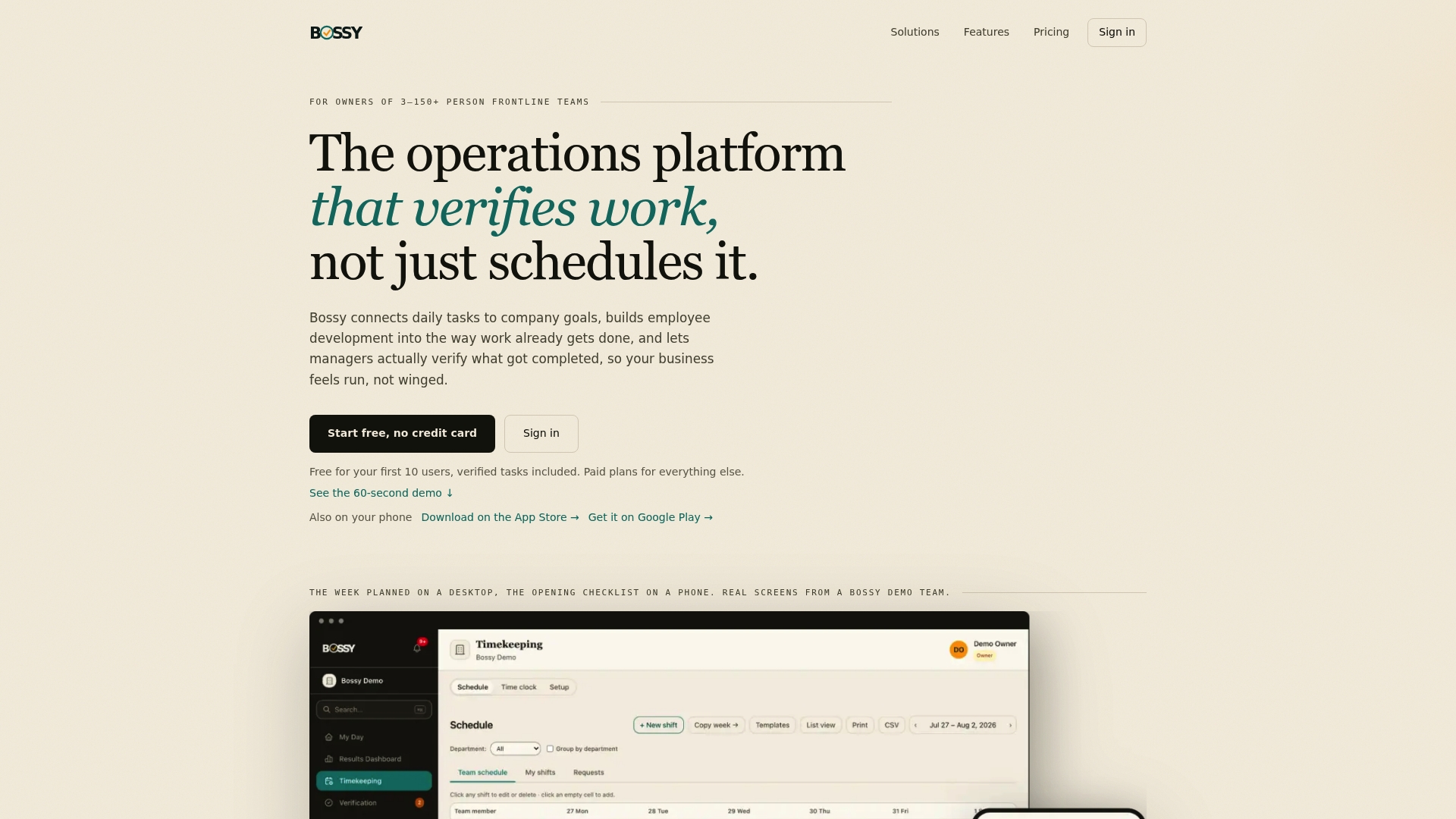
If you want to see how the pieces connect, start at bossyhq.com.
Our take
Most onboarding fails quietly. Nobody decides to do it badly. The owner is busy, the buddy is busy, and "we'll go over that next shift" turns into never.
We think the fix is simple: write the plan as tasks, give each one an owner and a way to prove it's done, and put the one-on-ones on the calendar. When you can see that a new hire has completed the opening routine, you can coach instead of guess.
That's why Bossy ties daily tasks to goals and builds development into the same workflow. Onboarding isn't a separate project. It's the first 90 days of the same system you use every day.
FAQ
How long should an onboarding plan be?
SHRM says onboarding can span anywhere from a day or two to 12 months. For most frontline roles, plan for 90 days, with the heaviest support in the first two weeks. Adjust for the role's complexity and the person's experience.
What should I include on day one?
Welcome, a tour, safety and policy basics, the buddy, the schedule and time clock, and a first shift with a clear job. Keep paperwork short and don't pile everything into one day.
Who should own onboarding?
The hiring manager owns the experience, with a buddy for day-to-day questions and HR or payroll for paperwork. Cornell's guide describes this as a partnership, not a solo job.
Do I need a template?
A template saves time and keeps every hire consistent. Use a one-page 30-60-90 format with a task, an owner, a due date and proof of completion for each item.
Sources
- SHRM: Complete Employee Onboarding Guide
- SHRM: Maximizing Success
- Partnership for Public Service and Booz Allen Hamilton: Getting On Board
- Lehigh University: Revised Onboarding Plan & Checklist
- University of Minnesota: Planning New Employee Onboarding
- Columbia University HR: Onboarding
- Baylor University: Manager Onboarding Toolkit
- Soteria: 90-Day Playbook
- Cornell University: Hiring Supervisor Guide
- RemotePeople: New Hire Paperwork
- Dla Piper: Global Expansion Employment Guide